




Get in Touch
Recent posts



Trending Topics
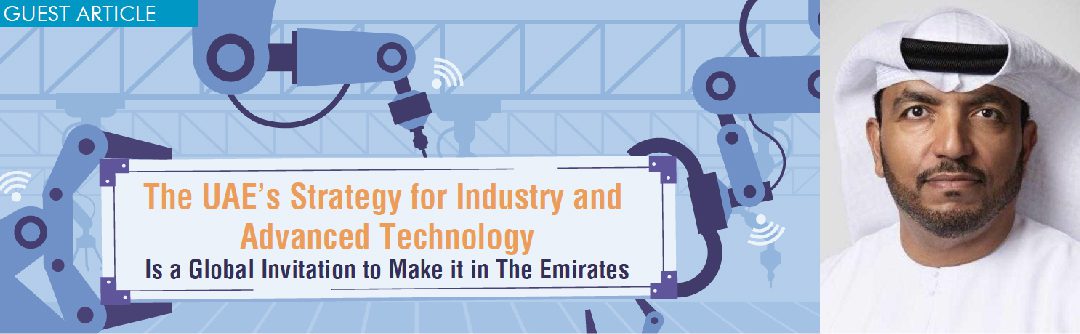
 His Excellency Omar Ahmed , Suwaina Al Suwaidi
When His Highness Sheikh Mohammed bin Rashid Al Maktoum, Vice President and Prime Minister of the UAE and Ruler of Dubai, launched the UAE’s National Strategy for Industry and Advanced Technology earlier this year, he ushered in a new era.
Known as Operation 300bn, the strategy provides a clear roadmap for the UAE to become a world-leading industrial hub within the next decade. With its focus on developing our capabilities in industries of the future like space, green hydrogen and biotechnology, the announcement instantly attracted widespread attention from a swathe of international investors, policymakers and commentators. The consensus that emerged was that this latest – in a long line – of bold moves from the UAE’s leadership, marked a quantum leap for the nation’s industrial sector.
At its heart, the strategy aims to increase the industrial sector’s GDP contribution to AED300 billion by 2031 by accelerating the adoption of advanced technology across the value chain. This, we firmly believe, will boost productivity, generate added in-country value, create a raft of new, highly skilled jobs for the nation’s emerging talents, further diversify our economy and enhance global competitiveness.
In short, we are setting out to transform the industrial sector into a key driver of sustainable growth – and a pillar of the national economy. We will turbocharge existing industries where we have an established presence, and we will venture to new frontiers by leveraging advanced technologies and Fourth Industrial Revolution (4IR) solutions and applications. We will research what the future could look like, and we will develop the technologies to take us there.
Under the new strategy, innovation will not be a mere buzzword. It will be our de facto approach to industry as we cultivate a culture of ingenuity and entrepreneurship, and encourage everyone, from around the world, to come and make it in The Emirates.
Solid grounds
Though it sets a new tone for the UAE, this strategy was not developed out of the blue. Boasting the strongest credit ratings in the region, the UAE has long enjoyed investment safe haven status, with enviable economic stability and a promising growth landscape; bolstered by its strategic location, robust financial reserves, huge sovereign wealth funds, and sustainable government spending that ensures a healthy economic cycle.
Energy resources and raw materials required for industrial use are also available at competitive costs. Furthermore, UAE-based manufacturers can take advantage of laws that guarantee full ownership rights for foreigners in 122 economic activities across 13 sectors – soon to be expanded to cover the majority of industrial sectors – which will come into full effect as of 1 June 2021. Combine this with zero percent corporation tax and a wealth of accessible geographic locations and specific business zones ready to boost further industrial development, and it is easy to see why so many global, regional and local manufacturers were already developing their businesses in the UAE. Simply put, the UAE is an ideal strategic market for the world’s most innovative companies, reached new levels of high-tech excellence worldwide.
An appealing business landscape
As part of our journey towards enhanced economic diversification, the UAE has long sought to develop policies, procedures and practices that foster the growth of both the national economy and the private sector.
Our efforts here speak for themselves. The UAE is consistently ranked among the top countries around the world in key economic competitiveness and ease of doing business indices. This is largely as a result of the many incentives, legal and logistical facilities, and collaborative regulatory environment we have introduced for businesses over the years. The results speak for themselves; we are proud to support a stable private sector with an ambitious growth agenda.
The UAE has a transport and logistics ecosystem that’s considered the most efficient and comprehensive in the region, and one of the easiest to reach from anywhere in the world, via 10 airports and 12 seaports. With a handling capability of more than 17 million tons annually and a cargo capacity of 80 million tons, the UAE sits at the intersection of Asia, Europe and Africa, giving its manufacturers easy access to markets where more than five billion people live.
Enabling Operation 300bn
The Ministry of Industry and Advanced Technology will be the enabler of Operation 300bn. We will be responsible for developing legislative and regulatory frameworks, providing energy at competitive prices, and developing an advanced technology roadmap, a framework for research and development (R&D), and launching the National In-Country Value (ICV) program.
The ICV program is a core component of the UAE’s industrial transformation. It aims to redirect expenditure on procuring goods and services into the national economy. In parallel, the metrology standards developed by Ministry will ensure local industrial infrastructure meets international standards and enable the ICV Program to enhance the competitiveness of local products and services and boost collaboration between the public and private sectors.
To achieve these targets, industry players should prepare to work with the Ministry on the adoption of new and updated industrial laws, the roll-out of digital platforms for services and licensing, the promotion of locally produced goods and the enablement of an R&D ecosystem.
Priority sectors
The strategy leaves no single industry behind but has established a framework through which the current industrial landscape can continue to thrive. Industries with existing national significance, such as energy, petrochemicals, plastics, heavy industries and manufacturing; strategic industries that aim to enhance economic resilience and reduce dependence on global supply chains, such as food, water, agriculture and healthcare; and future industries, such as space, biotechnology, medical technology, sustainable products and sectors that can be supported by 4IR applications.
Enabling these sectors and facilitating the entry of innovators and investors are some of the key pillars of the strategy. Furthermore, the role of the Emirates Development Bank (EDB) as the financial engine of the strategy is crucial. By 2025, the bank will expand its financing portfolio to AED30 billion to support entrepreneurs, startups, SMEs and large corporates, who will help spur the nation’s transition to a knowledge-based economy.
Make it in The Emirates: Gateway to the Future
The strategy is complemented by the first-of-its-kind industrial campaign, ‘Make it in The Emirates’. It’s an open invitation to investors, industrialists and innovators to participate in the growth of the industrial sector in the UAE. The UAE has always been a land of opportunity for those with the talent and imagination to realize their dreams. Our investment environment and openness to global markets and competitive advantages ensure a capital-rich landscape for the industry-minded creator. Consider this your invitation to come and make it in The Emirates. It’s your opportunity to engage with the ministry and to invest in a forward-thinking, industrious, global future.
 Sameer M Nawani , Chief Representative of Dubai Chamber International Office - India
India and Dubai share historic and strong trade and cultural ties. The non-oil trade between India and Dubai has consistently increased over years from $26 billion in 2017 to $36 billion in 2019, making India the second largest trading partner for Dubai. Indians are the largest investors in Dubai’s real estate sector and make up the largest segment of tourists visiting the emirate. The city also is home to over a million Indian nationals, who account for over 30% of the population of the Emirate.
Since 2015, India and the UAE have exchanged several high-level visits, which strengthened the relationship and led to the signing of the Comprehensive Strategic Partnership, an agreement that aims to expand economic cooperation and boost bilateral trade and investment. Given the role Chambers play in mobilizing businesses and promoting trade and investments, India’s Prime Minister Narendra Modi during his visit to Dubai in February 2018, welcomed the idea of Confederation of Indian Industries (CII) opening an office in Dubai and Dubai Chamber of Commerce & Industry opening an office in India. Dubai Chamber opened its first representative office in Mumbai, India, in June 2018. The main objective of the office in India is to identify bilateral business opportunities that businesses in India and Dubai can capitalize on and benefit from.
The year 2020 has not been an easy one. It has put the healthcare systems of global economies through tremendous strain, disrupted supply chains and brought businesses to a standstill. In such times where the world is pressing a reset, the continued exchange between India and UAE is ensuring a smoother turnaround in economic activities. Both governments have been agile in taking the right measures while enhancing ease of doing business. Businesses on both sides are being extremely pro-active in exploring diversification, finding growth opportunities globally, implementing technology and strengthening their supply chain. We have seen growing interest in a number of high-potential sectors, and you can read on to learn more about these opportunities.
Food security and trade
Ensuring food security is high on the agenda for UAE and the pandemic has underlined its importance. India is first globally in milk production, livestock population and millet production and ranks second in fish, rice, wheat, cereals, fruits & vegetables, and total food production. India has the potential to double its food exports from $30 billion in 2019 to $60 billion in 2022. Lack of storage facility and transportation infrastructure results in 30% food losses in India. The India-UAE Food Corridor project is expected to fill this gap, with an investment of $7 billion from the UAE to develop dedicated logistics infrastructure connecting farm to ports in India. This project has the potential to increase the food trade between India and the UAE from $2.2 billion to $7 billion in next five years.
Dubai has developed specialized infrastructure to facilitate global trade of select products. Jebel Ali Freezone (JAFZA) in Dubai, is home to the world’s largest port-based sugar refinery which has a production capacity of 2 million MT and contributes to 3% of the refined sugar production of the world. JAFZA also has a rice hub which handles the storage, processing, and packaging of rice. Around 66% of the rice imported into Dubai comes from India. There are dedicated storage facilities for grains, pulses and other food products at JAFZA.
Dubai Multi Commodity Centre (DMCC), the free zone focused on commodities trade is home to the Tea Centre and Coffee Centre. The Tea Centre is a purpose-built facility dedicated to storing, blending, and packaging of tea. The centre has 5000 MT of storage capacity. The Coffee Centre is a 15000 square metre state-of-art temperature-controlled facility which can be used to store, clean, roast, package and distribute coffee. It also has a coffee quality centre laboratory, cupping lab, and training campus. DMCC in 2020, introduced an agri trade platform called Agriota, which facilitates trade between Indian farmers and international traders.
In 2021, Dubai Chamber is pushing ahead with new initiatives to facilitate collaboration between businesses to connect the infrastructure of Dubai and the production capacity of India.
Retail Opportunities
Retail in India is highly fragmented but transforming at a tremendous pace. It is expected to become a $1.75 trillion market by 2026. India has the second largest population in the world. With a growing middle-class and increasing urbanization, the household incomes are rising, resulting in increased consumer spending. Driven by these developments, India has seen numerous homegrown brands in retail like Lenskart, Nykaa, Forest Essentials, Belgian Waffles, etc. grow at an enormous speed. The young new India is ambitious and aspirational, making it an ideal destination for International brands and retailers, opening doors for retail businesses from Dubai.
Having one of the busiest airports and being one of the world’s most sought-after tourist destinations, Dubai is a great place for retailers and brands to have high international visibility. Dubai ranks number one globally in international brand penetration. Dubai has been among the most popular destination for Indian businesses since a few decades. It endures as an ideal destination for new and fast-growing Indian brands and retailers to learn the lessons of international operations in a dynamic market which echoes global trends, and yet provides a familiar environment close to home.
Technology and scale-ups
India is the third largest start-up ecosystem in the world whereas Dubai is the preferred hub for start-ups in MENA region. Strong regulations, access to funding, sizeable market, thriving start-up ecosystem and access to talent makes Dubai a lucrative destination for start-ups. Numerous Indian start-ups providing tech solutions have seen their solutions being widely accepted by businesses in Dubai, which has given them a strong footing in MENA region as well as helped expand their operations back home.
The pandemic has accelerated the adoption of digital solutions in banking and healthcare. Telemedicine services saw a spike in demand and hospitals rapidly moved to implementing solutions for contactless delivery of services. Digital transformation in banking is a key enabler in boosting business. The ability to be able to pay anyone, anywhere at the click of a button has been a game changer and has seen new business models evolve across sectors. The payments and the venture capital regulations introduced by the Dubai International Financial Centre (DIFC) in 2020 are changing the financial services and funding ecosystem. The DIFC’s Innovation License Program helps innovative tech companies work in a regulated environment and helps DIFC build supportive systems and regulations.
The Dubai Chamber International Office in India along with Dubai Startup Hub, StartupIndia and Mumbai FinTech Hub organized the Dubai Tech Tour, a virtual delegation in 2020, which was joined by promising fintech and health-tech scale-ups. The scale-ups Advarisk, AIkenist, Anatomiz3D, BestDoc, Cube, ePayLater, Karza Technologies, Lucine Rich Bio, Metanoa, Seragen, Supermoney, Turtlemint, Value3 and vPhrase were shortlisted through a rigorous screening process and introduced to key businesses & investors in Dubai. Some of these scaleups are in advanced stages of negotiating their first commercial deals or currently in the process of setting-up in Dubai.
Riding on this success, in 2021, the India Office of Dubai Chamber will focus on RetailTech and introduce tech solutions from India that address the changing needs of retail and e-commerce.
Dubai Chamber currently has a network of 11 International Offices in Latin America, Africa, and Eurasia, dedicated to exploring promising markets and facilitating trade and investments between these regions and Dubai.
 Pushpakaran Parambath , Senior Partner - Kreston Menon Corporate Services
 Liza Robbins , Chief Executive

 Raju Menon , Chairman and Managing Partner - Kreston Menon
 kreston Global
London – Kreston Global is happy to announce the re-election of Sudhir Kumar, Senior Partner and Head of Corporate Communications at Kreston Menon, as Board Director for Kreston Global, representing the newly formed Middle East and Africa (MEA) region.
His leadership in the Middle East has been exemplary in terms of driving collaboration and commercial partnerships as well as ensuring high standards of client service delivery. Sudhir will continue to focus on supporting Kreston’s strategic vision, and being a strong voice for member firms in the Middle East and Africa. His ongoing commitment aligns with Kreston Global’s mission to drive collaboration, innovation, and sustainable growth across its international network.
Sudhir Kumar said
“I am so pleased to be able to continue serving on the Kreston Global Board. Being re-elected is an honour and testament to the collaborative spirit we have built. I look forward to continuing to help support the network’s strong focus on risk and international expansion to help create opportunities for our member firms, and strengthening our presence in emerging markets.”
Liza Robbins. Chief Executive, said:
“Sudhir is an excellent board member and a wonderful advocate for the network – having won our global network entrepreneur award in previous years demonstrates how much he cares about what we do and how we do it. I am so pleased we can continue to work together on the Board. “
 Bhawana
, Manager - Kreston ME Consulting
Bhawana
, Manager - Kreston ME Consulting
Valuing a Tech Company in the Middle East
Imagine you have built a successful tech company in the Middle East, offering technology solutions in the UAE and Saudi Arabia. Years of hard work have paid off, and now a big client, a multinational corporation, wants to buy your business.
But how do you decide the value of what you have achieved? This is the dilemma for the owners of this private tech company as they plan to sell the business they have built from scratch.
The Valuation Challenge
Valuing a private company in an emerging market is not easy. Without stock prices or market consensus, it’s a mix of growth potential, regional factors, and market competition. To navigate this dilemma, the owners enlisted KMEC, a trusted advisor for advisory services, to guide them through two contrasting valuation methods: the forward-looking Discounted Cash Flow (DCF) approach, which looks at the company’s future cash potential, and the EBITDA multiple method, which builds on current earnings strength.
With these valuations, the owners must negotiate with a savvy multinational buyer aiming to enhance its capabilities. Should they go with the optimistic DCF, the realistic EBITDA, or a mix of both? The multinational will examine every detail, but the tech company’s strategic advantage might influence the final price.
This case study explores valuation and negotiation in an emerging market, where ambition meets opportunity, and every decision impacts the outcome—a story of strategy, risk, and seeking fair value in a fast-changing tech world
Background
The technology company provided enterprise solutions focused on emerging sectors in the region. It had established a solid presence in the UAE and Saudi Arabia, benefiting from the region’s increasing demand for technology solutions. The firm served a diverse client base, including several large multinational companies.
One of these clients, a multinational corporation, had been a significant customer for years. Impressed by the technology company’s solutions and regional expertise, the multinational expressed interest in acquiring it to expand and build its own in-house capabilities. The owners considered this as a good opportunity to exit the business. However, they needed to establish a fair valuation of the business for negotiations.
The Challenge
Valuing a privately held technology company operating in an emerging market is complex. Unlike public companies with market-driven stock prices, these firms lack a clear benchmark. The valuation had to also take into account the organization’s growth potential in a region undergoing digital transformation, while also factoring the risks of a competitive and fast-changing industry.
To address this, the owners approached KMEC, a business consulting firm specializing in business valuations for companies in the Middle East. The firm was engaged to provide a range of valuations to support the owners in the negotiations it could have with the potential buyer.
 Sangeetha Thomas
, Security & Cyber Resilience-Kreston ME Consulting
Sangeetha Thomas
, Security & Cyber Resilience-Kreston ME Consulting
Picture this: You are sitting at your desk, sipping your morning coffee, when an urgent email notification pops up in your inbox. Your customer’s data is on sale, along with sensitive contracts and financial records. Customer information is exposed, and regulators step in asking accountability, while the cost of fixing this mess is increasing by the minute. This is the kind of scenario that keeps CFOs up at night-and in today’s world, it’s not just an impossibility. It happens more often than expected, and is a real threat that can materialize anytime.
As a CFO, you are no stranger to handling risk. But cybersecurity? That often feels like a different ballgame-technical, complex, and frankly, a bit overwhleming. You are not alone. Many CFOs struggle to wrap their heads around the digital risks tied to technology, not knowing whether they are meeting regulatory demands, adequately protecting customer data, or ensuring that their suppliers and operations are secure. The stakes are high: one misstep can lead to fines, loss of trust, and inflating costs.
But here is the good news: cybersecurity does not have to be a black box. In fact, it can be one of your most powerful tools for driving efficiency, cutting costs, and gaining a competitive edge as a business. This article will walk you through the common challenges, look at some myths, and give you a clear, actionable plan to make cybersecurity work for you-not against you.
 kreston Global
 Bhawana
, Manager - Kreston ME Consulting
Bhawana
, Manager - Kreston ME Consulting
Valuing a Tech Company in the Middle East
Imagine you have built a successful tech company in the Middle East, offering technology solutions in the UAE and Saudi Arabia. Years of hard work have paid off, and now a big client, a multinational corporation, wants to buy your business.
But how do you decide the value of what you have achieved? This is the dilemma for the owners of this private tech company as they plan to sell the business they have built from scratch.
The Valuation Challenge
Valuing a private company in an emerging market is not easy. Without stock prices or market consensus, it’s a mix of growth potential, regional factors, and market competition. To navigate this dilemma, the owners enlisted KMEC, a trusted advisor for advisory services, to guide them through two contrasting valuation methods: the forward-looking Discounted Cash Flow (DCF) approach, which looks at the company’s future cash potential, and the EBITDA multiple method, which builds on current earnings strength.
With these valuations, the owners must negotiate with a savvy multinational buyer aiming to enhance its capabilities. Should they go with the optimistic DCF, the realistic EBITDA, or a mix of both? The multinational will examine every detail, but the tech company’s strategic advantage might influence the final price.
This case study explores valuation and negotiation in an emerging market, where ambition meets opportunity, and every decision impacts the outcome—a story of strategy, risk, and seeking fair value in a fast-changing tech world
Background
The technology company provided enterprise solutions focused on emerging sectors in the region. It had established a solid presence in the UAE and Saudi Arabia, benefiting from the region’s increasing demand for technology solutions. The firm served a diverse client base, including several large multinational companies.
One of these clients, a multinational corporation, had been a significant customer for years. Impressed by the technology company’s solutions and regional expertise, the multinational expressed interest in acquiring it to expand and build its own in-house capabilities. The owners considered this as a good opportunity to exit the business. However, they needed to establish a fair valuation of the business for negotiations.
The Challenge
Valuing a privately held technology company operating in an emerging market is complex. Unlike public companies with market-driven stock prices, these firms lack a clear benchmark. The valuation had to also take into account the organization’s growth potential in a region undergoing digital transformation, while also factoring the risks of a competitive and fast-changing industry.
To address this, the owners approached KMEC, a business consulting firm specializing in business valuations for companies in the Middle East. The firm was engaged to provide a range of valuations to support the owners in the negotiations it could have with the potential buyer.
 H.E Hadi Badri
, CEO, Dubai Economic Development Corporation - Dubai Department of Economy and Tourism
H.E Hadi Badri
, CEO, Dubai Economic Development Corporation - Dubai Department of Economy and Tourism
Dubai’s economy is on an accelerated trajectory, serving as a symbol of resilience, optimism, and progress in an increasingly unpredictable global landscape. While many economies have faced headwinds over the past 24 months, Dubai’s visionary leadership, decisive action, and robust policies have cemented its position as a beacon of growth and opportunity.
Central to this success is the Dubai Economic Agenda, D33, launched in January 2023 by His Highness Sheikh Mohammed bin Rashid Al Maktoum, Vice President and Prime Minister of the UAE and Ruler of Dubai. D33 is an ambitious blueprint to position Dubai among the world’s top three global cities and double the size of its economy.
The agenda is built upon ten strategic pillars, serving as catalysts for accelerated economic growth. Key priorities include strengthening Dubai’s leadership in sectors such as logistics, manufacturing, finance, tourism, enhancing economic productivity through a highly skilled and multicultural workforce, and fostering a culture of innovation.
D33 also underscores Dubai’s commitment to reinforcing its status as a global hub for multinational corporations (MNCs), family offices, small and medium enterprises (SMEs), and local champions – ensuring a pro-business environment and maintaining global cost competitiveness.
D33 also outlines measurable targets, including:
Doubling Dubai’s foreign trade volume
Raising FDI to AED 60 billion (USD 16 billion) annually
Lifting private sector investments to AED 1 trillion (USD 272 billion)
Positioning Dubai as a Top 4 global financial hub
Above all, the agenda prioritizes preserving and advancing quality of life, tolerance, security and safety – values that continue to define Dubai’s identity as a modern, inclusive and future-ready city.
An Economy on the Move: Growth, Momentum and Opportunity
Two years since the announcement of D33, the implementation of the agenda has generated positive momentum and measurable results for Dubai.
Dubai’s economic growth reflects its dynamism and adaptability. With 3.2% GDP growth in the first half of 2024—double the OECD average—the emirate continues to outperform global benchmarks. Core economic engines such as foreign trade, investment flows, and tourism remain on a rapid trajectory, while emerging opportunities like artificial intelligence (AI) and virtual assets add further momentum, particularly in relation to attracting high skilled talent.
Dubai’s regulatory framework and visa reforms— including the Golden Visa, Five-Year Multi-Entry Visa, Virtual Working Program, Freelance Visa, Green Visa, and Retirement Visa — further enable business growth and attract global talent.
Gateway to Global Markets: Connecting East, West and Beyond
Trade remains a cornerstone of Dubai’s economy, achieving a milestone of AED 2 trillion (USD 544 billion) in trade value in 2023—an almost 10x increase in 20 years. With a trade value nearly five times its GDP, Dubai continues to punches well above its weight globally.
This performance underscores Dubai’s strategic role in connecting East and West, enabling businesses to access growth markets across the Middle East, Africa, Europe and Asia. Looking ahead through 2025 and beyond, Dubai’s trade sector is set to thrive, leveraging its geographic advantage, world-class logistics infrastructure, and a network of trade agreements (also known as Comprehensive Economic Partnership Agreements or CEPAs) covering more than 45 countries — with over 20 agreements in the pipeline, representing a significant share of global GDP and trade.
Logistics Unbound: Powering Global Trade and Connectivity
Dubai’s logistics sector is world-class, with seaports and airports connecting businesses to over 400 cities worldwide. Home to global logistics leaders like Emirates, DP World, Maersk and DHL among others, Dubai has cemented its position as a leading global logistics hub.
Plans to enhance connectivity to future economic corridors in Africa, Asia and Latin America will further solidify Dubai’s role as a super connector.

Advancements in smart logistics and sustainability will play a key role in strengthening Dubai’s logistics sector, supporting its ambition to rank among the top five global logistics hub under D33.
Advanced Manufacturing: Leading Innovation and Sustainability
Dubai’s manufacturing sector is evolving, with a focus on attracting investments in high-tech and green industries. A recent example is Eaton’s investment in a sustainable campus for advanced manufacturing and R&D in Dubai, announced in July 2024.
To accelerate growth, Dubai Economic Development Corporation (DEDC), in collaboration with government entities, has introduced a series of targeted policies to attract new investments, expand capacity and enhance competitiveness:
Manufacturing Incentives Program – Offers incentives such as competitive utility and land prices and access to loans and capital expenditure support for new and expanding factories.
Solar Power Policy – Allows factories to generate 100% of their energy needs from solar power, reducing costs and enhancing sustainability.
In-Country Value (ICV) Program – Boosts competitiveness of local manufacturers and SMEs through government procurement opportunities.
These initiatives underscore Dubai’s commitment to positioning itself as a global advanced manufacturing hub, aligned with the UAE’s net-zero carbon emissions target by 2050. Building on the success of hosting COP28 in 2023, Dubai is attracting companies to establish green manufacturing centers, reinforcing its leadership in sustainable industrial transformation.
Eaton set-up sustainable campus for advanced manufacturing and R&D in Dubai
Eaton is a global intelligent power management company with 2023 revenues in excess of USD 23 billion. In July 2024, Eaton signed an agreement with DP World to build a state-of-the-art sustainable campus in Dubai, integrating its local commercial, manufacturing, and support functions with room for future growth. The 500,000+ sqft facility will include a cutting-edge R&D centre focused on sustainable manufacturing, AI, and Industry 4.0 innovations.
The project, slated for completion in 2026, will create 700 jobs, including high-skilled engineering roles and advanced manufacturing positions. Eaton’s manufacturing centre will fully embrace Industry 4.0 principles through automation, analytics, and advanced robotics. According to Craig Arnold, Chairman and CEO of Eaton,’ This new partnership with DP World and Jafza underscores our commitment to growth in the region and supports Dubai’s D33 transformation to position the city as a leader in high-tech manufacturing and innovation.‘
Financial Powerhouse: Thriving Capital Markets
Dubai’s financial services sector continues to expand, supported by a robust capital market and increased wealth inflows.
The Dubai Financial Market (DFM) has been the best-performing regional index for two consecutive years, with international investors contributing half of the trading activity over the last year. Since 2022, Dubai has had 10 IPOs, generating over USD 300 billion in investor demand. Notably, Talabat’s USD 2 billion IPO in Q4 2024 was the largest tech IPO globally in 2024.
The Dubai International Financial Centre (DIFC) houses a diverse ecosystem of 400+ financial firms including banks, hedge funds, wealth managers, family offices, law firms and fintech companies. A growing base of high-skilled talent from global firms continues to strengthen this ecosystem. DIFC’s 2030 strategy aims to double its size and economic contribution to GDP, reinforcing Dubai as a financial innovation leader.
Innovation Unleashed: Embracing AI, Blockchain and the Future Economy
Dubai is advancing as a global innovation hub, home to two-thirds of the world’s most innovative companies, many of which have established AI and innovation centers in the city.
A highly skilled digital workforce—spanning 200 nationalities—has fueled growth in fields such as engineering and data science, with AI talent quadrupling between 2021 and 2023. The wider UAE is now ranked among the top three global hubs for AI talent, according to the AI Index Report by Stanford University.
Backed by world-class digital infrastructure and pro-innovation policies, Dubai leads in AI, blockchain, and R&D. Initiatives like Sandbox Dubai facilitate regulatory advancements, enabling innovation in sectors such as PropTech, the gig economy, and virtual assets.

Tourism Redefined: The World’s Most Desired Destination
Tourism has proven to be a major success story for Dubai. The city welcomed a record 17.2 million visitors in 2023, and is on track to deliver a new record milestone in 2024. Dubai has continuously solidified its position as the most popular global destination for three consecutive years, as ranked by TripAdvisor—a unique accolade achieved by no other city. Building on the success of Expo 2020, which attracted over 24 million visitors, Dubai has strengthened its position as a hub for MICE tourism. Dubai hosts a year-round calendar of major business, leisure, and sporting events that continue to draw international visitors. In 2024, GITEX Global welcomed 200,000 attendees, cementing its status as the world’s largest tech conference and Gulfood attracted 150,000 attendees, showcasing Dubai’s ability to host large-scale events across diverse industries. Similarly, the Dubai Fitness Challenge saw participation from 2.73 million people in 2024.
Infrastructure for Tomorrow: Building Prosperity and Growth
Infrastructure investment remains central to Dubai’s growth strategy. Government spending increased by 43% in 2024 compared to 2019, with plans for a 33% rise in 2025, reaching over USD 10 billion. Major projects include a USD 35 billion investment in Al Maktoum International Airport and the expansion of the Dubai Metro planned over the next few years, ensuring sustainable growth through efficient infrastructure. These investments highlight Dubai’s commitment to public-private partnerships and long term growth, ensuring sustained progress and competitiveness.
Investment Magnet: The World’s #1 Destination for FDI
Dubai’s position as a global investment destination is reinforced by its leadership in greenfield foreign direct investment (FDI). For the third consecutive year, Dubai ranks first globally in FDI projects, attracting investments from 88 countries—a 57% increase compared to pre-pandemic levels.
These investments, predominantly in medium- to high-tech sectors, bring advanced industrial and technical expertise to the emirate, further cementing its role as a hub for innovation and growth.
In real estate, while transaction values have grown by 75% year-on-year over the past two years, with 40% of investors entering the market for the first time, Dubai’s market remains one of the least at risk of a bubble globally, according to UBS.
Additionally, the UAE has welcomed 10,000 high-net-worth individuals over the past two years, drawn to Dubai’s robust financial ecosystem, stable economy and exceptional quality of life.
This diverse pool of investments and investors not only strengthens Dubai’s economic foundation but also enhances its resilience to global shocks. Dubai’s continued focus on diversification ensures that it remains insulated from volatility, while its pro-business policies continue to attract regional and global investors.
The Talent Magnet: Shaping the Workforce of Tomorrow
Dubai is not just a magnet for capital – it is also a destination of choice for highly skilled global talent. Recognized as the most sought-after city to live and work, Dubai continues to attract top-tier professionals who drive innovation and growth.
The number of new residents increased by 56% in Q3 2024, following a 50% rise the prior year. Notably, 75% of newly created jobs were filled by highly skilled professionals, reflecting Dubai’s transition to a knowledge-based economy.

Dubai’s commitment to attracting and retaining world-class talent remains a cornerstone of its vision, enabling businesses and industries to thrive in an increasingly globalized and knowledge-based economy.
Shaping the Future: Opportunities Without Limits
Dubai’s achievements and global standing are reflected in prestigious international rankings. In 2024, Brand Finance – the world’s leading independent brand valuation consultancy – ranked Dubai among the top five global cities in its Global City Index, up from #9 in 2023. Dubai is globally ranked #1 in the Business and Investment pillar, #1 globally for Future Growth Potential and #2 for its Strong and Stable Economy.
These accolades underscore Dubai’s status as a leading global business hub, supported by a sound regulatory framework, robust financial systems and resilience in an ever-evolving global landscape.
Dubai Economic Agenda, D33: Driving Growth, Excellence and Opportunity
Dubai is more than a city—it is proof that a vision of ambition, resilience, and excellence can be delivered. As we progress toward our 2033 goals, our focus remains on building a thriving ecosystem for businesses and individuals alike.
With sustained investments in infrastructure, pro-business policies, a commitment to innovation, and a focus on talent development, Dubai continues to lead as a global hub for growth and opportunity.
We invite corporates and individuals to partner with us, unlock new opportunities, and achieve their goals in Dubai.
At the Dubai Economic Development Corporation (DEDC), our dedicated teams stand ready to guide investors at every stage—from business setup and long-term residence visas to guided learning journeys and aftercare services—ensuring seamless operations and lasting success in Dubai.
Be part of Dubai’s ongoing success story, today.
investindubai.gov.ae

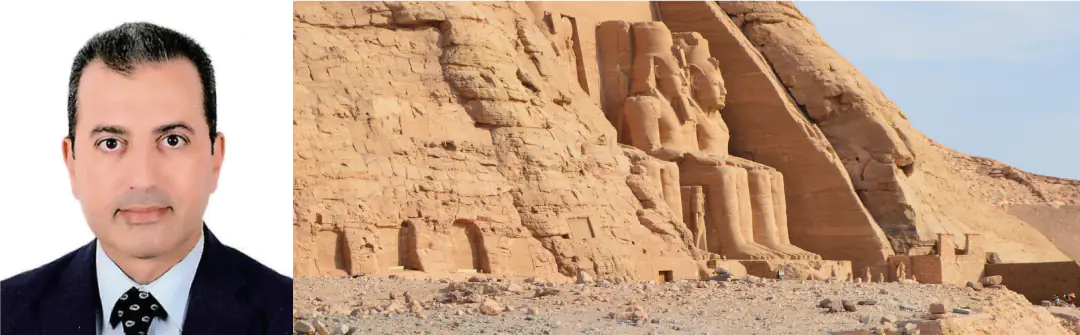 H.E. Hossam Hussein Ismail
, Consul General of the Arab Republic of Egypt in Dubai
H.E. Hossam Hussein Ismail
, Consul General of the Arab Republic of Egypt in Dubai
The Historical Bond
The Arab Republic of Egypt and The United Arab Emirates share a deep and longstanding bond on both governmental and people’s level. These relations were strengthened by historical ties that go beyond political and economic aspects. Historically, the relations between the two countries embedded in the past were further strengthened with the declaration of the Union in 1971 and the fundamental support of Egypt, through sending teachers, engineers and doctors from Egypt, to support the UAE’s union and its institutions. The UAE in turn provided all forms of support to the Egyptian army and people, supporting Egypt’s efforts in claiming back its occupied territories in the 1973 October war.
UAE’s national anthem “Ishy Bilady”- Live my Country – which was composed by the Egyptian musician Saad Abd Al-Wahhab is perhaps one of the most significant testaments of the ties between the two nations.
The UAE’s late founding father, Sheikh Zayed bin Sultan Al Nahyan, believed in Egypt’s position in the Arab world, and its pivotal and pioneering role regionally. He supported Egypt and Syria in their 1973 war for the liberation of the Arab Occupied Territories by imposing an oil boycott, making his famous declaration: “Arab oil is not dearer than Arab blood.”
Today, around 600,000 Egyptians live in UAE, working in various sectors such as education, construction, health care, administrative and judiciary services, supporting the progress and development in the UAE, while also representing one of the important pillars of the Egyptian economy through annual remittances reaching 2.1 billion dollars in 2022-2023.
On the other hand, Egypt continues to welcome UAE nationals visiting for tourism, as Egypt remains as one of their favorite touristic destinations in the Arab, African and southern Mediterranean regions. It is worth mentioning that the number of visitors to Egypt has increased to 15 million tourists in 2023.
On the political level, continued coordination is taking place between both leaderships as well as exchange of high official visits.
The Economic Ties
Economically, both the Arab Republic of Egypt and the United Arab Emirates are members in the Greater Arab Free Trade Area. The solid trade exchange between the two countries increased during the first 11 months of 2022 by 6.5 % compared to the same period in the previous year (2021) recording 4.6 billion US$; 1.8 billion exports from Egypt in the first 11 months of 2022 compared to 1.4 billion US$ during the same period in 2021 (increase of 14.4%). On other hand, the value of Egypt imports from UAE increased from 2.7 to 2.8 billion US$ in the first 11 months of 2022 (increase of 1.9%), Precious stones, pearls and jewelries are the major exports (799.6 million US$) then tools and electric machineries along with spare parts (219.6 million US$), clothes (164.3 million US$), vegetables and plants (58.7 million US$) and finally furniture and readymade facilities worth 31.7 million US$.
In terms of UAE investments in Egypt, it has witnessed a significant growth up to 5.7 billion US$ during the financial year 2021-2022 compared to 1.4 billion US$ during the same period during 2020-2021, an increase of 300%. The “Ras Al-Hikma” deal also signed between both sides in February 2024 worth 35 billion US$ considered to be the largest direct investment deal in the history of Egypt, confirming Egypt’s position as one of the most attractive destinations for foreign direct investment, and moving the country to the 32 rank worldwide in 2023, after it was ranked 45 in 2014. This progress has been achieved following the Egyptian State’s efforts to encourage foreign investment, as one of the Government’s economic plan priorities.
The increase in foreign investment flow to Egypt is related to many factors, including availability of trained workforce at competitive prices, large consumer market, competitive tax rates, access to global markets and diversified economy, in addition to a general atmosphere that encourages and attracts investment.
FDI Support
In more details, the legislative system in Egypt provides several forms that are compatible with the needs of each investor, including:
Free Zones System
Projects operating under the Free Zones System enjoy many incentives, guarantees and exemptions granted through Investment Law No. 72 of 2017, and the most important of which are:
• Profits of companies and their subsidiaries subject to the free zone systems are exempted from the tax on revenues from commercial and industrial activities and dividend income tax.
• Capital assets and production requisites necessary for practicing the project’s activity are exempted from the value added tax.
• Domestic components are exempted from the custom duties in case these goods are sold inside the domestic markets.
• All imports and exports of companies operating under the Free Zone System are exempted from custom duties and taxes.
• The projects operating under the Free Zones System and its profits are not subject to laws and regulations of taxes and customs applied in Egypt, these projects are subject to:
– 2% of the value of goods upon entry (CIF) in respect of storage projects, and 1% of the value of goods upon exit (FOB) in respect of manufacturing and assembly projects, and direct transit goods consigned to specific destination are exempted from paying such fee.
– 1% of the total revenue generated by projects maintaining activities which require no entry or exit of goods, based on financial statements approved by legal accountants.
– 1% of the total revenue generated by manufacturing and assembly projects upon exportation of commodities abroad, and 2% of the total revenue generated thereby upon entry of commodities into the country, and direct transit goods consigned to specific destinations are exempted from paying the fees.
– 2% of the total revenue generated, regarding any other projects aforementioned in the previous provision.
Investment Zones System
Investment Zone is a specific area designated for some developers to establish investment activities, and its borders shall be established by virtue of decree of Prime Minister, and the developer is responsible for carrying out the establishment, development and implementing the infrastructure of the zone, the developer can be a private company or government agency.
According to Investment Law No. 17 of 2017, investment zones are established as follows:
• By virtue of decree of the Prime Minister upon a proposal of GAFI BoD, Appropriate Minister and the Minister concerned, it is permissible to establish investmentzones specialized in various fields of investment, including logistic, agriculture and industrial investment zones, provided that the decree shall include the location, nature of activities permitted to operate and the schedule for establishment, in addition to any general conditions related to such activities.
• The developer, who is in charge of the investment zone, shall take the necessary procedures for carrying out the construction works in accordance with the schedule stated in the license.
• It is permissible, upon the decision of the Prime Minister or a delegate thereof, to grant the licensee an additional period in light of the justifications presented by the developer, subject to GAFI BoD approval.
Technological Zones System
Investment projects established within Technological Zones are projects operating in the fields of communications and information technology, including industrial activities, electronics design and development, data centers, outsourcing activities, software development and technology education. Also, all machinery and tools required by projects operating within Technological Zones may not be subject to taxes and custom duties within Egypt, and these projects enjoy special investment incentives permitted by Investment Law No. 17 of 2017.
Economic Zones System
One of the most important zones in Egypt is the Special Economic Zones in the Northwest of Suez Canal, offering a number of benefits to the projects located there, as part of the Zone management’s vision to provide factors that guarantee lowest cost of production for projects operating therein. These advantages include:
• 10% of the unified income tax within the Zone (versus 20% outside) applicable on the profit of the capital companies and on income on natural persons and on revenues derived from land and non-residential buildings.
• 5% of the income tax (versus 10% outside the Zone).
• A one-stop shop that provides the investor with single- point authority over other government agencies in core areas.
• The Economic Zone has a supreme committee that supervises the taxation system.
• The Economic Zone has a special customs service specialized to serve the Zone.
• Allowing access to the domestic markets, duties on sales to domestic market will be assessed on the value of imported inputs only.
Golden License
The golden license is a comprehensive approval on the set up, operation and management of a project, including building licenses of such project and the allocation of the real property required therefor. It may be granted to companies upon a decree of the Council of Ministers. This approval may also include providing incentives, and is valid on its own without the need to take any other action.
The total number of projects that have been granted the Golden License has reached 29 (March 2024) since the launch of this license in 2022, with a value of about 10 billion US$.
These efforts are part of Egyptian government’s ongoing efforts to encourage the foreign direct investment flows.
More information
More information about the advantage of investing in Egypt can be found on the website of the General Authority for Investment and Free Zones: www.gafi.gov.eg
 Pushpakaran Parambath
, Senior Partner - Kreston Menon Corporate Services
Pushpakaran Parambath
, Senior Partner - Kreston Menon Corporate Services
UAE is coagulating its standing as one of the promising hubs of startups and scale-ups in the region. According to global level field players, institutions and indicators, the country is in a progressive and promising path enhancing the number of startups. The government is involved in creating an integrated investment environment by introducing favorable business regulations and flexible policies. Programs like Abu Dhabi’s Hub71, Dubai Future Accelerators, and the Sharjah Entrepreneurship Center (Sheraa) provide startups with mentorship, office space, and funding. These initiatives help entrepreneurs connect with global investors and partners, giving them the resources they need to grow.
Recent statistics show that the UAE topped the GCC countries as the leading incubator for startups, with over 8,600 startups registered across the country in the year 2024. The data highlighted that the UAE is leading the region in the fintech startup sector, with over 750 plus companies currently operating in this field.
Reports from the global consulting and research firm, Startup Genome, affirmed that the UAE’s various emirates continue to advance in international rankings, emerging as the fastest-growing startup ecosystems in the region. Abu Dhabi, Sharjah and Dubai are taking the lead by creating incentivised environments of which Abu Dhabi maintains its position as the fastest growing startups ecosystem in the MENA region. Abu Dhabi itself achieved almost USD 6 billion in value during the period of 2021-2024. The report also indicated that early-stage start-up funding amassed to USD224 million, while venture capital funding between the second half of 2021 and 2023 exceeded USD1 billion, driven by the growing activities of startups operating under Abu Dhabi’s global tech ecosystem, Hub71. Abu Dhabi’s startup community continues to grow, driven by Hub71’s dedicated programmes, strategic partnerships, and commitment to innovation, which strengthens Abu Dhabi’s position as a leading and fast-growing global technology hub.
Dubai also strengthened its leadership in creating ecosystems that support start-up growth, ranking at the top of both global and regional startup ecosystem valuations. Dubai ranked first in the Gulf and second in the region in this field. In5, a TECOM Group subsidiary, has supported more than 1,000 startups, raising funding since its inception in 2013, continuing to play a pivotal role in promoting the sustainable economic growth of these companies.
Sharjah holds a global position by making significant contributions to business growth in the UAE, hosting around 60,000 small, medium, and startup companies distributed across its free zones and industrial zones.
The UAE Ministry of Economy has introduced a “Scale-Up Platform” which serves as a one-stop-shop online portal for small and medium-sized enterprises with high growth potential that provides access to products and services designed to enable the scaling of future unicorns. It focuses on five major pillars, namely, digital transformation, global expansion, joint operation and support services, exports promotion and support, and funding.
The future of the UAE’s economy is closely tied to the success of its startup ecosystem. Start-ups will continue to drive innovation, create jobs, and help diversify the economy. Startups will be essential in shaping the next phase of economic growth—one based on creativity, technology, and sustainability.
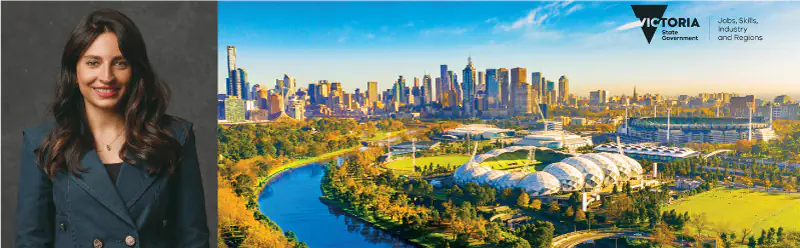 Gonul Sorbest
, Gönül Serbest, Commissioner for Victoria to Europe, Middle East, Türkiye and Africa State Government of Victoria
Gonul Sorbest
, Gönül Serbest, Commissioner for Victoria to Europe, Middle East, Türkiye and Africa State Government of Victoria
The State of Victoria, a powerhouse of innovation, diversity and ideas in Australia, has long enjoyed a flourishing partnership with the United Arab Emirates (UAE). With shared values of progress, ambition, and opportunity, our collaboration has paved the way for dynamic trade, investment, and cultural exchanges. As we enter 2025, we look ahead with optimism, ready to deepen our ties and embrace new partnerships together.
Victoria: The Gateway to Australian Excellence
Victoria is a leading contributor to Australia’s economic success. It is the most rapidly growing State in Australia in terms of population, jobs growth and the economy more broadly. Home to Melbourne, our state capital and a global city, Victoria is renowned for its world-class education system, enviable lifestyle, world-leading sports ecosystem, a cultural and dining destination and a state that builds and makes things.
Our economy is built on diversity, with strengths in industries such as agriculture, advanced manufacturing, digital technology, health and life sciences, and sport.
One of Victoria’s great assets is our extensive international presence and reach. With 23 trade and investment offices strategically located in key markets across the globe, Victoria boasts the largest international network of any Australian state or territory. These offices play a vital role in connecting Victorian businesses with international partners and vice-versa, fostering collaboration, and driving economic growth.
The UAE holds a special place in Victoria’s international partnerships. As the first Australian state or territory to establish a trade and investment office in Dubai in 1997, Victoria has demonstrated its long-term commitment to region, and over the years, this relationship has enabled Victorian businesses to explore new markets, share expertise, and achieve success across traditional and emerging industries.
Longstanding Partnership with the UAE
The recently concluded Comprehensive Economic Partnership Agreement (CEPA), announced in September 2024, between Australia and the UAE marks a significant milestone in our bilateral relations. The UAE is already Australia’s and Victoria’s largest trade partner in the Middle East and the Agreement is set to strengthen economic ties, offering expanded opportunities for trade and investment.
A testament to this growing relationship is the significant investment by the UAE’s Lulu Group in Melbourne, which highlights the confidence of UAE businesses in Victoria’s thriving economy and underscores the potential for deeper economic ties in the years ahead.
These economic links are further enriched by the vibrant UAE-born community in Victoria, which represents 33% of the UAE-born population in Australia, fostering strong and valuable people-to-people connections.
Education: A Pillar of Collaboration
Victoria is Australia’s leader in transnational education, supported by the largest offshore education network of any Australian state. Victoria is home to 18 major medical research institutes, 10 universities with four dual sectors, 12 TAFEs. These institutions, together with our state’s schools, underpin a highly skilled workforce. Each year, over 12,000 students from the broader META region choose to study in Victoria, drawn by our globally ranked universities, vocational training and English Language institutes. Beyond the classroom, we collaborate with Middle Eastern institutions to develop tailored education programs, share research, and foster innovation.
We believe in creating opportunities for lifelong learning and upskilling, ensuring that individuals and industries alike can adapt to the evolving global economy. This vision aligns with the UAE’s forward-thinking approach to education and workforce development.
Sport: A Bridge Between Cultures
Sport is a universal language that brings people together, and Victoria has established itself as the undisputed sporting state of Australia, driven by Melbourne’s world-class sports calendar, premier sporting infrastructure, and thriving innovation networks.
As the only city in the world to host both a Tennis Grand Slam (Australian Open) and a Formula 1 Grand Prix we also excel off the court with a leading business of sport event, the upcoming SportNXT conference. Our state is at the forefront
of using sport to foster international relationships.
As the Victorian Government is dedicated to fostering long-term, meaningful relationships, building on shared interests and the Gulf’s growing focus on sports as an economic driver, I recently led our first-ever trade sports economy trade delegation to the Gulf, made up of more than 20 world class Victorian companies with expertise and comprehensive knowledge across a wide array of sports sectors.
Victoria’s expertise in sport extends beyond hosting world-class events. We are leaders in sports technology, infrastructure, community participation and governance.
Future Perspectives: Opportunities Abound
Victoria’s strong ties with the UAE are exemplified by the success stories of Victorian companies that have established a presence and thrived in the region. Ego Pharmaceuticals, a leading skincare manufacturer, has expanded its footprint in the UAE, providing high-quality products tailored to the needs of the local market and building strong brand recognition. Last year, they celebrated 30 years since the opening of their office in Dubai in 1993.
Similarly, PMY Group, a global technology consultancy specializing in major events and infrastructure, has brought its expertise to the UAE, supporting high-profile projects with innovative solutions. These companies represent the strength and versatility of Victorian businesses, showcasing their ability to adapt, innovate, and contribute meaningfully to the UAE’s dynamic and ambitious economy.


Looking ahead
Upcoming key events in Melbourne such as the World Chambers Congress (WCC) in September 2025 —offer platforms to showcase our shared strengths, vision and deepen connections.
The 14th WCC will take place in Melbourne from 2 to 4 September 2025 at the Melbourne Convention and Exhibition Centre. Dubbed the ‘Business Olympics,’ this premier global event is poised to welcome business leaders and innovators from around the world, showcasing Melbourne’s thriving business community while fostering meaningful connections and collaborations that will drive the future of global exchanges. This is a perfect opportunity to welcome valued partners and business leaders and influencers from the UAE to connect and strengthen ties.
We are also actively supporting numerous trade delegations to the UAE, ensuring that Victorian companies are well-positioned to engage and grow in these high-profile, sector-leading trade shows. Key sectoral events, such as Gulfood, provide a platform to strengthen partnerships, explore new opportunities, and showcase Victoria’s expertise across a range of industries.
Let’s chat
Ever changing challenges demand collaboration and innovation. By working together, Victoria and the UAE can drive solutions that benefit our people and economies. Whether through advancing renewable energy, fostering entrepreneurship, or celebrating cultural diversity, our partnership is a testament to what can be achieved through shared vision and determination.
As we embark on the new year, I extend my deepest gratitude to our partners in the UAE for their ongoing support and friendship. We look forward to continuing the work in 2025 and building on our relationship defined by trust, mutual respect and shared ambitions.
For those interested in connecting or learning more about opportunities with Victoria, we invite you to reach out and connect with our team. We look forward to the conversation.
 Ravishanker V
, Director - Taxation, Kreston Menon
Ravishanker V
, Director - Taxation, Kreston Menon
Unrealised Gains and Losses: The Realisation Basis Election
A critical one-time choice in the first CT return is whether to elect the “realisation basis” for unrealised gains and losses. Under normal accrual accounting, certain assets or liabilities can have unrealised gains or losses (for example, a rise in value of an investment property or securities portfolio) that are recorded in profit before any actual sale or settlement. By default, such unrealised gains would be included in accounting income and thus taxable. The realisation basis election allows a company to defer tax on unrealised gains and losses until they are actually realised.
This election is only available in the first tax period, and once made, it applies to all future periods unless exceptionally revoked with Federal Tax Authority (FTA) approval. The election can be applied in one of two ways: either to (a) all assets and liabilities that are measured at fair value through profit (or subject to impairment accounting), or (b) to all assets and liabilities held on capital account. For example, if an investment property’s fair value increased by AED 2 million during 2024, electing the realisation basis would mean this AED 2 million unrealised gain is not taxed in 2024 – instead, tax will only be due when the property is actually sold and that gain is realised.
Businesses with significant fair-value adjustments should strongly consider making this election in their first return, as it can defer the tax on such unrealised gains until a future sale, improving cash flow.
 Alex Peal
, Managing Partner - James Cowper Kreston Peal
Alex Peal
, Managing Partner - James Cowper Kreston Peal
Trade and Investment
The latest statistics on trade and investment between the UK and the UAE highlight the strength of this partnership. At the end of 2024, total trade in goods and services between the UK and the UAE amounted to £24.3 billion, an increase of 11.1% from the previous year. Of this, UK exports to the UAE were £15.5 billion, while imports from the UAE were £8.9 billion.
The UAE and UK are actively working towards a free trade deal with the GCC, which has the potential to increase bilateral trade by 16%, adding an extra $10.85 billion per year to the trade between the UK and GCC countries in the long run. This effort underscores the deep-rooted economic relationship between the UAE and UK, which continues to evolve and expand, reflecting their shared vision for a dynamic and sustainable global economy.
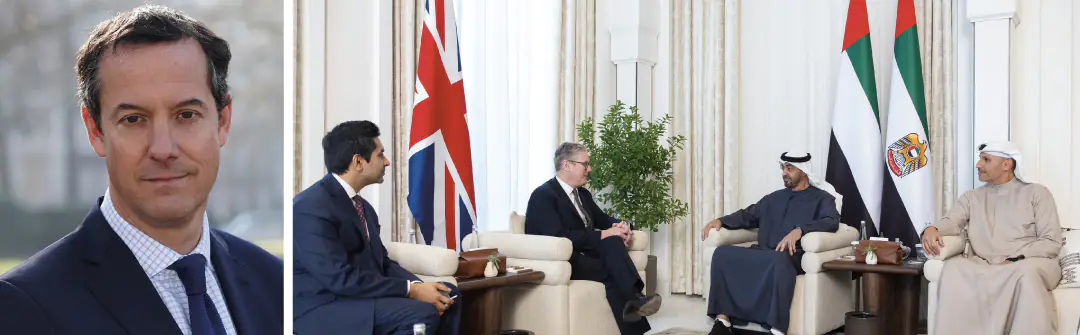 H.E. Edward Hobart
, British Ambassador to the United Arab Emirates Hobart
H.E. Edward Hobart
, British Ambassador to the United Arab Emirates Hobart
Financial services at the heart
The UAE-UK financial relationship is built on deep historical foundations pre-dating the UAE’s Union in 1971. British banks were among the first international financial institutions to establish operations in the UAE, creating a foundation for cross-border banking relationships that continue today. Investment quickly started to flow in both directions. The financial centres of Abu Dhabi Global Market and Dubai International Financial Centre were built on a UK model, with English Common Law at their core.
Earlier in May, the Lord Mayor of London visited the UAE with a delegation which included representatives from Howden, Aberdeen, KPMG and Guavapay, a global fintech company. Capital markets and professional services continue to provide a promising area for UK-UAE financial cooperation, with the London Stock Exchange positioned to attract more landmark UAE listings beyond Masdar’s green bonds and ADQ’s multi-billion-dollar offerings. The UAE’s introduction of corporate tax and evolving sustainability requirements increases demand for specialised UK accounting expertise, particularly in ESG reporting and AI-powered financial management.
Both the UK and UAE are leaders in the fintech revolution with British innovators like Smart, Checkout.com, and Wise engaged in modernising banking solutions throughout the Emirates, with the UK’s fintech expertise complementing the UAE’s digital transformation agenda.
 Raju Menon
, Chairman and Managing Partner - Kreston Menon
Raju Menon
, Chairman and Managing Partner - Kreston Menon
In a landmark reform aimed at enhancing the business ecosystem and reinforcing Dubai’s status as a global investment hub, Dubai Executive Council has passed a resolution permitting Free Zone companies to do business in the Dubai mainland. This change has the potential to open new markets, bring in new business synergies and facilitate more foreign direct investment into the Emirate.
Let us do a deep dive into what the new resolution entails and how it could benefit businesses.
The Resolution No. (11) of 2025: A definite Step Forward
Dubai Executive Council Resolution No. (11) of 2025 permitting Dubai Free Zone entities to expand their business activities to mainland Dubai through the issuance of onshore licenses and activity permits.
The companies registered in Free Zones were restricted from engaging in commercial activities in the mainland which many considered to be regulatory and financial divide that restrained businesses in an increasingly interconnected environment.
The new resolution aims to bridge that gap. Free Zone companies can now engage with the mainland market directly, subject to compliance with Dubai’s regulatory framework, licensing requirements, and sector-specific approvals. This initiative complements with D33 Agenda – the economic vision of Dubai which aims to double the size of economy, which will position Dubai as one of the three global cities for business and innovation.
The Mechanism
Free Zone entities who are looking to take advantage of the new resolution which will be integrating Free Zones and Mainland, may apply for one of the three new types of licenses/permits:
 HE Jean-Christophe Paris
, Consul General of France in Dubai and Northern Emirates
HE Jean-Christophe Paris
, Consul General of France in Dubai and Northern Emirates
Over the last 50 years, the United Arab Emirates and France have built a remarkably strong and multifaceted partnership, and we are now looking at the future.
The bilateral relationship is booming in all fields including defense, culture, education, space, artificial intelligence, energy and environment. Bilateral trade between France and the UAE reached 8.5 billion euros in 2024, marking a significant 15% increase from the previous year. This upward trajectory highlights the strengthening economic ties and the growing role of both countries in each other’s economic landscapes. The UAE stands as France’s largest partner in the Near and Middle East, accounting for 42.3% of French exports to the region. On the other hand, it is France’s second-largest supplier, representing 16% of French imports from the region. Furthermore, France remains a prime destination for Emirati investment, with Foreign Direct Investment (FDI) reaching 2,3 billion euros in 2023. A notable testimony of this momentum is the long-standing and fruitful partnership between Mubadala and Bpifrance, the French public investment bank. This collaboration continues to play a pivotal role in facilitating joint ventures and driving cross-border investments, further deepening the ties between our two nations.
A strong French companies’ presence in the UAE
French companies have played a pivotal role in supporting the UAE’s development for decades, with some partnerships dating back over 50 years. Over time, France has become a key partner in a variety of sectors. From energy major players that have helped build critical infrastructure and support the country’s sustainability goals, to their involvement in the creation of the Dubai metro and tramway, and to luxury and tourism brands that have shaped the UAE’s global image as a premier destination, France’s presence is both strategic and long-standing. Today, more than 600 French subsidiaries operate across the Emirates, employing around 30,000 people—making it the largest French business presence in the Middle East, ranging from industry giants to SMEs and startups.
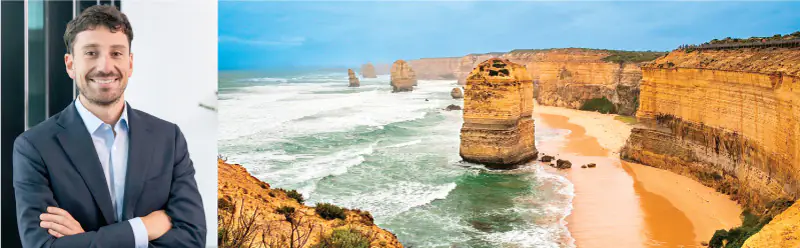 Jack Delmo
, Chief Executive Officer - McLean Delmo Bentleys
Jack Delmo
, Chief Executive Officer - McLean Delmo Bentleys
For businesses looking to expand into new markets, Australia is a great place to invest. Known for its political stability, robust economy, and vibrant multicultural society, Australia offers a highly skilled workforce and supportive government policies to enable foreign investment.
Victoria, Australia’s second most populous state has experienced steady growth over the last ten years and is forecast to grow by 2.6%, exceeding other Australian states and territories. Melbourne, the state’s capital, is now the most populated city in Australia. As part of its growth story, the Victorian Government has an ongoing commitment to encouraging inbound investment. Jack Delmo, Chief Executive Officer, McLean Delmo Bentleys discusses why Australia, and particularly Victoria is a great place to do business and what businesses need to consider when establishing operations.
Government Support for Inbound Investment
The Australian Government actively encourages foreign investment through various initiatives. Austrade, the government’s trade and investment arm, provides comprehensive support to international investors, including market insights, networking opportunities, and assistance in navigating regulatory frameworks. Additionally, state-level bodies such as Invest Victoria offer tailored support for businesses setting up operations in the region.
“Australia offers an unparalleled combination of business stability, talent availability, and market access,” comments Jack Delmo, “With the government’s investor-friendly policies and Victoria’s innovation-driven economy, businesses have an excellent platform for growth.”
Setting Up a Business in Australia: Key Considerations
While Australia offers a wealth of opportunities, establishing a business requires careful planning and compliance with local regulations. Following are the critical steps and considerations for businesses looking to expand into the Australian market.
Choose the Right Business Structure
Selecting the appropriate legal structure for your Australian operations is crucial, as it will impact taxation, regulatory obligations, and overall flexibility. A foreign company setting up in Australia for the first time may do so in one of three ways:
• Representative office – where there is no direct business operations in Australia, but the foreign company wishes to provide some support to its Australian customers.
• Branch – where a company intends operating a business in Australia, but the foreign company does not wish to establish a separate legal structure to operate through.
• Subsidiary – where a company intends operating a business in Australia, and a foreign company does wish to establish a separate legal entity to operate through.
Consulting a professional advisor can help determine the most suitable structure based on your business goals and work through the many considerations including Australian taxation issues, repatriation of profits to the country of origin, Corporations Act and financial reporting obligations, long and short-term business strategy, management independence, etc.
Company Secretarial Matters
Compliance with corporate governance requirements is essential. Businesses must appoint a local resident director and ensure ongoing compliance with Australian Securities and Investment Commission (ASIC) regulations, including the timely filing of annual returns and financial statements.
“Effective company secretarial services are key to maintaining good standing with regulators,” advises Jack Delmo, “Non-compliance can lead to penalties, additional administrative burdens and reputational risks.”
Taxation Compliance and Considerations for Non-Residents
Australia has a well-developed tax system, and understanding its nuances is critical for foreign investors. Key tax considerations include:
• Corporate Tax Rate: The standard corporate tax rate is 30%, but a lower rate of 25% applies to businesses with an aggregated turnover below AUD 50 million.
• Goods and Services Tax (GST): A 10% GST applies to most goods and services. GST may need to be charged on invoices, but can also be claimed on various expenses paid.
• Withholding Tax: Withholding tax can apply to dividend, interest and royalty payments to foreign entities. Rates can differ depending on various factors, including the existence of a Double Tax Agreement (DTA) with certain foreign country. We note that the United Arab Emirates doesn’t not have a DTA with Australia.
• Transfer Pricing: Transactions between related parties must comply with Australia’s transfer pricing rules, ensuring that they are conducted at arm’s length.
• Employment Taxes: Consideration needs to be given to legalities if you are employing directly in Australia. These include employment laws, employment withholding requirements, Workcover insurances and superannuation.
• Thin Capitalisation Rules: These rules are designed to ensure investment in Australia is adequately capitalised. This can apply to limit deductions in specific scenarios, however a de-minimis threshold of $2m applies to the debt deduction.
• General Anti-Avoidance Rules: Can be applied to deny tax benefits where certain conditions are met. These rules are primarily focused on arrangements that have entered into with a dominant purpose to obtain a tax benefit.
Managing an international structure and mitigating the incidence of tax leakage can be a complex and highly customised exercise which involves consideration of strategic, commercial and tax variables and having regard to several limitations imposed by integrity features of the Australian tax law. Professional advice on tax structuring and compliance can help businesses optimise their tax position and avoid pitfalls.
Accounting Services
Accurate and transparent financial reporting is crucial for maintaining investor confidence and meeting regulatory requirements. Engaging local accounting professionals ensures compliance with Australian Accounting Standards and International Financial Reporting Standards (IFRS).
“Leveraging local expertise in accounting and financial reporting helps businesses stay compliant while focusing on their core operations,” commented Jack Delmo.
With its vibrant economy, strategic location, and supportive business environment, Australia offers immense opportunities for businesses looking to expand into new markets. By understanding the key steps involved in setting up operations and leveraging professional services, companies can unlock the full potential of this market.
“Investing in Australia is a strategic move for businesses aiming to expand their global footprint,” says Jack Delmo. “With the right guidance and resources, businesses can thrive and contribute to Australia’s economic landscape.”
Whether you are a seasoned multinational or a burgeoning enterprise, Australia welcomes you with a wealth of opportunities.
 Virginia Cook
, Marketing Director - Kreston Global
Virginia Cook
, Marketing Director - Kreston Global
What is a name?
We all have our favourite brands, don’t we? Ones that resonate with us, that speak to us and to whom we are loyal regardless of our “sensible” heads telling us that we could probably find a cheaper or better alternative elsewhere.
But why do we get so “hooked” on certain brands? Have you ever tried to analyse why something generates an “emotional” response when we are able to be very factual and pragmatic about other aspects of our lives?
I quite like this definition of a brand from Investopedia. “A brand is the collective impact or lasting impression from all that is seen, heard, or experienced by customers who encounter a company and its products and services. In creating a brand, a business is managing the effect that the product or service is having on the customer.”
In my younger days, it was always the consumer brands that shaped branding theory (although these days we have incredibly powerful business brands); then it was all about being a “bundle of wants and desires in the mind of the customer.” Either way as we know, it is so much more than the visual. What we talk about now is the “experience” that we, the consumer, have when we use the brand/s that we love.
What do we mean by experience? It is every single activity, online manifestation, printed brochure, customer interaction that had with every part of our product that will create that “lasting impression”; the “collective impact” we seek in a strong and compelling brand. It’s that “managing the effect” as the definition above articulates.
When it comes to professional services brands, what is being “used” or purchased is the deep technical, specialist, business advice that is customised to our clients’ specific problem. So, creating a differentiated brand in this case means ensuring every single point at which our customer interacts with us reinforces those special characteristics. This is really saliant when clients need advice and solutions from different parts of the network. Managing that experience for our clients across international boundaries and jurisdictions is hyper-important.
The word “Kreston” means “responsible, trustworthy” in ancient Greek, and our member firms take that very seriously. Our name is fundamental to the promise our brand offers our clients and the experience we need to give them.
Kreston: Our whole is greater than the sum of our parts
As a worldwide network of accounting and business advisory firms, Kreston advisers want to be compelling to ambitious, entrepreneurial, interesting clients who seek to expand their business operations around the world. These sorts of clients want to move fast, need on-the-ground support, and require local savvy business advisers who know how to get the job done, and the right business connections to make that happen. Independent, ambitious, and fiercely entrepreneurial, Kreston firms are ideally placed for clients like these across the world. The key is to manage that experience so that it is consistent and reliable for our clients wherever they are in the world.
Kreston has a powerful backstory that reinforces the drive and energy that exists in the network today. Formed in 1971 by 2 entrepreneurial accountants, one from our German firm, Kreston Bansbach, and one from an English firm, Finnie & Co, that is now part of BDO, these 2 accountants were early pioneers of both an international mindset and the concept of a network of firms around the world who collaborate to help clients expand overseas. Fifty years on, Kreston is an energetic community of like-minded people who love working together to help their clients succeed.
Five Steps to Building a Global Brand
We know from member surveys and feedback that building our global brand is a key priority for our membership.
As a network we have wide and varied audiences. Our people, our firm leadership, our firms’ clients, our potential clients, our potential future recruits and all the people involved in helping us deliver work and value as suppliers and referrers.
That’s a lot of people to try and influence. Which is why we are in this together and we are working on a 5-step programme to build that worldwide global brand.
- A shared vision and ambition – one brand worldwide
- A compelling proposition that unites us – a purpose that we all agree with
- A consistent experience across our people and our clients – online is now king
- A reputation and narrative that is compelling to our clients and our people
- Ambassadors and advocates who help create and spread our culture
There isn’t the space to go into the detail for all these steps now. But we already know our shared ambition is a strong worldwide brand: entrepreneurial firms united in a collegiate, collaborative, community-minded enterprise, fuelling ambition and walking shoulder-to-shoulder with our clients. Our members will hear more in October about our shared vision, ambition, and purpose at our first world conference for 3 years in the wonderful city of Madrid.
Let’s take a closer look at steps 3, 4 and 5 and how we work on these essential areas of the digital challenge, a strong narrative to clients, and engagement of our younger people involved in the network, so they feel a sense of ownership, pride, and opportunity.
Why Digital is King in the Battle for Hearts and Minds
The Covid pandemic changed our lives fundamentally. We were becoming digitally adept, used to doing research online, fact finding, comparing providers. But suddenly in early 2020, that was the only way we could work – the only way we could buy – and the only way we could find out any information. And we haven’t looked back. Statista.com’s April 2022 analysis confirms “As of April 2022, there were five billion internet users worldwide, which is 63 percent of the global population. Of this total, 4.65 billion were social media users.” We will never return to a world where we are not “digital first.”

Although accounting firms may rely heavily on personal recommendations to grow business locally, growing a business regionally and globally takes a robust digital brand. 62% of businesses make decisions about who to do business with using just digital content to make their shortlists (Forrest Group, 2021). There are almost 2 billion websites in the digital landscape. Getting people to come to our websites is important – creating campaigns and stories that are interesting to read and add value to our clients’ research is critical. We have a great bank of client case studies that demonstrate the way that Kreston firms help their clients and regularly send our international clients update on tax, audit, and other international topics of interest.
Lynsey Thornthwaite, Kreston Global Digital Brand and Content Manager, gives us a view of our digital performance so far, “The Kreston Global website is growing rapidly; we have doubled the organic traffic in six months, and we could do that again over the next six months. Watching how users on the website clearly indicates that these new users are in that research phase, top of the funnel. They are navigating through the website, checking the “Doing Business In” pages, then navigating the country firms’ pages.”
“The traffic coming from member websites to the Kreston Global website is a great example of buyer intent in that research phase. The Kreston Menon website is the number one firm website referring traffic to the Kreston Global website. This is due to a combination of offline activity; there is an incredible amount of work going in to raising the profile of the firm – and the online activity, and a simple to navigate website that signposts users through the customer journey effectively. We can see that users from Kreston Menon are finding the journey fluid and the content meets their needs. The audience locations are not just regional, but global and the percentage of those visitors who return is third highest overall, a positive indication of interest and engagement.” Kreston Menon is part of our group of firms who really understand the power of digital engagement.
Understanding the “Interpreneur”
A professional brand stands and falls on the quality of its reputation and the way it shows how it understands its core client buyer. So, we focus a lot on enhancing our reputation with media and content creation. Our global group experts in Corporate and HNWI Tax, VAT, Audit, Transfer Pricing, Global Mobility and Corporate Finance write and publish expert advice to demonstrate our collective knowledge in these areas. This helps our reputation as a strong business advisory brand.
As well as topical and expert content, we have recently commissioned research across 6 main global markets to probe the way in which business owners decide to expand their businesses globally, what challenges they see as key and what are the characteristics found in successful “interpreneurs.”
We call these types of business owners/investors and directors “Interpreneurs,” and the results were fascinating, giving us real insight into what type of geographies, age and gender profile makes a more likely interpreneur and what they want from governments and advisers to help them success.
We will be running a series of podcasts with our advisers and clients looking more closely at the steps to success and have developed a web tool so that clients and prospects can see if they share the characteristics for success.
Ambassadors and advocates
Our culture is forged and strengthened the more our members interact with each in communities of interest. By building more ambassadors for Kreston through involving our younger people more in the network, we gain so much from their input and energy. It is so important that they can see Kreston as a network of opportunity for future career development, where they can work on interesting and ambitious clients and with enthusiastic committed professionals and peers from around the globe. All of whom are important advocates for the Kreston brand.
We are fortunate to have Kreston Menon in our network as they are true exemplars of what it means to have a strong, strategic brand focus – it is not by chance that they have a recognised “Superbrand” status in the UAE. They are energetic business builders in their own country of course, but through forging strong relationships with government bodies in the region, by investing in an international strategy abroad to get the most out of the network, and by being very supportive and involved in Kreston’s community building activities, they have gained a big following and strong relationships with colleagues across the world in the Kreston network.
“You have to invest to see a return” is the mantra of many business advisers when helping their client to think long-term. This is very much our attitude at Kreston Global – when our firms invest in the network and in helping us to build our global brand – like Kreston Menon – then together we will be stronger, compelling, and connected together by our shared ambition.
 Sangeetha Thomas
, Security & Cyber Resilience-Kreston ME Consulting
Sangeetha Thomas
, Security & Cyber Resilience-Kreston ME Consulting
The UAE has been acknowledged as a global leader by the Global Cybersecurity Index 2024 for its commitment to promoting robust cybersecurity practices and measures. With a notable increase in maturity, the UAE has attained the highest tier-one rating, distinguishing it as a ‘role model’ among countries.
It has also been globally recognized to be progressive in making strategic investments, and adopting innovative technologies such as cloud computing and artificial intelligence. While the nation has made considerable progress in digital governance, it still faces challenges in securing critical infrastructure for both public and private sectors.
The modernization of infrastructure and digital transformation has sparked innovation and growth, especially through initiatives like UAE’s ‘Entrepreneurial Nation’. However, there is an urgent need to enhance stability and resilience within critical infrastructure. Readiness to address risks that arise from accessing information across various devices, through diverse communication channels, and within an ever-evolving technology landscape is essential for survival.
Evolving Business Frontline
Securing the enterprise’s security perimeter is crucial, as it has become the frontline for businesses. As more users and devices traverse traditional network boundaries, and as automation increases through non-human identities, the ‘attack surface’ of organizations is constantly expanding. The rising demand for cloud computing and the use of AI, machine learning for operational efficiency have significantly broadened the security perimeter.
Today, the concern is not whether an organization will face an attack, but rather how it can effectively respond, defend, and minimize damage to its critical business assets while recovering from such incidents. This shift from the timing of attacks to methods of response has led organizations to focus on building resilience into their infrastructure. Although technology solutions can help foster secure working environments, they do not provide full assurance of security. Weak processes that utilize these technological solutions can still be vulnerable.
Today’s Challenges
The ease of integrating Artificial Intelligence (AI) into business meetings, processes, and operations have made it a decisive factor for organizations striving to remain competitive. However, the rapid adoption of AI by employees pose management challenges for organizations, similar to the infiltration of shadow IT applications into enterprise systems. Clear guidance and direction are essential for the smooth integration of AI and applications within organizations.
In today’s knowledge economy, ‘data’ has emerged as a new currency; data breaches can dismantle trust built over years, undermining customer and partner confidence. Recent research on hacktivism posts on the dark web indicated that the most prevalent topics were related to data (33%) and access (21%). Adopting approaches like ‘Zero Trust Architecture’ provide a structured method for maintaining a secure posture. However, this must be implemented holistically, addressing both process security and secure technology architecture.
According to 2024 Verizon Data Breach Report, 55% of data breaches could be attributed to human error. It is crucial for enterprises to cultivate sound cybersecurity practices to sustain a secure digital environment and effectively mitigate human-related risks.
Unauthorized access to information assets can lead to an organization’s infrastructure being misused for launching cyberattacks against government entities or other organizations. For instance, penalties for compromising a government website in the UAE can include a seven-year prison sentence and fines ranging from Dh 250,000 to
Dh 1.5 million.
UAE Cybersecurity Landscape
According to the UAE Cyber Security Council’s ‘State of the UAE – Cybersecurity Report 2024,’ 21% of exposure to cyber threats was linked to insider actions, and 40% of identified vulnerabilities in assets have persisted within the enterprise for more than five years. These figures highlight deficiencies in organizational security processes, leaving them susceptible to exploitation through ransomware, phishing, and other attacks. A study by IBM in 2024 indicated that phishing was the primary attack vector in 27% of enterprise breaches.
To bolster enterprises in their security efforts, the UAE has introduced a National Cybersecurity Strategy, backed by well-defined assurance frameworks, policies, and standards. These guidelines are applicable to organizations based on their industry and significance to the national economy, regardless of their size. The strategy is built on five key pillars and encompasses 60 initiatives aimed at mobilizing the entire cybersecurity ecosystem. Complementing this framework, UAE Cyberlaws define strict measures to combat cybercrime, imposing penalties and imprisonment for cyber attacks and breaches.
Organizations operating in UAE must be aware of the regulatory landscape governing their digital assets and infrastructure, enabling them to adopt necessary measures to comply with cybersecurity requirements. In cases of a breach or compromise, organizations in the UAE are expected to demonstrate due diligence and the appropriate actions taken to protect, respond, and recover, in accordance with established assurance frameworks.
What can businesses do?
A sound understanding of UAE’s cybersecurity landscape and initiatives can help shape and direct security programs effectively. Knowledge of sector specific cybersecurity requirements, thorough understanding of risks posed to critical assets, vulnerability assessement of its enterprise estate with measured exposure to cyber threats should form the basis of defining and adopting an enterprise secure profile through good governance, secure processes, and an optimized security architecture.
When organizations implement robust security policies and controls that align with their technology investments, they establish a dependable security control framework to consistently manage critical assets and guide user behavior to reduce risks while ensuring regulatory compliance. Regular communication about the significance of cybersecurity and recognition of employees’ contributions can reinforce positive behaviors and offset human risks.
Business operations often require organizations to adhere to various industry-specific compliance regulations, which must be demonstrated through certifications or their equivalent. Certifying competence in securing information assets will enhance organizations’ competitiveness by meeting qualification criteria and ensuring compliance with regulatory demands, besides avoiding potential fines and legal complications. Security can no longer remain an after-thought for organizations.
Leadership must prioritize cybersecurity and exemplify good security hygiene practices to foster a growth mindset. It’s time to go beyond survival tactics and set the course to thrive in today’s digital economy.
No Items.
 Surandar Jesrani
, CEO & Managing Partner - MMJS Consulting
Surandar Jesrani
, CEO & Managing Partner - MMJS Consulting
Following an announcement on 31 January 2022, the UAE Government released Federal Decree Law No. 47 of 2022 on Taxation of Corporations and Businesses (UAE CT Law) on 9 December 2022. This follows a first of its kind public consultation drive which began on 28 April 2022 seeking feedback from stakeholders on key features and principles of the planned UAE CT regime. The UAE CT Law has been supplemented by 158 Frequently Asked Questions (FAQs) which provide further guidance regarding the intent and principles of the legislation.
Though largely in line with principles contained in the public consultation document, provisions contained in UAE CT Law have addressed issues on key aspects which is indicative of the positive approach of the UAE Government for implementing a cohesive, straightforward and transparent legislative framework.
UAE CT is applicable on taxable income of resident and non-resident persons for financial years beginning on or after 1 June 2023. UAE CT will be applied at a rate of 0 percent on taxable income upto AED 375,000 and a general rate of 9 percent for taxable income above AED 375,000. Resident entities are taxable on worldwide income whereas non-residents would be taxable on UAE sourced income which could include income from a resident in the UAE, income derived from the UAE or income from activities performed or benefitted in the UAE.
The personal income of natural persons has been kept outside the scope of UAE CT, however, business income of individuals is within the ambit of UAE CT. The meaning of business and commercial activities in respect of natural persons would be notified in a separate Cabinet Decision.
UAE CT Law provides for exemptions for businesses engaged in extraction of natural resources, Government and Government controlled entities, charities and public benefit entities, investment funds, pension and social security funds, subject to conditions. Certain exempted categories are required to claim the exemption through an application process to be notified.
Free Zones are a key economic driver for the UAE and this fact has been appropriately addressed in the UAE CT regime through an incentive to Free Zone registered persons being taxed at the rate of 0 percent on Qualifying Income. Qualifying Income would be detailed in a specific Cabinet Decision which is expected imminently at the time of going to press. However the Free Zone Person incentive carries stringent conditions including maintaining substance in the Free Zone License, satisfying transfer pricing requirements and other compliances. These conditions may not be straightforward for many businesses to comply given existing holding structures, business models and operations.
Provisions for taxable income and its computation largely follow internationally accepted best practices including exemptions to dividends from domestic companies and participation interests, a cap on net interest deduction at 30 percent of EBITDA and a cap on business entertainment expenses at 50 percent. Reliefs for small businesses, intra-group transactions and restructuring has been provided. It is important to note that UAE CT Law explicitly states that expenditure is deductible only if it is incurred exclusively for business purposes and accordingly, expenditure which is personal in nature, or incurred for exempt or incentivized income may not be deductible.
The parent entity of a resident group of companies can make an application to form a tax group with its UAE subsidiaries, subject to meeting strict conditions. These conditions include a 95 percent ownership requirement and neither the parent nor a subsidiary can be an exempt or a Qualifying Free Zone person. The parent company of a tax group is responsible for administrative mandates under law and would submit a single tax return.
The UAE CT Law has been generous in respect of tax losses providing for indefinite carry forward for setoff against future taxable income capped at 75 percent of such taxable income provided certain conditions are met. Tax losses may also be transferred between resident companies with 75 percent common shareholding subject to the specified cap for set-off.
Persons subject to UAE CT are mandated to register with the Federal Tax Authority (FTA) and obtain a Tax Registration Number. Early bird registrations have been activated by the FTA on the Emara Tax portal. However, it is understood from authorities that a registration should be obtained prior to filing of tax returns.
All Taxable Persons subject to UAE CT, including Qualifying Free Zone Persons, will be required to file a tax return and pay any due tax within 9 months from the end of a tax year (which is the current financial year followed by such taxpayers).
As per Law, transactions with associated enterprises (related parties) and connected persons are required to comply with the arm’s-length principle which would be in line with OECD Transfer Pricing (TP) Guidelines. However, the definitions of related parties and connected persons are customized to suit the socio-economic climate of UAE and include kinship up to the fourth degree which may trigger TP requirements. UAE CT Law requires UAE businesses to maintain TP documentation which will be prescribed under a Ministerial Decision. TP documentation must be submitted to the FTA within 30 days of a request. Further, all taxpayers would be required to submit a TP disclosure form along with the UAE CT return detailing the controlled transactions of a tax year.
As per UAE CT Law, documentary evidence supporting tax positions taken by the taxpayer should be maintained for at least 7 years from the end the relevant tax year.
Additionally, UAE business may be requested to submit financial statements and other documentary evidence including transfer pricing to the FTA.
UAE CT Law includes a detailed general anti-abuse rule (GAAR) intended to disregard transactions or arrangements undertaken with the purpose of obtaining a tax advantage. GAAR applies from the date of publication of UAE CT Law in the Official Gazette.
As part of transitional provisions, the UAE CT Law also provides that the opening tax balance sheet would be the closing accounting balance sheet for the financial year immediately before the first tax year and should conform to the arm’s length principle.
The impact of a new business law or regime are far-reaching for an economy and considering that tax legislation is relatively new for UAE businesses, additional care should be taken while assessing implications under UAE CT Law. As further details would be forthcoming over the coming months through a series of Ministerial and Cabinet Decisions, businesses should closely monitor developments and prepare for change management well in advance to mitigate the probability of unfavorable outcomes. As part of the run up to the effective date of UAE CT on business activities, investors and entrepreneurs alike may consider assessing the impact of UAE CT on as is basis, structural changes (keeping in mind GAAR), modelling cash flow implications, consider exemption regimes, and developing processes and related procedures to manage compliance.
Natural persons undertaking a business activity should assess whether income earned could be regarded as business or commercial in nature and take steps to structure such activities to be tax efficient.
Every change is an opportunity to become more efficient in the way we do things and I believe this is true even in the case of implementing UAE CT in your business activities.
No Items.
No Items.
No Items.
No Items.
No Items.
No Items.
Virginia Cook
, Marketing Director - Kreston Global
What is a name?
We all have our favourite brands, don’t we? Ones that resonate with us, that speak to us and to whom we are loyal regardless of our “sensible” heads telling us that we could probably find a cheaper or better alternative elsewhere.
But why do we get so “hooked” on certain brands? Have you ever tried to analyse why something generates an “emotional” response when we are able to be very factual and pragmatic about other aspects of our lives?
I quite like this definition of a brand from Investopedia. “A brand is the collective impact or lasting impression from all that is seen, heard, or experienced by customers who encounter a company and its products and services. In creating a brand, a business is managing the effect that the product or service is having on the customer.”
In my younger days, it was always the consumer brands that shaped branding theory (although these days we have incredibly powerful business brands); then it was all about being a “bundle of wants and desires in the mind of the customer.” Either way as we know, it is so much more than the visual. What we talk about now is the “experience” that we, the consumer, have when we use the brand/s that we love.
What do we mean by experience? It is every single activity, online manifestation, printed brochure, customer interaction that had with every part of our product that will create that “lasting impression”; the “collective impact” we seek in a strong and compelling brand. It’s that “managing the effect” as the definition above articulates.
When it comes to professional services brands, what is being “used” or purchased is the deep technical, specialist, business advice that is customised to our clients’ specific problem. So, creating a differentiated brand in this case means ensuring every single point at which our customer interacts with us reinforces those special characteristics. This is really saliant when clients need advice and solutions from different parts of the network. Managing that experience for our clients across international boundaries and jurisdictions is hyper-important.
The word “Kreston” means “responsible, trustworthy” in ancient Greek, and our member firms take that very seriously. Our name is fundamental to the promise our brand offers our clients and the experience we need to give them.
Kreston: Our whole is greater than the sum of our parts
As a worldwide network of accounting and business advisory firms, Kreston advisers want to be compelling to ambitious, entrepreneurial, interesting clients who seek to expand their business operations around the world. These sorts of clients want to move fast, need on-the-ground support, and require local savvy business advisers who know how to get the job done, and the right business connections to make that happen. Independent, ambitious, and fiercely entrepreneurial, Kreston firms are ideally placed for clients like these across the world. The key is to manage that experience so that it is consistent and reliable for our clients wherever they are in the world.
Kreston has a powerful backstory that reinforces the drive and energy that exists in the network today. Formed in 1971 by 2 entrepreneurial accountants, one from our German firm, Kreston Bansbach, and one from an English firm, Finnie & Co, that is now part of BDO, these 2 accountants were early pioneers of both an international mindset and the concept of a network of firms around the world who collaborate to help clients expand overseas. Fifty years on, Kreston is an energetic community of like-minded people who love working together to help their clients succeed.
Five Steps to Building a Global Brand
We know from member surveys and feedback that building our global brand is a key priority for our membership.
As a network we have wide and varied audiences. Our people, our firm leadership, our firms’ clients, our potential clients, our potential future recruits and all the people involved in helping us deliver work and value as suppliers and referrers.
That’s a lot of people to try and influence. Which is why we are in this together and we are working on a 5-step programme to build that worldwide global brand.
- A shared vision and ambition – one brand worldwide
- A compelling proposition that unites us – a purpose that we all agree with
- A consistent experience across our people and our clients – online is now king
- A reputation and narrative that is compelling to our clients and our people
- Ambassadors and advocates who help create and spread our culture
There isn’t the space to go into the detail for all these steps now. But we already know our shared ambition is a strong worldwide brand: entrepreneurial firms united in a collegiate, collaborative, community-minded enterprise, fuelling ambition and walking shoulder-to-shoulder with our clients. Our members will hear more in October about our shared vision, ambition, and purpose at our first world conference for 3 years in the wonderful city of Madrid.
Let’s take a closer look at steps 3, 4 and 5 and how we work on these essential areas of the digital challenge, a strong narrative to clients, and engagement of our younger people involved in the network, so they feel a sense of ownership, pride, and opportunity.
Why Digital is King in the Battle for Hearts and Minds
The Covid pandemic changed our lives fundamentally. We were becoming digitally adept, used to doing research online, fact finding, comparing providers. But suddenly in early 2020, that was the only way we could work – the only way we could buy – and the only way we could find out any information. And we haven’t looked back. Statista.com’s April 2022 analysis confirms “As of April 2022, there were five billion internet users worldwide, which is 63 percent of the global population. Of this total, 4.65 billion were social media users.” We will never return to a world where we are not “digital first.”
Although accounting firms may rely heavily on personal recommendations to grow business locally, growing a business regionally and globally takes a robust digital brand. 62% of businesses make decisions about who to do business with using just digital content to make their shortlists (Forrest Group, 2021). There are almost 2 billion websites in the digital landscape. Getting people to come to our websites is important – creating campaigns and stories that are interesting to read and add value to our clients’ research is critical. We have a great bank of client case studies that demonstrate the way that Kreston firms help their clients and regularly send our international clients update on tax, audit, and other international topics of interest.
Lynsey Thornthwaite, Kreston Global Digital Brand and Content Manager, gives us a view of our digital performance so far, “The Kreston Global website is growing rapidly; we have doubled the organic traffic in six months, and we could do that again over the next six months. Watching how users on the website clearly indicates that these new users are in that research phase, top of the funnel. They are navigating through the website, checking the “Doing Business In” pages, then navigating the country firms’ pages.”
“The traffic coming from member websites to the Kreston Global website is a great example of buyer intent in that research phase. The Kreston Menon website is the number one firm website referring traffic to the Kreston Global website. This is due to a combination of offline activity; there is an incredible amount of work going in to raising the profile of the firm – and the online activity, and a simple to navigate website that signposts users through the customer journey effectively. We can see that users from Kreston Menon are finding the journey fluid and the content meets their needs. The audience locations are not just regional, but global and the percentage of those visitors who return is third highest overall, a positive indication of interest and engagement.” Kreston Menon is part of our group of firms who really understand the power of digital engagement.
Understanding the “Interpreneur”
A professional brand stands and falls on the quality of its reputation and the way it shows how it understands its core client buyer. So, we focus a lot on enhancing our reputation with media and content creation. Our global group experts in Corporate and HNWI Tax, VAT, Audit, Transfer Pricing, Global Mobility and Corporate Finance write and publish expert advice to demonstrate our collective knowledge in these areas. This helps our reputation as a strong business advisory brand.
As well as topical and expert content, we have recently commissioned research across 6 main global markets to probe the way in which business owners decide to expand their businesses globally, what challenges they see as key and what are the characteristics found in successful “interpreneurs.”
We call these types of business owners/investors and directors “Interpreneurs,” and the results were fascinating, giving us real insight into what type of geographies, age and gender profile makes a more likely interpreneur and what they want from governments and advisers to help them success.
We will be running a series of podcasts with our advisers and clients looking more closely at the steps to success and have developed a web tool so that clients and prospects can see if they share the characteristics for success.
Ambassadors and advocates
Our culture is forged and strengthened the more our members interact with each in communities of interest. By building more ambassadors for Kreston through involving our younger people more in the network, we gain so much from their input and energy. It is so important that they can see Kreston as a network of opportunity for future career development, where they can work on interesting and ambitious clients and with enthusiastic committed professionals and peers from around the globe. All of whom are important advocates for the Kreston brand.
We are fortunate to have Kreston Menon in our network as they are true exemplars of what it means to have a strong, strategic brand focus – it is not by chance that they have a recognised “Superbrand” status in the UAE. They are energetic business builders in their own country of course, but through forging strong relationships with government bodies in the region, by investing in an international strategy abroad to get the most out of the network, and by being very supportive and involved in Kreston’s community building activities, they have gained a big following and strong relationships with colleagues across the world in the Kreston network.
“You have to invest to see a return” is the mantra of many business advisers when helping their client to think long-term. This is very much our attitude at Kreston Global – when our firms invest in the network and in helping us to build our global brand – like Kreston Menon – then together we will be stronger, compelling, and connected together by our shared ambition.
 Swati Arora
, Partner at Kreston Menon and Hayford Integral Training Institute
Swati Arora
, Partner at Kreston Menon and Hayford Integral Training Institute
TRENDS FOR TOMORROW
The Abu Dhabi Sustainability Week Future Skills 2030 Report identified the driving sources that will shape the future of jobs and skills in the world. The technological advancement is bound to open new horizons in the fields of automation, artificial intelligence and robotics, big data and data analysis, virtual reality and augmented reality. The global drive towards sustainability will create a new set of green jobs in alternative energy and waste management.
The current Fourth Industrial Revolution has forced every industry to undergo rapid changes and the existence of businesses will depend on how well they adapt to the new unique skills that do not exist today.
INVESTING IN YOUR PEOPLE
It is true that organizations are keeping pace with the market and technological advancements to capitalize on the business opportunities, but they can have a significant competitive advantage only if they have the ability to address the skill gaps and upskill their workforce.
Rapid advancements in technology have brought in the need of training existing employees on new technologies and tools, and upskilling existing workers who already know the organization, processes and clients will be much effective than bringing in new people. It is a universally proven fact that reskilling is a smaller investment than hiring and training a new worker. There will be a positive impact on the morale of the employees as they are given the opportunity to stay relevant, productive and effective in the competitive and constantly changing job market, where many industries are being disrupted by new technologies.
How to Upskill Your Workforce
Organizations should have a comprehensive upskilling strategy in order to cater to the requirements of the future. The strategy should lay down concrete plans and programs to provide the employees with the necessary knowledge and skills to adapt to changing technologies, work situations and job profiles. The various methods to Reskill and Upskill your workforce include:
Training programs: Specific training programs that focus on developing the skills and knowledge relevant to the requirements and objectives of the organization. The cost the organization incurs for in-house training programs, or the financial support provided for the employees to attend external courses will prove as the right investment decision to stay competitive.
Cross training and Job rotation: Progressive companies train and develop their team members to take up totally different roles within the organization, allowing them to develop their career by equipping them to acquire new skills and gain new experiences.
E-Learning programs: Organizations can encourage and support employees to enroll for specialized online learning programs which will help them learn new technologies and practices.
Conferences and workshops: Providing opportunities for employees to attend industry specific conferences and workshops can provide them with opportunities to learn from industry experts.
INVESTING IN YOURSELF
It is critical for any professional to learn new skills or improve existing ones to increase their knowledge, expertise and value in the job market.
Professional upskilling opportunities are available to individuals at all levels of their careers in the UAE. Universities, colleges, and vocational training centers provide formal education. These institutions offer various courses, including short-term certificates and long-term diplomas.
Besides formal education, there are many other ways to upskill individuals. Professional training companies offer professional development programs ranging from professional degree preparation to leadership and management courses to technology courses. Individuals can also upskill themselves online through a variety of platforms and resources which can be accessed from anywhere.
Professional upskilling, and thereby remaining updated, is a critical factor for anyone looking to grow their career in the UAE’s rapidly evolving job market. Remember, upskilling is an ongoing process. Make it a habit to continuously learn and develop your skills to stay competitive in your industry.
SKILLS IN DEMAND IN UAE
The UAE job market is quite diverse and very futuristic. As the economy is seeing a surge in investments in technology, infrastructure and energy, there is a huge demand for highly skilled workforce.
Digital and Technology Skills – The UAE is rapidly moving towards digitalization, which has increased the demand for professionals with digital and technology skills such as data analysis, artificial intelligence, cybersecurity, digital marketing and software development.
Healthcare – Healthcare professionals especially doctors, nurses, pharmacists and researchers in pharmaceuticals are in high demand.
Digital Marketing – No longer a novel field, it has now evolved into a must-have function for organizations and skill for marketeers. Every organization need digital marketing professionals to help them connect with the world.
Blockchain – The understanding of this technology with huge multi-function application possibilities is still in the process of being probed and discovered. It has applications in Finance, HR, Procurement, Quality management, Contract management… the list is growing!
Cryptocurrency Management – This is a rapidly evolving and growing field. With greater exposure and greater number of players, its great flexibility and security in use, cryptocurrency is poised to become an indelible part of finance function in most companies.
Metaverse – Only a few institutions have the expertise to provide training in the Metaverse. This is touted as a parallel universe in the days ahead.
Finance and Accounting – Finance and accounting professionals, particularly those with qualifications such as Chartered Accountant (CA), Certified Public Accountant (CPA) or Certified Management Accountant (CMA) are in high demand in the UAE.
Hospitality and Tourism – Job opportunities for trained hospitality professionals are plenty, as the hospitality and tourism industry is a significant contributor to the country’s economy.
Human Resources – Employers in the UAE are looking for professionals with strong people management and recruitment skills to help them attract, manage and retain talent.
Sales and Marketing – We talk about bots taking away sales and customer care jobs, but professionals with strong communication, negotiation and customer relationship management skills are still sought after.
ENGAGE A PROFESSIONAL TRAINING COMPANY
Engaging a professional training company to upskill your workforce has its own benefits. Their expertise and experience give them the edge in designing and delivering effective training programs apt for your field. Many training companies design training programs designed for the specific needs of your workforce.
Efficiency and effectiveness: Professional training companies can save your organization time and money by delivering training programs efficiently and effectively. They can ensure that the training programs align with your business objectives, are delivered on time and have a measurable impact on performance.
Such institutions having access to a range of resources, including industry-specific research, cutting-edge technologies and best trainers can help your organization stay up to date with the latest trends and advancements in your industry.
 His Excellency Carel Richter
, Consul General of the Kingdom of the Netherlands for Dubai & Commissioner General of the Netherlands
His Excellency Carel Richter
, Consul General of the Kingdom of the Netherlands for Dubai & Commissioner General of the Netherlands
This year, 2022, marks fifty years of bilateral relations between the United Arab Emirates and the Kingdom of the Netherlands. Our ties are warm and friendly, and we are full of anticipation for the next fifty years. With our successful Expo 2020 Dubai participation still fresh in mind, we have a lot to look forward to.
Food Security
As I am writing this article, H.E. Minister Mariam Almheiri is heading a trade delegation to the Netherlands, focused on food security and horticulture. More than 30 representatives from the Emirati horticultural sector joined her to visit GreenTech – a leading 3-day horticultural technology exhibition in Amsterdam – and the Floriade Expo 2022. On the first day of her visit, Minister Almheiri addressed the pressing topic of food security in her keynote opening speech at GreenTech: “Just as the Netherlands have looked at innovation and technology, we are doing the same — to really look into what kind of foods make sense to grow in the UAE, harnessing the power of technology.”
The Netherlands is the second largest exporter of agricultural produce in the world, while also one of the most densely populated countries. By co-creating technologies with partners from the private sector and knowledge institutions, we work to find solutions to global challenges, using expertise from areas such as artificial intelligence and robotics. Optimizing local production with a minimal usage of scarce resources, is key in what the Netherlands stands for.
Being a partner for other countries in increasing food security, be it through knowledge or technology transfer, is very important for the Netherlands. Logistical costs make global supply less economically feasible. The pandemic has shown us how fragile supply chains can be. The war in Ukraine not only impacts the people of Ukraine. In our region, food prices are increasing and foreign powers knock on the door to secure energy supply.

Floriade Expo 2022
The city of Almere in the Netherlands is the stage for the seventh edition of the international horticulture exhibition – Floriade Expo 2022. Floriade is organized only once every ten years and the main theme of this edition is ‘Growing Green Cities’. This outdoor Expo lasts six months and is open till October 9th, 2022.
The UAE is a prominent participant, with a stunning 3D printed pavilion, with the theme ‘Salt Water Cities: Where land meets the sea’. The pavilion exhibits how the UAE has been resilient and was able to overcome the challenging environment of desert and sea to grow into sustainable and thriving communities. Featuring interactive sculptures and immersive installations, the UAE pavilion is a living lab encouraging visitors to learn about the abundance of salt-loving plants that thrive in the country’s challenging arid climate.

Uniting Water, Energy and Food
The UAE and the Netherlands share many commonalities, including the importance of innovation and “making the best of what we have”. The UAE has done an outstanding job in the execution of the mega project Expo 2020 Dubai, especially given the challenges the pandemic posed. It was an honor to be part of this world exhibition, where the whole world was represented, highlighting the aspirations of humankind. Our participation in Expo 2020 Dubai is exemplary of the Dutch approach when it comes to innovation. With the multi-year, regional strategy themed “Uniting Water, Energy and Food”, architect V8 led a consortium that put together a fully circular biotope in the Dubai desert. The “SunGlacier” machine on the roof of the pavilion captured 1,200 liters of water per day from the air.
This water was used for three purposes: cooling the pavilion, as drinking water, and for watering the edible herbs and leafy greens that grew on the central cone in the pavilion. On the inside of the cone, we grew delicious oyster mushrooms. The water harvesting machine was powered by beautiful organic solar cells, built into the skylights of the pavilion. All the construction materials for the pavilion were sourced locally. We are deconstructing the pavilion and repurposing all the materials, preferably in the form they were originally intended for. The characteristic sheet piles, for instance, will be used in other construction projects up to ten times!
As a result of all the innovation and hard work done in the Netherlands pavilion, we can proudly share with you that we have received over 10 awards including the “Best Sustainability innovation” and “Best Architecture & Landscape”.

Continued Focus
In our journey to unite Water, Energy and Food, Expo 2020 Dubai was instrumental. We have had the honor to host many VVIPS, delegations and over 950,000 visitors. Our national day was an absolute highlight, with the visit of our royal couple, as well as a trade mission headed by our minister for Foreign Trade and Development Cooperation. The MoU for the Joint Economic Committee was signed during this visit, with the aim to intensify bilateral trade. We have hosted 125+ events at our Expo pavilion, all with a focus to further develop the ties between the UAE and the Gulf region and the Netherlands.
With the progressive measures the UAE takes to be an even more business friendly destination, we see increased interest in the UAE by our Dutch clients, the Netherlands’ businesses. Building on the facilities freezones have to offer, the initiatives taken facilitate FDI and 100% foreign ownership, and the excellent positioning as a hub, we see a steady increase in business set-up and expansion. The UAE is an important trading partner for the Netherlands, ranking 3rd in the EU as trade partner and being one of the top priority countries in our foreign economic policy. Moreover, the Gulf region is a priority region for the Netherlands, providing the proverbial magnifying glass for all opportunities that arise here.
Momentum
Building on the strategy of Uniting Water, Energy and Food, where Expo 2020 Dubai has proven to be an accelerator for our bilateral interests, we’re now in the midst of celebrating our 50 years of bilateral relations with the UAE. This momentum is worth treasuring, especially with more relevant events coming up. With anticipation we’re looking out to the next big climate conference COP28. This theme is at the core of what drives us; jointly developing solutions for global challenges, that make a difference for the generation of today as well as for those to come.
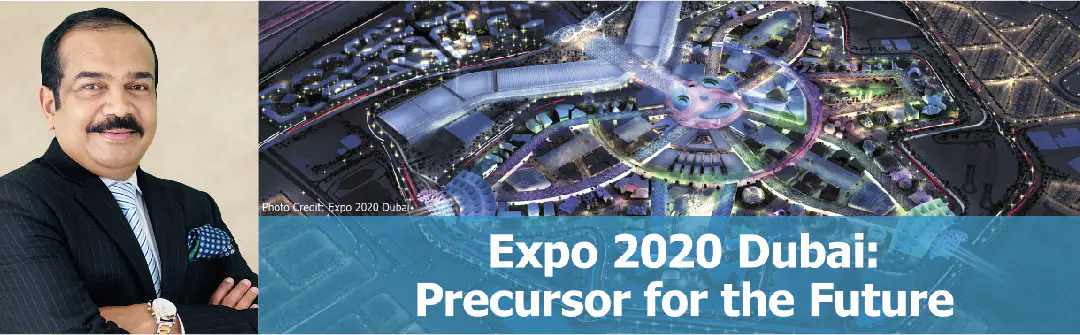 Sudhir Kumar
, Senior Partner & Head of Corporate Communications - Kreston Menon and Director - Kreston Global Board
Sudhir Kumar
, Senior Partner & Head of Corporate Communications - Kreston Menon and Director - Kreston Global Board
World’s Mega Event
The UAE has taken the global center stage with the opening of Expo 2020 Dubai which is termed rightly as the extravaganza of business, technology, connectivity, and culture. One may wonder on the long term objectivity of this mega event, but the policymakers of the UAE are confident about the long term economic legacy the Expo is bound to create.
With 191 country pavilions and themed exhibitions at the Opportunity, Mobility and Sustainability pavilions, the eagerly awaited Expo 2020 Dubai is expected to draw in more than 25 million visitors.
Many countries and large companies are looking to the expo, which is the first major global event open to visitors since the pandemic, to spur economic activity and boost investor confidence.
Expo 2020 Dubai will showcase the latest and boldest innovations across the globe and will be a platform to present solutions to the future for the world in quest for remedies.
UAE – Today and Future
UAE’s approach to future and progress are reflected in the words of His Highness Sheikh Mohammed Bin Rashid Al Maktoum, Prime Minister of the UAE and Ruler of Dubai, “The future belongs to those who can imagine it, design it, and execute it. It isn’t something you await, but rather create.”
The UAE has set its target high to be the numero uno in all the competitive indexes by the centennial anniversary of the Union in 2071. The aspiring national strategy “Towards the next 50” aims to represent the UAE’s next 50 years, building on the foundation of the progress made in the past 50 years.
The roadmap chartered by the UAE for the future includes visionary initiatives like the UAE Centennial Plan 2071, Food Security Strategy 2051, Dubai Clean Energy Strategy, Fujairah 2040 plan, National Advanced Sciences Agenda 2031, Abu Dhabi Economic Vision 2030, Environment Vision 2030, Dubai Industrial Strategy 2031, Plan Abu Dhabi 2030, Dubai 2040 Urban Master Plan, United Global Emirates and Make it in the Emirates and these programs will be guided by the recently announced ‘Principles of the 50′.
Currently, the UAE is placed very high on World Bank’s annual ease of doing business ranking and is always streamlining the processes to better the position. The UAE is the only Arab Country to be listed in the top 10 competitive countries for 4 consecutive years. Dubai has been ranked the fifth best city in the world and was hailed for its innovation, infrastructure, iconic landmarks and world class entertainment.
The credit of the UAE being ranked third among 27 emerging global economies goes to the leadership’s long term strategies on being a testbed for imagining, designing and executing future innovations.
The economic and political environments which are highly conducive for businesses to thrive make the nation a favourable destination for enterprises across the spectrum – from large multinational conglomerates, small and medium businesses to fleet-footed, innovative startups.
The decisive economic measures and new amendments to the residency and investment legislations initiated by the leadership of UAE has stimulated the flow of foreign investments into the country.
The word ‘futuristic’ has become synonymous with the UAE, as a country that not only embraces the future, but courageously create it!
Expo and the UAE Economy
The positive impact of Expo 2020 Dubai, which is arguably the world’s largest event is already visible in almost all the spheres of life, especially among businesses in the UAE. The local businesses are showing immense confidence and strong optimism and the immediate results are seen in key sectors such as travel and tourism and hospitality, with the influx of foreign visitors arriving for the mega event.
The global investment forums, investor pitching conferences and the networking opportunities at the Expo 2020 Dubai is set to create lot of investment interests from across the globe. Even if 0.5% of the visitors decide to invest in businesses in the UAE, we are talking about 125,000 new set ups!
The International Monetary Fund (IMF) has forecasted an economic growth of 3.1% this year for the country, which is higher than the Central Bank’s estimate which projected that the UAE economy will expand 2.1% this year.
The second-biggest Arab economy is expected to reap benefits of the Expo for the next nine years as the Expo legacy is going to drive more international investments. Expo 2020 is expected to give a significant boost of USD33 billion to the UAE economy and is estimated to add more than 900,000 jobs between 2013 (Expo awarded year) and 2031.
UAE’s banking assets are expected to grow by 10% next year, as the Expo has given a much needed impetus to the UAE economy, while other economies are still trying hard to recover from the pandemic-driven slowdown.
A diversified portfolio of public-private partnership (PPP) projects worth more than 25 billion Dirhams was recently announced by Dubai on the sidelines of Expo, which includes projects in the urban development, road and transport as well as health and safety sectors. It is noteworthy that the total value of Dubai’s existing and announced PPP projects now exceeds 65 billion Dirhams. In addition to the fiscal benefits, PPP is a way forward in involving private capital for economic diversification, attracting FDI and promoting local businesses and start-ups, thus help Dubai in creating a sustainable economic growth model.

As the stage is set with the 100% foreign ownership legislation, the visa reforms, ease of arbitration and excellent infrastructure, Dubai is set to see a transformation of industries from fintech to food production. Foreign investments are expected in key sectors particularly those associated with the knowledge economy and advanced technologies which includes Artificial Intelligence, the Internet of Things, Blockchain, innovative medical technologies, high-speed transportation, augmented virtual reality, self-driving cars and renewable energy.
The Expo 2020 will definitely attract more investment and talent to Dubai and the UAE, as this mega show will be showcasing the exciting opportunities not only for entrepreneurs and businesses but also for creative and innovative individuals.
His Excellency Omar Ahmed
, Suwaina Al Suwaidi
When His Highness Sheikh Mohammed bin Rashid Al Maktoum, Vice President and Prime Minister of the UAE and Ruler of Dubai, launched the UAE’s National Strategy for Industry and Advanced Technology earlier this year, he ushered in a new era.
Known as Operation 300bn, the strategy provides a clear roadmap for the UAE to become a world-leading industrial hub within the next decade. With its focus on developing our capabilities in industries of the future like space, green hydrogen and biotechnology, the announcement instantly attracted widespread attention from a swathe of international investors, policymakers and commentators. The consensus that emerged was that this latest – in a long line – of bold moves from the UAE’s leadership, marked a quantum leap for the nation’s industrial sector.
At its heart, the strategy aims to increase the industrial sector’s GDP contribution to AED300 billion by 2031 by accelerating the adoption of advanced technology across the value chain. This, we firmly believe, will boost productivity, generate added in-country value, create a raft of new, highly skilled jobs for the nation’s emerging talents, further diversify our economy and enhance global competitiveness.
In short, we are setting out to transform the industrial sector into a key driver of sustainable growth – and a pillar of the national economy. We will turbocharge existing industries where we have an established presence, and we will venture to new frontiers by leveraging advanced technologies and Fourth Industrial Revolution (4IR) solutions and applications. We will research what the future could look like, and we will develop the technologies to take us there.
Under the new strategy, innovation will not be a mere buzzword. It will be our de facto approach to industry as we cultivate a culture of ingenuity and entrepreneurship, and encourage everyone, from around the world, to come and make it in The Emirates.
Solid grounds
Though it sets a new tone for the UAE, this strategy was not developed out of the blue. Boasting the strongest credit ratings in the region, the UAE has long enjoyed investment safe haven status, with enviable economic stability and a promising growth landscape; bolstered by its strategic location, robust financial reserves, huge sovereign wealth funds, and sustainable government spending that ensures a healthy economic cycle.
Energy resources and raw materials required for industrial use are also available at competitive costs. Furthermore, UAE-based manufacturers can take advantage of laws that guarantee full ownership rights for foreigners in 122 economic activities across 13 sectors – soon to be expanded to cover the majority of industrial sectors – which will come into full effect as of 1 June 2021. Combine this with zero percent corporation tax and a wealth of accessible geographic locations and specific business zones ready to boost further industrial development, and it is easy to see why so many global, regional and local manufacturers were already developing their businesses in the UAE. Simply put, the UAE is an ideal strategic market for the world’s most innovative companies, reached new levels of high-tech excellence worldwide.
An appealing business landscape
As part of our journey towards enhanced economic diversification, the UAE has long sought to develop policies, procedures and practices that foster the growth of both the national economy and the private sector.
Our efforts here speak for themselves. The UAE is consistently ranked among the top countries around the world in key economic competitiveness and ease of doing business indices. This is largely as a result of the many incentives, legal and logistical facilities, and collaborative regulatory environment we have introduced for businesses over the years. The results speak for themselves; we are proud to support a stable private sector with an ambitious growth agenda.
The UAE has a transport and logistics ecosystem that’s considered the most efficient and comprehensive in the region, and one of the easiest to reach from anywhere in the world, via 10 airports and 12 seaports. With a handling capability of more than 17 million tons annually and a cargo capacity of 80 million tons, the UAE sits at the intersection of Asia, Europe and Africa, giving its manufacturers easy access to markets where more than five billion people live.
Enabling Operation 300bn
The Ministry of Industry and Advanced Technology will be the enabler of Operation 300bn. We will be responsible for developing legislative and regulatory frameworks, providing energy at competitive prices, and developing an advanced technology roadmap, a framework for research and development (R&D), and launching the National In-Country Value (ICV) program.
The ICV program is a core component of the UAE’s industrial transformation. It aims to redirect expenditure on procuring goods and services into the national economy. In parallel, the metrology standards developed by Ministry will ensure local industrial infrastructure meets international standards and enable the ICV Program to enhance the competitiveness of local products and services and boost collaboration between the public and private sectors.
To achieve these targets, industry players should prepare to work with the Ministry on the adoption of new and updated industrial laws, the roll-out of digital platforms for services and licensing, the promotion of locally produced goods and the enablement of an R&D ecosystem.
Priority sectors
The strategy leaves no single industry behind but has established a framework through which the current industrial landscape can continue to thrive. Industries with existing national significance, such as energy, petrochemicals, plastics, heavy industries and manufacturing; strategic industries that aim to enhance economic resilience and reduce dependence on global supply chains, such as food, water, agriculture and healthcare; and future industries, such as space, biotechnology, medical technology, sustainable products and sectors that can be supported by 4IR applications.
Enabling these sectors and facilitating the entry of innovators and investors are some of the key pillars of the strategy. Furthermore, the role of the Emirates Development Bank (EDB) as the financial engine of the strategy is crucial. By 2025, the bank will expand its financing portfolio to AED30 billion to support entrepreneurs, startups, SMEs and large corporates, who will help spur the nation’s transition to a knowledge-based economy.
Make it in The Emirates: Gateway to the Future
The strategy is complemented by the first-of-its-kind industrial campaign, ‘Make it in The Emirates’. It’s an open invitation to investors, industrialists and innovators to participate in the growth of the industrial sector in the UAE. The UAE has always been a land of opportunity for those with the talent and imagination to realize their dreams. Our investment environment and openness to global markets and competitive advantages ensure a capital-rich landscape for the industry-minded creator. Consider this your invitation to come and make it in The Emirates. It’s your opportunity to engage with the ministry and to invest in a forward-thinking, industrious, global future.
Sameer M Nawani
, Chief Representative of Dubai Chamber International Office - India
India and Dubai share historic and strong trade and cultural ties. The non-oil trade between India and Dubai has consistently increased over years from $26 billion in 2017 to $36 billion in 2019, making India the second largest trading partner for Dubai. Indians are the largest investors in Dubai’s real estate sector and make up the largest segment of tourists visiting the emirate. The city also is home to over a million Indian nationals, who account for over 30% of the population of the Emirate.
Since 2015, India and the UAE have exchanged several high-level visits, which strengthened the relationship and led to the signing of the Comprehensive Strategic Partnership, an agreement that aims to expand economic cooperation and boost bilateral trade and investment. Given the role Chambers play in mobilizing businesses and promoting trade and investments, India’s Prime Minister Narendra Modi during his visit to Dubai in February 2018, welcomed the idea of Confederation of Indian Industries (CII) opening an office in Dubai and Dubai Chamber of Commerce & Industry opening an office in India. Dubai Chamber opened its first representative office in Mumbai, India, in June 2018. The main objective of the office in India is to identify bilateral business opportunities that businesses in India and Dubai can capitalize on and benefit from.
The year 2020 has not been an easy one. It has put the healthcare systems of global economies through tremendous strain, disrupted supply chains and brought businesses to a standstill. In such times where the world is pressing a reset, the continued exchange between India and UAE is ensuring a smoother turnaround in economic activities. Both governments have been agile in taking the right measures while enhancing ease of doing business. Businesses on both sides are being extremely pro-active in exploring diversification, finding growth opportunities globally, implementing technology and strengthening their supply chain. We have seen growing interest in a number of high-potential sectors, and you can read on to learn more about these opportunities.
Food security and trade
Ensuring food security is high on the agenda for UAE and the pandemic has underlined its importance. India is first globally in milk production, livestock population and millet production and ranks second in fish, rice, wheat, cereals, fruits & vegetables, and total food production. India has the potential to double its food exports from $30 billion in 2019 to $60 billion in 2022. Lack of storage facility and transportation infrastructure results in 30% food losses in India. The India-UAE Food Corridor project is expected to fill this gap, with an investment of $7 billion from the UAE to develop dedicated logistics infrastructure connecting farm to ports in India. This project has the potential to increase the food trade between India and the UAE from $2.2 billion to $7 billion in next five years.
Dubai has developed specialized infrastructure to facilitate global trade of select products. Jebel Ali Freezone (JAFZA) in Dubai, is home to the world’s largest port-based sugar refinery which has a production capacity of 2 million MT and contributes to 3% of the refined sugar production of the world. JAFZA also has a rice hub which handles the storage, processing, and packaging of rice. Around 66% of the rice imported into Dubai comes from India. There are dedicated storage facilities for grains, pulses and other food products at JAFZA.
Dubai Multi Commodity Centre (DMCC), the free zone focused on commodities trade is home to the Tea Centre and Coffee Centre. The Tea Centre is a purpose-built facility dedicated to storing, blending, and packaging of tea. The centre has 5000 MT of storage capacity. The Coffee Centre is a 15000 square metre state-of-art temperature-controlled facility which can be used to store, clean, roast, package and distribute coffee. It also has a coffee quality centre laboratory, cupping lab, and training campus. DMCC in 2020, introduced an agri trade platform called Agriota, which facilitates trade between Indian farmers and international traders.
In 2021, Dubai Chamber is pushing ahead with new initiatives to facilitate collaboration between businesses to connect the infrastructure of Dubai and the production capacity of India.
Retail Opportunities
Retail in India is highly fragmented but transforming at a tremendous pace. It is expected to become a $1.75 trillion market by 2026. India has the second largest population in the world. With a growing middle-class and increasing urbanization, the household incomes are rising, resulting in increased consumer spending. Driven by these developments, India has seen numerous homegrown brands in retail like Lenskart, Nykaa, Forest Essentials, Belgian Waffles, etc. grow at an enormous speed. The young new India is ambitious and aspirational, making it an ideal destination for International brands and retailers, opening doors for retail businesses from Dubai.
Having one of the busiest airports and being one of the world’s most sought-after tourist destinations, Dubai is a great place for retailers and brands to have high international visibility. Dubai ranks number one globally in international brand penetration. Dubai has been among the most popular destination for Indian businesses since a few decades. It endures as an ideal destination for new and fast-growing Indian brands and retailers to learn the lessons of international operations in a dynamic market which echoes global trends, and yet provides a familiar environment close to home.
Technology and scale-ups
India is the third largest start-up ecosystem in the world whereas Dubai is the preferred hub for start-ups in MENA region. Strong regulations, access to funding, sizeable market, thriving start-up ecosystem and access to talent makes Dubai a lucrative destination for start-ups. Numerous Indian start-ups providing tech solutions have seen their solutions being widely accepted by businesses in Dubai, which has given them a strong footing in MENA region as well as helped expand their operations back home.
The pandemic has accelerated the adoption of digital solutions in banking and healthcare. Telemedicine services saw a spike in demand and hospitals rapidly moved to implementing solutions for contactless delivery of services. Digital transformation in banking is a key enabler in boosting business. The ability to be able to pay anyone, anywhere at the click of a button has been a game changer and has seen new business models evolve across sectors. The payments and the venture capital regulations introduced by the Dubai International Financial Centre (DIFC) in 2020 are changing the financial services and funding ecosystem. The DIFC’s Innovation License Program helps innovative tech companies work in a regulated environment and helps DIFC build supportive systems and regulations.
The Dubai Chamber International Office in India along with Dubai Startup Hub, StartupIndia and Mumbai FinTech Hub organized the Dubai Tech Tour, a virtual delegation in 2020, which was joined by promising fintech and health-tech scale-ups. The scale-ups Advarisk, AIkenist, Anatomiz3D, BestDoc, Cube, ePayLater, Karza Technologies, Lucine Rich Bio, Metanoa, Seragen, Supermoney, Turtlemint, Value3 and vPhrase were shortlisted through a rigorous screening process and introduced to key businesses & investors in Dubai. Some of these scaleups are in advanced stages of negotiating their first commercial deals or currently in the process of setting-up in Dubai.
Riding on this success, in 2021, the India Office of Dubai Chamber will focus on RetailTech and introduce tech solutions from India that address the changing needs of retail and e-commerce.
Dubai Chamber currently has a network of 11 International Offices in Latin America, Africa, and Eurasia, dedicated to exploring promising markets and facilitating trade and investments between these regions and Dubai.
 Kreston Menon
About DSP
Founded in 2005, Dubai Science Park (DSP) is a vibrant, holistic, science-focused community, dedicated to supporting entrepreneurs, SMEs and MNEs. Since its inception, the community has grown to more than 350 companies, employing over 3,600 professionals in the sciences, energy and environmental sectors. Designed specifically for the needs of businesses and professionals who work in sciences, DSP fosters an ecosystem that supports scientific research, creativity and innovation. It strives to be Dubai’s most innovative and vibrant community for all segments of the science sector and a place where corporates and residents can work, live and flourish.
Its collaborative environment engages leaders in science, research, academia, and business to understand and set industry trends which tackle relevant and current societal and economic issues. With a prime location in Dubai, the science park provides businesses with easy access to key transportation networks.
Supporting local growth
Dubai Science Park aims to play a significant role in Dubai’s Vision 2021 by facilitating a more sustainable and self-sufficient future that maximises the use of local resources and talent. DSP will achieve this by supporting innovation in the sciences by helping companies utilise cutting-edge technology and information to foster growth and change in the areas of human science, plant science, material science, environmental science and energy science.
In 2018, DSP made significant progress towards delivering its mission, which seeks to grow the local science sector by enhancing the ease of doing business within its community. DSP welcomed new business partners, with key inaugurations including BASF, a German construction chemicals firm and the largest chemical producer in the world; Biocad, a leading Russian biotechnology company; and inui Health, an American digital tech company based in Silicon Valley. Most recently, Pharmax Pharmaceuticals, a GMP-licensed international manufacturer and distributor of medications, became the first pharmaceutical manufacturing company to join DSP’s growing community.
DSP nurtures entrepreneurs in the science fields through a fast and easy setup model that allows them to kick-start their projects and innovate. It also helps bridge the gap between academia and businesses, supporting career development within the field of science for students in the UAE. DSP raises awareness about the science industry within the society to increase its appeal and attractiveness among youth and talent.
Enhancing the ease of doing business
DSP is the region’s first science focused community that caters to the pharmaceuticals, food and agriculture, diagnostics and analysis, as well as energy and environment sectors (among others). It is evolving as a hub for companies in the field of human science, plant science, material science, environmental science and energy science.
With nearly 90 per cent of pharmaceuticals in the UAE being imported, Dubai Science Park’s 360-degree approach to enhancing the ease of doing business aims to both attract key organisations from abroad looking to access business opportunities across the region as well as foster local enterprise growth. Ultimately, by developing the local market, DSP looks to create an environment that enables the emirate to reduce its dependency on imports.
The science park is designed specifically for the needs of businesses and professionals in the science sector. Its robust infrastructure combines office space, laboratories and warehousing facilities for businesses to flourish and features a state-of-the-art, plug and play, Laboratory Complex, that meets the highest international environmental standards.
DSP also hosts strategic networking events where business partners and stakeholders were given the unique opportunity to meet with experts and analysts from across the science sectors. This facilitates synergies within the community through connecting businesses operating in the science sector.
Positioning Dubai as a Hub
DSP is strengthening the position of Dubai as a destination for science companies, R&D, manufacturing and prototyping activities in a conducive environment that facilitates business growth.
DSP plays an integral role in actualising Dubai Industrial Strategy 2030 and developing the UAE’s innovation-led economy through the development of a thriving business hub in which scientific companies can innovate, thrive and grow.
 Jenny Reed
, Director of Quality and Professional Standards - Kreston Global
Jenny Reed
, Director of Quality and Professional Standards - Kreston Global
The degree to which environmental, social, and governance (ESG) reporting is being talked about depends very much on where you are in the world. The United Arab Emirates (UAE) has been somewhat of a trailblazer within the Middle East region when it comes to ESG:
• The UAE’s Securities and Commodities Authority issued guidance back in 2020 which mandated listed companies on the Abu Dhabi Securities Exchange (ADX) or Dubai Financial Market (DFM) to disclose ESG information in their annual report.
• In January, President His Highness Sheikh Mohamed bin Zayed Al Nahyan declared 2023 to be the “Year of Sustainability”.
• COP28 will be held in Dubai towards the end of this year, only the second time that the conference has been held in the Middle East.
• The UAE is the first Middle East and North Africa (MENA) nation to declare a strategic initiative to reach Net Zero by 2050.
ESG reporting is a challenge both for companies and firms of accountants. The increase in the volume of information that must be captured and reported on and, in due course, assured, is vast, and differs significantly from company to company depending on their industry sector and how they operate.
This can be even more difficult for smaller companies, many of which will get caught by ESG disclosure requirements despite them not being directly applicable to such companies yet in most jurisdictions. This is due to the concept of supply chain disclosures e.g. Scope 3 emissions for greenhouse gases, where a company has to disclose the CO2 emissions that it is indirectly responsible for up and down its value chain. Smaller companies will soon find themselves being asked for ESG data by their listed company customers, and most are simply not yet geared up to measure, capture, and analyze all the data that will be requested.
A further challenge is the lack of global standards for ESG reporting, resulting in a fragmented approach across the world (often known as the “alphabet soup”) which makes the situation even more difficult for companies within global operations and supply chains. However, this is now starting to change.
The formation of the International Sustainability Standards Board (ISSB) was announced at COP26 in Glasgow just two years ago. In that short time, a new international standard setting body has been set up to develop global sustainability disclosure standards that are backed by the G7, the G20, the International Organization of Securities Commissions (IOSCO), the Financial Stability Board, and numerous countries’ finance ministers and central banks.
Its work culminated in the release of the ISSB’s inaugural two sustainability standards on 26 June 2023:
IFRS S1 General Requirements for Disclosure of Sustainability-related Financial Information
The objective of S1 is to require an entity to disclose information about its sustainability-related risks and opportunities that is useful to users of general purpose financial reports.
IFRS S2 Climate-related Disclosures
S2 is focused on climate-related risks and opportunities.
We now have the first standards that will provide a global baseline for sustainability-related disclosures. These have been designed to work alongside financial reporting standards to enable seamless financial and sustainability reporting in the same reporting package. The two standards have been built on and consolidate the Task Force on Climate-Related Financial Disclosures (TCFD) recommendations, the Sustainability Accounting Standards Board (SASB – now part of the ISSB) standards, the Climate Disclosure Standards Board (CDSB) Framework, Integrated Reporting Framework and World Economic Forum metrics to streamline sustainability disclosures.
It’s early days, but the hope is that a consensus will form, and a majority of countries will choose to adopt the new ISSB standards over the coming years. The speed at which this will happen will vary considerably though in different jurisdictions. For example:
• Progress in the USA is strongly linked to the results of the next presidential election, due to be held in 2024.
• The EU forged ahead with its own ESG reporting framework, the European Sustainability Reporting Standards (ESRS). In its recent response to the EU consultation on the ESRS, IFAC noted: “significant concerns regarding the need for interoperability that supports a global system for reporting”. The European Commission and ISSB are continuing to work together to close the gap, but in the meantime, some substantial differences between the two will cause issues for many international companies that have operations in the EU.
One of the biggest challenges of ESG and sustainability reporting is the move to what is known as an “integrated mindset”. To deliver useful information for both internal decision-making as well as for external investors and wider stakeholders, many organizations are looking to break down functional and information silos, with a view to taking a holistic approach to both financial and sustainability information from within an organization and from outside.
This is something that is high on the corporate agenda at the moment, with IFAC president Kevin Dancey raising this in his presentation to the Forum of Firms in New York in June. This was also the topic of a recent conference I attended in Frankfurt, where academics, standard-setters, regulators, the accounting profession, and the business community got together to explore some of the practical challenges of taking such an approach.
The other aspect of ESG and sustainability reporting that affects the profession is the provision of assurance, and as with reporting, the situation is fragmented. The closest international standard we currently have is the ISAE 3XXX series:
• ISAE 3000 covers the provision of assurance other than audits or reviews of historical financial information, but is not specific to ESG and sustainability, and so is somewhat generic for this purpose and lacking in guidance on critical matters.
• ISAE 3410 only covers greenhouse gas emissions, and so is too narrow in scope on its own.
In the absence of anything better, most auditors have been muddling through using the above two standards. However, ESG assurance is an area where other third-party specialists outside of the accounting profession have also been providing services, using a variety of other assurance standards such as AA1000 and ISO14064. These vary considerably in terms of the amount of work to be performed and the level of assurance provided.
Fortunately, the International Auditing and Assurance Standards Board (IAASB) is coming to the rescue. It is currently working on a new sustainability assurance standard which will be known as ISSA 5000. Work has been progressing at a great pace compared to the usual time taken to draft a brand new standard, and the IAASB approved the first draft for public consultation at its recent meeting in June, with the aim of releasing the final version in September 2024.
Whilst this has been going on, the International Ethics Standards Board for Accountants (IESBA) has been running its own project, looking at ethical and independence issues affecting the provision of sustainability assurance engagements. The current plan is for a new Part 5 to the IESBA Code of Ethics which will apply to both limited and reasonable assurance engagements of sustainability information. The drafting will be such that it will be applicable to all sustainability assurance practitioners, both professional accountants and others.
ESG and sustainability reporting and assurance represent the biggest changes to the accounting and auditing professions for a generation. Within Kreston Global, our ESG Advisory Committee supports Kreston member firms in helping clients on their ESG journey. We can all play our part in moving towards a more sustainable world. His Highness couldn’t have put it better: “Today for Tomorrow”.
His Excellency Carel Richter
, Consul General of the Kingdom of the Netherlands for Dubai & Commissioner General of the Netherlands
This year, 2022, marks fifty years of bilateral relations between the United Arab Emirates and the Kingdom of the Netherlands. Our ties are warm and friendly, and we are full of anticipation for the next fifty years. With our successful Expo 2020 Dubai participation still fresh in mind, we have a lot to look forward to.
Food Security
As I am writing this article, H.E. Minister Mariam Almheiri is heading a trade delegation to the Netherlands, focused on food security and horticulture. More than 30 representatives from the Emirati horticultural sector joined her to visit GreenTech – a leading 3-day horticultural technology exhibition in Amsterdam – and the Floriade Expo 2022. On the first day of her visit, Minister Almheiri addressed the pressing topic of food security in her keynote opening speech at GreenTech: “Just as the Netherlands have looked at innovation and technology, we are doing the same — to really look into what kind of foods make sense to grow in the UAE, harnessing the power of technology.”
The Netherlands is the second largest exporter of agricultural produce in the world, while also one of the most densely populated countries. By co-creating technologies with partners from the private sector and knowledge institutions, we work to find solutions to global challenges, using expertise from areas such as artificial intelligence and robotics. Optimizing local production with a minimal usage of scarce resources, is key in what the Netherlands stands for.
Being a partner for other countries in increasing food security, be it through knowledge or technology transfer, is very important for the Netherlands. Logistical costs make global supply less economically feasible. The pandemic has shown us how fragile supply chains can be. The war in Ukraine not only impacts the people of Ukraine. In our region, food prices are increasing and foreign powers knock on the door to secure energy supply.
Floriade Expo 2022
The city of Almere in the Netherlands is the stage for the seventh edition of the international horticulture exhibition – Floriade Expo 2022. Floriade is organized only once every ten years and the main theme of this edition is ‘Growing Green Cities’. This outdoor Expo lasts six months and is open till October 9th, 2022.
The UAE is a prominent participant, with a stunning 3D printed pavilion, with the theme ‘Salt Water Cities: Where land meets the sea’. The pavilion exhibits how the UAE has been resilient and was able to overcome the challenging environment of desert and sea to grow into sustainable and thriving communities. Featuring interactive sculptures and immersive installations, the UAE pavilion is a living lab encouraging visitors to learn about the abundance of salt-loving plants that thrive in the country’s challenging arid climate.
Uniting Water, Energy and Food
The UAE and the Netherlands share many commonalities, including the importance of innovation and “making the best of what we have”. The UAE has done an outstanding job in the execution of the mega project Expo 2020 Dubai, especially given the challenges the pandemic posed. It was an honor to be part of this world exhibition, where the whole world was represented, highlighting the aspirations of humankind. Our participation in Expo 2020 Dubai is exemplary of the Dutch approach when it comes to innovation. With the multi-year, regional strategy themed “Uniting Water, Energy and Food”, architect V8 led a consortium that put together a fully circular biotope in the Dubai desert. The “SunGlacier” machine on the roof of the pavilion captured 1,200 liters of water per day from the air.
This water was used for three purposes: cooling the pavilion, as drinking water, and for watering the edible herbs and leafy greens that grew on the central cone in the pavilion. On the inside of the cone, we grew delicious oyster mushrooms. The water harvesting machine was powered by beautiful organic solar cells, built into the skylights of the pavilion. All the construction materials for the pavilion were sourced locally. We are deconstructing the pavilion and repurposing all the materials, preferably in the form they were originally intended for. The characteristic sheet piles, for instance, will be used in other construction projects up to ten times!
As a result of all the innovation and hard work done in the Netherlands pavilion, we can proudly share with you that we have received over 10 awards including the “Best Sustainability innovation” and “Best Architecture & Landscape”.
Continued Focus
In our journey to unite Water, Energy and Food, Expo 2020 Dubai was instrumental. We have had the honor to host many VVIPS, delegations and over 950,000 visitors. Our national day was an absolute highlight, with the visit of our royal couple, as well as a trade mission headed by our minister for Foreign Trade and Development Cooperation. The MoU for the Joint Economic Committee was signed during this visit, with the aim to intensify bilateral trade. We have hosted 125+ events at our Expo pavilion, all with a focus to further develop the ties between the UAE and the Gulf region and the Netherlands.
With the progressive measures the UAE takes to be an even more business friendly destination, we see increased interest in the UAE by our Dutch clients, the Netherlands’ businesses. Building on the facilities freezones have to offer, the initiatives taken facilitate FDI and 100% foreign ownership, and the excellent positioning as a hub, we see a steady increase in business set-up and expansion. The UAE is an important trading partner for the Netherlands, ranking 3rd in the EU as trade partner and being one of the top priority countries in our foreign economic policy. Moreover, the Gulf region is a priority region for the Netherlands, providing the proverbial magnifying glass for all opportunities that arise here.
Momentum
Building on the strategy of Uniting Water, Energy and Food, where Expo 2020 Dubai has proven to be an accelerator for our bilateral interests, we’re now in the midst of celebrating our 50 years of bilateral relations with the UAE. This momentum is worth treasuring, especially with more relevant events coming up. With anticipation we’re looking out to the next big climate conference COP28. This theme is at the core of what drives us; jointly developing solutions for global challenges, that make a difference for the generation of today as well as for those to come.
Sudhir Kumar
, Senior Partner & Head of Corporate Communications - Kreston Menon and Director - Kreston Global Board
World’s Mega Event
The UAE has taken the global center stage with the opening of Expo 2020 Dubai which is termed rightly as the extravaganza of business, technology, connectivity, and culture. One may wonder on the long term objectivity of this mega event, but the policymakers of the UAE are confident about the long term economic legacy the Expo is bound to create.
With 191 country pavilions and themed exhibitions at the Opportunity, Mobility and Sustainability pavilions, the eagerly awaited Expo 2020 Dubai is expected to draw in more than 25 million visitors.
Many countries and large companies are looking to the expo, which is the first major global event open to visitors since the pandemic, to spur economic activity and boost investor confidence.
Expo 2020 Dubai will showcase the latest and boldest innovations across the globe and will be a platform to present solutions to the future for the world in quest for remedies.
UAE – Today and Future
UAE’s approach to future and progress are reflected in the words of His Highness Sheikh Mohammed Bin Rashid Al Maktoum, Prime Minister of the UAE and Ruler of Dubai, “The future belongs to those who can imagine it, design it, and execute it. It isn’t something you await, but rather create.”
The UAE has set its target high to be the numero uno in all the competitive indexes by the centennial anniversary of the Union in 2071. The aspiring national strategy “Towards the next 50” aims to represent the UAE’s next 50 years, building on the foundation of the progress made in the past 50 years.
The roadmap chartered by the UAE for the future includes visionary initiatives like the UAE Centennial Plan 2071, Food Security Strategy 2051, Dubai Clean Energy Strategy, Fujairah 2040 plan, National Advanced Sciences Agenda 2031, Abu Dhabi Economic Vision 2030, Environment Vision 2030, Dubai Industrial Strategy 2031, Plan Abu Dhabi 2030, Dubai 2040 Urban Master Plan, United Global Emirates and Make it in the Emirates and these programs will be guided by the recently announced ‘Principles of the 50′.
Currently, the UAE is placed very high on World Bank’s annual ease of doing business ranking and is always streamlining the processes to better the position. The UAE is the only Arab Country to be listed in the top 10 competitive countries for 4 consecutive years. Dubai has been ranked the fifth best city in the world and was hailed for its innovation, infrastructure, iconic landmarks and world class entertainment.
The credit of the UAE being ranked third among 27 emerging global economies goes to the leadership’s long term strategies on being a testbed for imagining, designing and executing future innovations.
The economic and political environments which are highly conducive for businesses to thrive make the nation a favourable destination for enterprises across the spectrum – from large multinational conglomerates, small and medium businesses to fleet-footed, innovative startups.
The decisive economic measures and new amendments to the residency and investment legislations initiated by the leadership of UAE has stimulated the flow of foreign investments into the country.
The word ‘futuristic’ has become synonymous with the UAE, as a country that not only embraces the future, but courageously create it!
Expo and the UAE Economy
The positive impact of Expo 2020 Dubai, which is arguably the world’s largest event is already visible in almost all the spheres of life, especially among businesses in the UAE. The local businesses are showing immense confidence and strong optimism and the immediate results are seen in key sectors such as travel and tourism and hospitality, with the influx of foreign visitors arriving for the mega event.
The global investment forums, investor pitching conferences and the networking opportunities at the Expo 2020 Dubai is set to create lot of investment interests from across the globe. Even if 0.5% of the visitors decide to invest in businesses in the UAE, we are talking about 125,000 new set ups!
The International Monetary Fund (IMF) has forecasted an economic growth of 3.1% this year for the country, which is higher than the Central Bank’s estimate which projected that the UAE economy will expand 2.1% this year.
The second-biggest Arab economy is expected to reap benefits of the Expo for the next nine years as the Expo legacy is going to drive more international investments. Expo 2020 is expected to give a significant boost of USD33 billion to the UAE economy and is estimated to add more than 900,000 jobs between 2013 (Expo awarded year) and 2031.
UAE’s banking assets are expected to grow by 10% next year, as the Expo has given a much needed impetus to the UAE economy, while other economies are still trying hard to recover from the pandemic-driven slowdown.
A diversified portfolio of public-private partnership (PPP) projects worth more than 25 billion Dirhams was recently announced by Dubai on the sidelines of Expo, which includes projects in the urban development, road and transport as well as health and safety sectors. It is noteworthy that the total value of Dubai’s existing and announced PPP projects now exceeds 65 billion Dirhams. In addition to the fiscal benefits, PPP is a way forward in involving private capital for economic diversification, attracting FDI and promoting local businesses and start-ups, thus help Dubai in creating a sustainable economic growth model.
As the stage is set with the 100% foreign ownership legislation, the visa reforms, ease of arbitration and excellent infrastructure, Dubai is set to see a transformation of industries from fintech to food production. Foreign investments are expected in key sectors particularly those associated with the knowledge economy and advanced technologies which includes Artificial Intelligence, the Internet of Things, Blockchain, innovative medical technologies, high-speed transportation, augmented virtual reality, self-driving cars and renewable energy.
The Expo 2020 will definitely attract more investment and talent to Dubai and the UAE, as this mega show will be showcasing the exciting opportunities not only for entrepreneurs and businesses but also for creative and innovative individuals.
 H.E. Simon Penney
, Her Majesty’s Trade Commissioner for the Middle East and Her Majesty’s Consul General to Dubai and the Northern Emirates
H.E. Simon Penney
, Her Majesty’s Trade Commissioner for the Middle East and Her Majesty’s Consul General to Dubai and the Northern Emirates
The UK and the UAE share a deep and enduring friendship, built on decades of economic, cultural and people to people ties. This friendship, and the history that we share, lay the foundations for our future relationship.
The UK stands shoulder to shoulder with the UAE as the nation celebrates its 50th year, and looks ahead to the next fifty years. This is why the Partnership for the Future is so important. The Partnership for the Future was announced in September by Prime Minister Boris Johnson and HH Sheikh Mohamed bin Zayed, Crown Prince of Abu Dhabi and Deputy Supreme Commander of the UAE Armed Forces during His Highness the Crown Prince’s visit to the UK.
I was honoured to have taken part in the visit which saw a wide ranging programme of engagement including a business reception at No10 Downing Street, lunch with the Prime Minister, and a number of bilateral Ministerial meetings over two days. One personal highlight for me was seeing His Highness inspecting the guard of honour on Horse Guards Parade.
A Partnership for the Future
The Partnership for the Future encompasses many areas of collaboration from trade and investment to climate change and energy transition to artificial intelligence. At its core, the Partnership addresses two central pillars of great importance to the UK and the UAE: sustainable prosperity and addressing global issues.
Within trade and investment, our countries extended the existing UAE-UK Sovereign Investment Partnership (SIP) signed in March of this year by the UK’s Office for Investment and Mubadala Investment Company. In addition to the £1bn committed when the SIP was launched in March 2021, a further £9bn investment was agreed during the Crown Prince’s visit taking the total to £10bn.
The SIP will serve as the framework of our future-focused investment relationship. Over a five-year period, the SIP will invest across four key innovation-led sectors – technology, infrastructure, healthcare & life sciences, and clean & renewable energy – that will support job creation in both countries, strengthen national research and development capabilities and originate new areas of investment collaboration. These sectors were selected because they are of strategic importance to both countries as we address the challenges of today and tomorrow. Indeed, the UAE has already committed over £1.1bn across 12 transactions and we have visibility on a further £1bn this year, taking 2021 investment to over £2bn.
The UAE will gain access to world leading R&D in the UK. It provides a channel for the UAE to invest in tomorrow’s unicorns as well as encouraging more UK firms to establish a presence in the UAE in sectors that matter to the UAE’s economic plans.
For the UK, which is the leading destination for investment in new projects in Europe (EY UK Atrractiveness Report, June 2021), the SIP will provide much needed investment to drive R&D, provide a further source of growth capital for emerging firms, and ensure UAE investment aligns with UK priorities of attracting investment to all four corners of the UK.
A major focus of the SIP is identifying opportunities that benefit the whole of the UK, particularly outside London and the South East including Scotland, Wales and Northern Ireland. Greater investment in the UK’s industries of the future will create high-value jobs, boost the economy and level up the country as we build back better and greener.
Creating trade and investment foundations for the next 50 years
As the UAE celebrates its 50th year, the exchange of knowledge, innovation and ideas resulting from the Sovereign Investment Partnership will lay the groundwork as the nation looks ahead to the next 50 years.
The UAE’s Principles of the 50 is the strategic roadmap for the next fifty years, and hold important synergies with the UK’s levelling up agenda and our strategy to Build Back Better. Part of the Principles of the 50 includes the 10×10 goal to increase the UAE’s exports to ten key global markets – including the UK – by 10% per annum for ten years, and we look forward to supporting businesses in the UAE to achieve this.
While 2020 saw a drop in global trade figures, I look forward to the resumption of strong trade between the UK and the UAE, which saw a total of £18.6bn of bilateral trade in 2019.
When you look at the UAE’s economic roadmap for the coming decades and the UK’s growth industries, there’s a clear opportunity for our nations to be deeply linked as trade, investment and innovation partners.
Innovating for a Shared Future at Expo 2020 Dubai
This is clearly in evidence when we look at the UK’s engagement in Expo 2020 Dubai. Not only did the UK openly support Dubai’s bid for Expo 2020 back in 2011, it was also host to the Great Exhibition in 1851, the very first Expo if you will.
We are extremely proud of the UK Pavilion at Expo 2020 Dubai, and I am delighted to share some highlights with Kreston Menon News.

The building itself was conceptualised by Es Devlin OBE, and inspired by one of Stephen Hawking’s final projects, ‘Breakthrough Message’, where Hawking challenged the world to design a message representing Earth, life and humanity that could potentially be understood by another civilisation with the aim of encouraging us to think together as one world. Devlin took the concept further, drawing on the UAE and the UK’s shared history of poetry. Her idea was to invite humanity to create a poem using the power of Artificial Intelligence that could be beamed to outer space from Dubai.
Innovating for a Shared Future is the UK’s theme at Expo 2020 Dubai, and Artificial Intelligence underpins the UK Pavilion’s offer. The Pavilion will display AI technology first-hand, using a bespoke algorithm to generate poetry from contributed words. Crafted and designed by thought leaders and industry experts, and trained with thousands of poems, this unique technology will demonstrate the power of UK AI innovation.
Among the most notable elements of the UK Pavilion during the six-month long Expo will be the immersive Choral Space, where visitors will be surrounded by the Soundscape: music, voices and sounds donated from around the world. Visitors can contribute a word to the poem generated by our AI algorithm, which will be on display at the UK Pavilion. The poem will be known as the Collective Message and I hope all Kreston Menon readers will contribute to it, in person or virtually.
The UK Pavilion structure is simply stunning, and a truly accurate representation of Devlin’s vision.
Breakthrough Moments
The power of innovation is the driver behind the UK Pavilion’s Breakthrough Moments – a series of eight thought-provoking questions about our future designed to spark discussion around the world’s most pressing issues. These eight questions – which include How will we Travel?, What will we Eat? and How will we Thrive? – form the foundations of our programme, which will comprise exhibitions, panel discussions, seminars, podcasts, summits and much, much more.
Speakers from the UK and across the globe have been invited to contribute to the Breakthrough Moments, which will feature leaders and experts from a wide range of industries including fashion, design, technology and sustainability, showcasing the best of UK innovation. The UK Pavilion’s contribution will be presented alongside the 191 nations participating at Expo 2020 Dubai. Find out more about the Breakthrough Moments on the UK Pavilion website.
All this and more await you at the UK Pavilion.
I hope to see you there.
Photo Credit: WAM.ae
No Items.
 gulfnews
, Gulf News
gulfnews
, Gulf News
Those with Mainland Operations Await Signal on Extent of their ‘QUALIFYING INCOME'
Businesses operating out of UAE free zones and with a considerable presence on the mainland are thinking of possible restructures to the organization to absorb the upcoming Corporate Tax.
But any such changes to the business must stay on the right side of the ‘anti-abuse rules’ that form part of the UAE CT regulations, top tax consultants add.
“Yes, restructuring existing operations (of free zone enterprises with mainland operations) needs serious consideration,” said Nimish Goel, Partner at Dubai-based WTS Dhriva Consultants. “However, any restructuring or hiving off (of mainland operations) needs to factor in operational and commercial realities.
“The general anti-abuse rules need to be suitably factored.”
The anti-abuse rules are clear enough – businesses in the UAE cannot make changes solely to gain a tax advantage and thus hope to pay less on their annual income.
Hiving off mainland operations
In their consultations ahead of registering for the UAE CT regime, free zone businesses have talked of the possibility of hiving off their mainland operations to be standalone enterprises. Especially where these businesses operate separate licenses for their free zone and mainland operations.
Free zones represent one of the more significant contributors to the UAE GDP, and the UAE CT rules gives businesses there ample flexibility.
‘Qualifying income’
Under these rules, pure-play free zone businesses/their owners are exempt from the 9 per cent tax payment commitment based on their ‘qualifying income’. And this is to be confirmed by a UAE Cabinet decision that is expected shortly. (The UAE Corporate Tax comes into effect June 1, 2023.)
Raju Menon, Chairman and Managing Partner at Dubai-based consultancy Kreston Menon, emphasizes the point about ‘qualifying income’. “The UAE federal decree stipulated that free zone ‘persons’ could benefit by incurring a 0 per cent corporate tax only on the ‘qualifying income’, which is still to be defined,” said Menon. “Based on available guidance from the UAE Ministry of Finance, the qualifying income should include offshore as well as onshore sources of income of free zone persons (but) subject to strict conditions.
“Hence, there should be detailed guidance forthcoming on this aspect.” (When the decision comes on qualifying income, tax specialists hope it will also address ‘transfer pricing’ issues, which is ‘relevant as entities restructure to have standalone operations between free zone and mainland enterprises’.)
Fairly big incentive for free zone businesses
The ‘free zone person’ incentive is a substantial tax break for eligible businesses, according to Menon. (Apart from businesses engaged in extracting natural resources, government, and government-controlled entities also enjoy exemptions under the Federal Decree Law subject to eligibility criteria and conditions.)
Relief for small businesses
In addition, the Federal Decree Law does contain relief for small businesses ‘where a resident taxable person generating revenue up to a threshold – to be decided by the UAE Minister of Finance – may elect to be regarded as not having derived any taxable income for the relevant tax period,” said Menon. “Accordingly, there will not be any tax cost for such small businesses.
“Any new substantive legislation necessitates businesses to take cognizance of its applicability and plan for efficient change management. Businesses in the UAE should consider undertaking a deep review and documentation of revenue operations, assessing the impact of corporate tax, and completing requisite changes well in time of the effective date.”
Source: “UAE’s free zone companies have lots of tax planning to do”, by Manoj Nair, Business Editor, Business Section, Gulf News newspaper, 4 April 2023 and online article here.
Swati Arora
, Partner at Kreston Menon and Hayford Integral Training Institute
TRENDS FOR TOMORROW
The Abu Dhabi Sustainability Week Future Skills 2030 Report identified the driving sources that will shape the future of jobs and skills in the world. The technological advancement is bound to open new horizons in the fields of automation, artificial intelligence and robotics, big data and data analysis, virtual reality and augmented reality. The global drive towards sustainability will create a new set of green jobs in alternative energy and waste management.
The current Fourth Industrial Revolution has forced every industry to undergo rapid changes and the existence of businesses will depend on how well they adapt to the new unique skills that do not exist today.
INVESTING IN YOUR PEOPLE
It is true that organizations are keeping pace with the market and technological advancements to capitalize on the business opportunities, but they can have a significant competitive advantage only if they have the ability to address the skill gaps and upskill their workforce.
Rapid advancements in technology have brought in the need of training existing employees on new technologies and tools, and upskilling existing workers who already know the organization, processes and clients will be much effective than bringing in new people. It is a universally proven fact that reskilling is a smaller investment than hiring and training a new worker. There will be a positive impact on the morale of the employees as they are given the opportunity to stay relevant, productive and effective in the competitive and constantly changing job market, where many industries are being disrupted by new technologies.
How to Upskill Your Workforce
Organizations should have a comprehensive upskilling strategy in order to cater to the requirements of the future. The strategy should lay down concrete plans and programs to provide the employees with the necessary knowledge and skills to adapt to changing technologies, work situations and job profiles. The various methods to Reskill and Upskill your workforce include:
Training programs: Specific training programs that focus on developing the skills and knowledge relevant to the requirements and objectives of the organization. The cost the organization incurs for in-house training programs, or the financial support provided for the employees to attend external courses will prove as the right investment decision to stay competitive.
Cross training and Job rotation: Progressive companies train and develop their team members to take up totally different roles within the organization, allowing them to develop their career by equipping them to acquire new skills and gain new experiences.
E-Learning programs: Organizations can encourage and support employees to enroll for specialized online learning programs which will help them learn new technologies and practices.
Conferences and workshops: Providing opportunities for employees to attend industry specific conferences and workshops can provide them with opportunities to learn from industry experts.
INVESTING IN YOURSELF
It is critical for any professional to learn new skills or improve existing ones to increase their knowledge, expertise and value in the job market.
Professional upskilling opportunities are available to individuals at all levels of their careers in the UAE. Universities, colleges, and vocational training centers provide formal education. These institutions offer various courses, including short-term certificates and long-term diplomas.
Besides formal education, there are many other ways to upskill individuals. Professional training companies offer professional development programs ranging from professional degree preparation to leadership and management courses to technology courses. Individuals can also upskill themselves online through a variety of platforms and resources which can be accessed from anywhere.
Professional upskilling, and thereby remaining updated, is a critical factor for anyone looking to grow their career in the UAE’s rapidly evolving job market. Remember, upskilling is an ongoing process. Make it a habit to continuously learn and develop your skills to stay competitive in your industry.
SKILLS IN DEMAND IN UAE
The UAE job market is quite diverse and very futuristic. As the economy is seeing a surge in investments in technology, infrastructure and energy, there is a huge demand for highly skilled workforce.
Digital and Technology Skills – The UAE is rapidly moving towards digitalization, which has increased the demand for professionals with digital and technology skills such as data analysis, artificial intelligence, cybersecurity, digital marketing and software development.
Healthcare – Healthcare professionals especially doctors, nurses, pharmacists and researchers in pharmaceuticals are in high demand.
Digital Marketing – No longer a novel field, it has now evolved into a must-have function for organizations and skill for marketeers. Every organization need digital marketing professionals to help them connect with the world.
Blockchain – The understanding of this technology with huge multi-function application possibilities is still in the process of being probed and discovered. It has applications in Finance, HR, Procurement, Quality management, Contract management… the list is growing!
Cryptocurrency Management – This is a rapidly evolving and growing field. With greater exposure and greater number of players, its great flexibility and security in use, cryptocurrency is poised to become an indelible part of finance function in most companies.
Metaverse – Only a few institutions have the expertise to provide training in the Metaverse. This is touted as a parallel universe in the days ahead.
Finance and Accounting – Finance and accounting professionals, particularly those with qualifications such as Chartered Accountant (CA), Certified Public Accountant (CPA) or Certified Management Accountant (CMA) are in high demand in the UAE.
Hospitality and Tourism – Job opportunities for trained hospitality professionals are plenty, as the hospitality and tourism industry is a significant contributor to the country’s economy.
Human Resources – Employers in the UAE are looking for professionals with strong people management and recruitment skills to help them attract, manage and retain talent.
Sales and Marketing – We talk about bots taking away sales and customer care jobs, but professionals with strong communication, negotiation and customer relationship management skills are still sought after.
ENGAGE A PROFESSIONAL TRAINING COMPANY
Engaging a professional training company to upskill your workforce has its own benefits. Their expertise and experience give them the edge in designing and delivering effective training programs apt for your field. Many training companies design training programs designed for the specific needs of your workforce.
Efficiency and effectiveness: Professional training companies can save your organization time and money by delivering training programs efficiently and effectively. They can ensure that the training programs align with your business objectives, are delivered on time and have a measurable impact on performance.
Such institutions having access to a range of resources, including industry-specific research, cutting-edge technologies and best trainers can help your organization stay up to date with the latest trends and advancements in your industry.
Virginia Cook
, Marketing Director - Kreston Global
What is a name?
We all have our favourite brands, don’t we? Ones that resonate with us, that speak to us and to whom we are loyal regardless of our “sensible” heads telling us that we could probably find a cheaper or better alternative elsewhere.
But why do we get so “hooked” on certain brands? Have you ever tried to analyse why something generates an “emotional” response when we are able to be very factual and pragmatic about other aspects of our lives?
I quite like this definition of a brand from Investopedia. “A brand is the collective impact or lasting impression from all that is seen, heard, or experienced by customers who encounter a company and its products and services. In creating a brand, a business is managing the effect that the product or service is having on the customer.”
In my younger days, it was always the consumer brands that shaped branding theory (although these days we have incredibly powerful business brands); then it was all about being a “bundle of wants and desires in the mind of the customer.” Either way as we know, it is so much more than the visual. What we talk about now is the “experience” that we, the consumer, have when we use the brand/s that we love.
What do we mean by experience? It is every single activity, online manifestation, printed brochure, customer interaction that had with every part of our product that will create that “lasting impression”; the “collective impact” we seek in a strong and compelling brand. It’s that “managing the effect” as the definition above articulates.
When it comes to professional services brands, what is being “used” or purchased is the deep technical, specialist, business advice that is customised to our clients’ specific problem. So, creating a differentiated brand in this case means ensuring every single point at which our customer interacts with us reinforces those special characteristics. This is really saliant when clients need advice and solutions from different parts of the network. Managing that experience for our clients across international boundaries and jurisdictions is hyper-important.
The word “Kreston” means “responsible, trustworthy” in ancient Greek, and our member firms take that very seriously. Our name is fundamental to the promise our brand offers our clients and the experience we need to give them.
Kreston: Our whole is greater than the sum of our parts
As a worldwide network of accounting and business advisory firms, Kreston advisers want to be compelling to ambitious, entrepreneurial, interesting clients who seek to expand their business operations around the world. These sorts of clients want to move fast, need on-the-ground support, and require local savvy business advisers who know how to get the job done, and the right business connections to make that happen. Independent, ambitious, and fiercely entrepreneurial, Kreston firms are ideally placed for clients like these across the world. The key is to manage that experience so that it is consistent and reliable for our clients wherever they are in the world.
Kreston has a powerful backstory that reinforces the drive and energy that exists in the network today. Formed in 1971 by 2 entrepreneurial accountants, one from our German firm, Kreston Bansbach, and one from an English firm, Finnie & Co, that is now part of BDO, these 2 accountants were early pioneers of both an international mindset and the concept of a network of firms around the world who collaborate to help clients expand overseas. Fifty years on, Kreston is an energetic community of like-minded people who love working together to help their clients succeed.
Five Steps to Building a Global Brand
We know from member surveys and feedback that building our global brand is a key priority for our membership.
As a network we have wide and varied audiences. Our people, our firm leadership, our firms’ clients, our potential clients, our potential future recruits and all the people involved in helping us deliver work and value as suppliers and referrers.
That’s a lot of people to try and influence. Which is why we are in this together and we are working on a 5-step programme to build that worldwide global brand.
- A shared vision and ambition – one brand worldwide
- A compelling proposition that unites us – a purpose that we all agree with
- A consistent experience across our people and our clients – online is now king
- A reputation and narrative that is compelling to our clients and our people
- Ambassadors and advocates who help create and spread our culture
There isn’t the space to go into the detail for all these steps now. But we already know our shared ambition is a strong worldwide brand: entrepreneurial firms united in a collegiate, collaborative, community-minded enterprise, fuelling ambition and walking shoulder-to-shoulder with our clients. Our members will hear more in October about our shared vision, ambition, and purpose at our first world conference for 3 years in the wonderful city of Madrid.
Let’s take a closer look at steps 3, 4 and 5 and how we work on these essential areas of the digital challenge, a strong narrative to clients, and engagement of our younger people involved in the network, so they feel a sense of ownership, pride, and opportunity.
Why Digital is King in the Battle for Hearts and Minds
The Covid pandemic changed our lives fundamentally. We were becoming digitally adept, used to doing research online, fact finding, comparing providers. But suddenly in early 2020, that was the only way we could work – the only way we could buy – and the only way we could find out any information. And we haven’t looked back. Statista.com’s April 2022 analysis confirms “As of April 2022, there were five billion internet users worldwide, which is 63 percent of the global population. Of this total, 4.65 billion were social media users.” We will never return to a world where we are not “digital first.”
Although accounting firms may rely heavily on personal recommendations to grow business locally, growing a business regionally and globally takes a robust digital brand. 62% of businesses make decisions about who to do business with using just digital content to make their shortlists (Forrest Group, 2021). There are almost 2 billion websites in the digital landscape. Getting people to come to our websites is important – creating campaigns and stories that are interesting to read and add value to our clients’ research is critical. We have a great bank of client case studies that demonstrate the way that Kreston firms help their clients and regularly send our international clients update on tax, audit, and other international topics of interest.
Lynsey Thornthwaite, Kreston Global Digital Brand and Content Manager, gives us a view of our digital performance so far, “The Kreston Global website is growing rapidly; we have doubled the organic traffic in six months, and we could do that again over the next six months. Watching how users on the website clearly indicates that these new users are in that research phase, top of the funnel. They are navigating through the website, checking the “Doing Business In” pages, then navigating the country firms’ pages.”
“The traffic coming from member websites to the Kreston Global website is a great example of buyer intent in that research phase. The Kreston Menon website is the number one firm website referring traffic to the Kreston Global website. This is due to a combination of offline activity; there is an incredible amount of work going in to raising the profile of the firm – and the online activity, and a simple to navigate website that signposts users through the customer journey effectively. We can see that users from Kreston Menon are finding the journey fluid and the content meets their needs. The audience locations are not just regional, but global and the percentage of those visitors who return is third highest overall, a positive indication of interest and engagement.” Kreston Menon is part of our group of firms who really understand the power of digital engagement.
Understanding the “Interpreneur”
A professional brand stands and falls on the quality of its reputation and the way it shows how it understands its core client buyer. So, we focus a lot on enhancing our reputation with media and content creation. Our global group experts in Corporate and HNWI Tax, VAT, Audit, Transfer Pricing, Global Mobility and Corporate Finance write and publish expert advice to demonstrate our collective knowledge in these areas. This helps our reputation as a strong business advisory brand.
As well as topical and expert content, we have recently commissioned research across 6 main global markets to probe the way in which business owners decide to expand their businesses globally, what challenges they see as key and what are the characteristics found in successful “interpreneurs.”
We call these types of business owners/investors and directors “Interpreneurs,” and the results were fascinating, giving us real insight into what type of geographies, age and gender profile makes a more likely interpreneur and what they want from governments and advisers to help them success.
We will be running a series of podcasts with our advisers and clients looking more closely at the steps to success and have developed a web tool so that clients and prospects can see if they share the characteristics for success.
Ambassadors and advocates
Our culture is forged and strengthened the more our members interact with each in communities of interest. By building more ambassadors for Kreston through involving our younger people more in the network, we gain so much from their input and energy. It is so important that they can see Kreston as a network of opportunity for future career development, where they can work on interesting and ambitious clients and with enthusiastic committed professionals and peers from around the globe. All of whom are important advocates for the Kreston brand.
We are fortunate to have Kreston Menon in our network as they are true exemplars of what it means to have a strong, strategic brand focus – it is not by chance that they have a recognised “Superbrand” status in the UAE. They are energetic business builders in their own country of course, but through forging strong relationships with government bodies in the region, by investing in an international strategy abroad to get the most out of the network, and by being very supportive and involved in Kreston’s community building activities, they have gained a big following and strong relationships with colleagues across the world in the Kreston network.
“You have to invest to see a return” is the mantra of many business advisers when helping their client to think long-term. This is very much our attitude at Kreston Global – when our firms invest in the network and in helping us to build our global brand – like Kreston Menon – then together we will be stronger, compelling, and connected together by our shared ambition.
 Surandar Jesrani
, CEO & Managing Partner - MMJS Consulting
Surandar Jesrani
, CEO & Managing Partner - MMJS Consulting
The Ministry of Finance (MOF) has released high level details on the proposed UAE Corporate Tax (CT) regime in the form of a press release and Frequently Asked Questions (FAQs) published on web portal of tax authorities i.e. UAE MOF and the Federal Tax Authority (FTA). This is motivated by UAE’s desire to integrate into the global business community and meeting international tax standards, while minimizing compliance burden for UAE businesses and shielding small businesses and start-ups.
His Excellency Younis Haji Al Khoori, Undersecretary of MOF, stated that “the certainty of a competitive and best in class Corporate Tax regime, together with the UAE’s extensive double tax treaty network, will cement the UAE’s position as a world-leading hub for business and investment”. The relevant legislation for the CT regime (UAE CT Law) is currently being finalized and is expected to be promulgated during 2022. Once released, the UAE CT Law will provide details and guidance on several critical aspects.
UAE businesses will be subject to UAE Corporate Tax in a staggered manner from Financial Years (FYs) beginning on or after 1 June 2023. An entity having a FY beginning on 1 July 2023 and ending on 30 June 2024 will be subject to CIT from 1 July 2023. While, entities having a FY beginning on 1 January 2023 and ending on 31 December 2023, will be subject to UAE CT from 1 January 2024.
Scope
UAE CT is a federal tax and consequently, will apply to all businesses and commercial activities in the UAE except for extraction of natural resources which will continue to be taxed at the Emirate level. Likewise, the UAE CT regime will apply to individuals to the extent that they hold (or are legally required to hold) a business license or permit to carry out commercial, industrial and/or professional activities in UAE. This includes income earned by freelance professionals for activities carried out under a freelance license or permit.
Rates and Computation
Adopting a slab rate system, the headline UAE CT rate has been fixed at 9% to be calculated on taxable income as below:

An increased UAE CT rate would be applicable for large multinationals that meet specific criteria set with reference to pillar two of the OECD BEPS 2.0. Taxable income for a tax year is to be computed based on accounting net profit/income of a business reported in financial statements prepared in accordance with internationally acceptable accounting standards, after the prescribed adjustments. With a 9% standard tax rate, UAE CT regime will remain one of the most competitive tax jurisdictions in the world.
Exemptions from UAE CT
As per the issued FAQs, certain incomes have been kept outside the ambit of the UAE CT including:
• Foreign investors will not be subject to UAE CT if income is not earned from a regular trade/business in UAE;
• UAE CT will not apply on capital gains and dividends received by a UAE business from ‘qualifying shareholdings’; and
• UAE CT will not be applicable to qualifying intragroup transactions and restructuring subject to certain conditions to be specified under the legislation.
It has also been announced that UAE CT will honour tax incentives committed to businesses located in Free Zones, to the extent that eligible entities comply with applicable regulatory requirements and do not conduct business in mainland UAE. Further, current business models for trade in goods and/or provision of services may need to be restructured once further guidance is released by MOF. Free Zone businesses will nevertheless have to comply with certain obligations under UAE CT regime, including the obligation to register and file a Corporate Tax return and claim exempt as applicable.
Other key noteworthy aspects from the announcement
The UAE CT regime will allow a business to utilize tax losses incurred (from the date UAE CT is effective) to offset taxable income in subsequent tax years. Based on current guidance, it seems that eligibility for tax losses would be applied on a prospective basis i.e. from the first tax year onwards. Further, a ‘Fiscal Unity’ concept would be implemented as part of UAE Corporate Income Tax (CIT) law i.e. eligible UAE group of companies may elect form a tax group and file a single (consolidated) tax return subject to conditions to be specified.
A tax withholding regime has not been included in proposed UAE CT law. In other words, there will be no withholding tax on domestic and cross border payments. This can be seen as a substantial relief to UAE business as introduction of a withholding tax regime increases compliance burden and other administrative complexities. Foreign Tax Credit (FTC) will be allowed against UAE CT liability. This is in line with corporate tax regimes followed by most of the countries across the globe.
UAE businesses will need to comply with international Transfer Pricing (TP) rules and documentation requirements contained in OECD TP Guidelines (as amended in 2022) for related party transactions. It would be interesting to see if domestic transfer pricing rules are introduced similar to other tax jurisdictions in the region.
Accounting considerations
As per the FAQs, accounting profits/income of a business (which is the starting point of a taxable income computation) should be as per internationally acceptable accounting standards. Hence, it will be obligatory for all businesses under UAE CT regime to maintain accounting records as per International Financial Reporting Standards or prevalent GAAP in UAE. It would be interesting to see whether UAE CT law mandate annual financial statements to be audited in the absence of a mandatory requirement under commercial law for a large section of businesses in the UAE.

Key takeaways and what business in UAE should do in the interim
The announcements and guidance released by UAE MOF has clarified key design features of UAE CT, however, several uncertainties remain awaiting clarity in UAE CT law and its implementing regulations. Whilst the announcement implicates that large multinational groups (MNEs) will be taxed at a higher rate, it remains to be seen how this will be implemented from a policy perspective (e.g., increase in tax rate or a domestic minimum tax/ parallel tax) which is yet to be announced.
Businesses operating in UAE should consider the following to get ready well in advance of the UAE CIT go-live date:
• Finance functions should begin preliminary assessment of existing business operations to identify broad areas which could pose challenges from UAE Corporate Tax perspective
• Discuss the issues identified with relevant departments and plan an approach/ methodology to be adopted for implementing UAE CT
• Identifying possibility to restructure business operations and optimize the current business structure to minimize the impact of the proposed UAE CT and envisaged TP regulations
• Perform gap analysis to identify required system changes to meet financial information requirements for UAE CT compliance.
 Pushpakaran Parambath
, Senior Partner - Kreston Menon Corporate Services
Pushpakaran Parambath
, Senior Partner - Kreston Menon Corporate Services
The United Arab Emirates government published the Federal Decree No. 32 of 2021 concerning UAE Commercial Companies Law (CCL 2021) which came into force on 2nd January 2022, on which date the Federal Decree Law No. 2 of 2015 and its amendments (CCL 2020) were repealed.
Prominent provisions and amendments to the Law:
Public Joint Stock Companies (PJSC)
(a) Allows the establishment of companies for the purposes of acquisition or merger, and SPVs, and establishes a legal framework for these new legal forms and excludes them from some provisions of the Companies Law through a decision issued by the SCA to regulate the work of these forms of companies.
(b) Abolishes the maximum and minimum percentage of the founders’ contribution to the company’s capital at the time of the public offering as well as cancels the legal limitation of the subscription period and leaving the two matters to what is specified in the prospectus.
(c) Eliminates the requirement for the nationality of the members of the board of directors and upholds the organization shareholders’ decisions in the election of board members, in accordance with the terms and conditions set by the competent authority.
(d) Allows companies to transform into a Public Joint Stock Company and sell its shares or offer new shares in a public subscription without being restricted to a certain percentage by following the price-building mechanism of the security.
(e) Allows companies to divide and create legal rules governing division operations, thus contributing to diversifying the company’s activities and fields of work and increasing its projects and growth opportunities.
(f) Allows companies to determine the face value and to determine the percentage of the offering. The CCL 2021 allows shareholders to determine the nominal value of shares as specified in accordance with the PJSC’ Articles of Association thus removing the range of AED 1 to AED 100 prescribed by the CCL 2020.
(g) Finds financing solutions for companies through the issuance of other types of shares.
(h) Allow companies to issue discounted shares in case the market value of a company’s share price falls below the nominal value subject to (a) passing a special resolution; and (b) obtaining the approval of the Securities & Commodities Authority (SCA). However, the result of issuance of shares at a discount will cause a negative reserve, which must be settled from its future profits before any profit can be distributed amongst the shareholders.
Limited Liability Companies (LLC)
(a) Expiration of the Board of Managers’ term If the term of the Board of Managers expires, and a new Board of Managers is not appointed, then the existing board will continue to manage the LLC for a period of 6 months. At the end of this term a new board must be appointed by the LLC, and if not appointed, the Department of Economic Development (DED) can appoint a board whose term will not exceed one year, during which, the LLC must appoint a new Board of Managers. Therefore, the appointment of the Board of Managers by the DED is a stopgap arrangement that will be regularised if the LLC fails to appoint the board itself.
(b) Appointment of the Supervisory Board CCL 2020 obligated LLCs to appoint a Supervisory Board when the company consists of more than 7 shareholders. CCL 2021 has increased the number of required shareholders to 15. The Supervisory Board is appointed from at least three shareholders to supervise the company’s annual reports, budgets, distribution of profits and to also supervise the LLCs’ managers and submit a report in this regard to the General Assembly.
(c) Decrease in Legal Reserve CCL 2021 has decreased the extent of allocating a legal reserve from 10% to 5%, and as prescribed by the CCL 2020, the CCL 2021 emphasized that shareholders can stop this allocation if the legal reserve reaches 50% of the share capital.
Foreign Company Branches
Allows branches of foreign companies licensed in the country to transform into a commercial company with UAE citizenship.
 H.E. Noboru Sekiguchi
, Consul-General of Japan in Dubai
H.E. Noboru Sekiguchi
, Consul-General of Japan in Dubai
In this year of 2022, Japan and the United Arab Emirates are celebrating the 50th anniversary of the diplomatic relations which was established on 4th May 1972. The two nations have been fostering strong and friendly relationships for the past 50 years.
The trade relationship between Japan and the UAE have been traditionally highlighted by the cooperation in the energy field. However, in recent years both the governments have worked together on expanding the scope of cooperation in various fields such as education, renewable energy and space explorations. Let me point out the importance of the “Comprehensive Strategic Partnership Initiative (CSPI)” between our two countries, which is designed as a new cooperation framework based on the Joint Statement issued on the occasion of the visit by the then Prime Minister, Mr. Shinzo ABE to the UAE in 2018. The CSPI framework covers 12 fields of cooperation, not only traditional fields such as energy and business but also advanced technologies and women empowerment.
The bilateral cooperation has now flourished beyond the earth to the space. The UAE became the first Arab country to reach Mars in February last year with its Mars Mission named Hope Probe, and this made the people in the UAE and Japan excited. The HOPE was launched from the Tanegashima Space Center in Japan with an H2A rocket which was made in Japan by the Mitsubishi Heavy Industries, a renowned Japanese company. This is one among many contributions by Japan to the UAE’s space explorations, and the achievement gives us literally a “hope” for the future of our bilateral cooperation.
When we turn our eyes to the Expo, we can find interesting links between the two countries. The Emirate of Abu Dhabi participated in an Expo for its first time, even before the founding of the UAE, when the City of Osaka in Japan hosted the Expo in 1970. Half a century later, the UAE hosted the Expo 2020 Dubai, the very first Expo in the MENA region which saw the largest global gathering since the start of the pandemic, came to an end on March 31, 2022. Then, the baton of the Expo-host was handed over from Dubai to Expo 2025 Osaka, Kansai.
Relations on Trade and Commerce

Let me give you an overview of the trade relations between Japan and the UAE. The total value of imports from Japan to the UAE was USD 7.1 billion and that of exports from the UAE to Japan was USD 26.2 billion in 2019, which was before the pandemic. While the total value of both imports from Japan and exports to Japan dropped to USD 5.5 billion and to USD 16.3 billion respectively in 2020, the UAE is still one of the ten biggest importing partners for Japan and maintains strong trade ties with Japan. Transportation equipments account for the majority of Japan’s exports to the UAE. For Japanese industrial products, the UAE is an important destination because it has always been a re-exporting base to the markets abroad for these products. The importance of the UAE for Japan as a close trading partner would remain unchanged in the foreseeable future.
As for business and commerce relationships between our two nations, approximately 290 Japanese companies are currently operating in Dubai and the Northern Emirates, which cover a wide range of industries including manufacturing, wholesale and retail and transportation services. Many Japanese enterprises have established their regional headquarters for business in the Middle East and Africa in Dubai, owing to business-friendly environment for foreign companies created and enhanced by the UAE over the past 30 to 40 years, which consists of the stable social and political situation, the well maintained public safety and security and excellent infrastructure such as electricity, water, telecommunications, medical care and educational system, to name a few.
Furthermore, there are many free zones with much less restrictions for foreign investors and English is widely spoken as a business language in the UAE. These are the factors that have contributed to the UAE ranking first in the MENA region and 16th in the world in the business environment ranking issued by the World Bank. However, I believe the most important reason is that Dubai has created a diverse and tolerant society where people from different cultures and backgrounds find it easy to reside. The expat business community finds it welcoming that they have access to non-halal food and alcoholic beverages at select places in the emirate.
In addition, Dubai has succeeded in mitigating socio-economic impact of the pandemic since the early 2020, by starting PCR tests widely in the emirate while strengthening its medical systems, by having resumed to accommodate travelers including tourists from abroad as early as July 2020 and by accelerating the vaccination process at the fastest pace possible. Then, the Expo 2020 Dubai opened doors to the world, adopting effective preventive measures against the COVID-19 in October 2021. The event which was forced to be postponed for a year due to the pandemic, came to the grand finale with a great success at the end of March 2022. This success proved that those preventive measures by Dubai were correct and appropriate.
The government of Dubai has been standing firm with its policy of managing society “with COVID-19” since the early stage of the pandemic. This policy has made it possible for Dubai to continue to be a valuable and attractive investment destination not only for Japan, but also for countries all over the world.
Contribution to FDI from both sides
We, Japanese, welcome the trend of revamping the regulations on foreign investments in the UAE over the past few years. The abolishment of the required majority shareholding ratio of the UAE nationals in the foreign investments with the amendment to the Commercial Companies Law in September 2020 could be a tailwind policy for Japanese corporations who generally prefer 100% capital investments. Even the Japanese companies who have established their offices in the free zones see the new policy as a positive development in the UAE as it allows them to operate their businesses not only inside but also outside of the free zones.
It is noteworthy that each emirate is very proactive in attracting start-up companies from abroad. In this context, I could mention a few examples in Dubai – the Dubai Silicon Oasis, the Dubai Start-up Hub, and the Dubai International Financial Centre. Moreover, events such as GITEX and the Sharjah Entrepreneurship Festival are being held at various locations in the UAE to bring together the latest technologies and ideas from around the globe and Japanese start-ups are also turning their attention to the UAE.
Furthermore, I would like to point out that there is a growing business relationship between Japan and the UAE, not only at the national level but also at the local level, for example between Dubai and the Osaka Prefecture or the City of Osaka, the next host city of the Expo and the sister city of Dubai. Last December, the Osaka Chamber of Commerce and Industry co-hosted an online event with the Dubai Chamber of Commerce and Industry for business exchanges including a pitch session by enterprises located in Dubai and the other Middle Eastern countries who are keen to entering the Japanese market. Also, the Osaka Prefecture hosted a symposium in February 2022 connecting Japan and Dubai to encourage Japanese corporations to expand their operations into overseas as part of the commemoration events of the 50th anniversary of the diplomatic relations between Japan and the UAE.
Future Vision
As aforementioned, this year marks the 50th anniversary of the establishment of the diplomatic relations between Japan and the UAE. I, as the Consul-General of Japan in Dubai and the Northern Emirates, would like to emphasize my efforts in the following areas to make our relationship more multilayered and multifaceted towards the 50 years to come.
First, let me take up the economic area. I would like to bring new Japanese companies, especially start-up companies to the UAE, in addition to supporting Japanese enterprises who have been already operating in the UAE. On one hand, I believe that there are many start-ups in Japan which could provide solutions to the needs of the governmental organizations as well as private companies in the UAE.
On the other hand, I strongly feel that efforts have to be taken to make Japanese start-ups aware of the attractiveness of the UAE as an operation base and the business opportunities which the UAE is offering to foreign entrepreneurs. I would, therefore, like to promote exchanges between companies including start-ups from both nations and contribute to further economic development of our countries.

Secondly, I would like to increase the number of inbound tourists from the UAE by introducing them to various charms of Japan, especially food related ones such as wide variety of culinary in Japan and high-quality Japanese ingredients. We offered Saroma Wagyu which is one of the premium beef produced in the Hokkaido prefecture, Anpogaki (persimmons) from the Fukushima prefecture, and Crown Melon from the Shizuoka prefecture, when I hosted our Emperor’s Birthday Reception on the occasion of the 62nd birthday of His Majesty the Emperor Naruhito in February. After witnessing the long queue and receiving positive feedback from the guests, I found once again the tremendous market potential our food products have.
Lastly, I would like to develop platforms for further exchanges between the youths of Japan and the UAE who will lead the next generation of our great nations. In this context, I am strongly interested in promoting exchanges in new areas such as e-sports and e-games. The UAE Olympic Committee has recently recognized e-sports as an official event, and this proves the growing popularity of e-sports in the UAE. I have high expectations for young people to play a key role for deepening mutual understanding between Japan and the UAE and for being the driving force to further enhance our existing harmonious relationship for the next 50 years.
His Excellency Omar Ahmed
, Suwaina Al Suwaidi
When His Highness Sheikh Mohammed bin Rashid Al Maktoum, Vice President and Prime Minister of the UAE and Ruler of Dubai, launched the UAE’s National Strategy for Industry and Advanced Technology earlier this year, he ushered in a new era.
Known as Operation 300bn, the strategy provides a clear roadmap for the UAE to become a world-leading industrial hub within the next decade. With its focus on developing our capabilities in industries of the future like space, green hydrogen and biotechnology, the announcement instantly attracted widespread attention from a swathe of international investors, policymakers and commentators. The consensus that emerged was that this latest – in a long line – of bold moves from the UAE’s leadership, marked a quantum leap for the nation’s industrial sector.
At its heart, the strategy aims to increase the industrial sector’s GDP contribution to AED300 billion by 2031 by accelerating the adoption of advanced technology across the value chain. This, we firmly believe, will boost productivity, generate added in-country value, create a raft of new, highly skilled jobs for the nation’s emerging talents, further diversify our economy and enhance global competitiveness.
In short, we are setting out to transform the industrial sector into a key driver of sustainable growth – and a pillar of the national economy. We will turbocharge existing industries where we have an established presence, and we will venture to new frontiers by leveraging advanced technologies and Fourth Industrial Revolution (4IR) solutions and applications. We will research what the future could look like, and we will develop the technologies to take us there.
Under the new strategy, innovation will not be a mere buzzword. It will be our de facto approach to industry as we cultivate a culture of ingenuity and entrepreneurship, and encourage everyone, from around the world, to come and make it in The Emirates.
Solid grounds
Though it sets a new tone for the UAE, this strategy was not developed out of the blue. Boasting the strongest credit ratings in the region, the UAE has long enjoyed investment safe haven status, with enviable economic stability and a promising growth landscape; bolstered by its strategic location, robust financial reserves, huge sovereign wealth funds, and sustainable government spending that ensures a healthy economic cycle.
Energy resources and raw materials required for industrial use are also available at competitive costs. Furthermore, UAE-based manufacturers can take advantage of laws that guarantee full ownership rights for foreigners in 122 economic activities across 13 sectors – soon to be expanded to cover the majority of industrial sectors – which will come into full effect as of 1 June 2021. Combine this with zero percent corporation tax and a wealth of accessible geographic locations and specific business zones ready to boost further industrial development, and it is easy to see why so many global, regional and local manufacturers were already developing their businesses in the UAE. Simply put, the UAE is an ideal strategic market for the world’s most innovative companies, reached new levels of high-tech excellence worldwide.
An appealing business landscape
As part of our journey towards enhanced economic diversification, the UAE has long sought to develop policies, procedures and practices that foster the growth of both the national economy and the private sector.
Our efforts here speak for themselves. The UAE is consistently ranked among the top countries around the world in key economic competitiveness and ease of doing business indices. This is largely as a result of the many incentives, legal and logistical facilities, and collaborative regulatory environment we have introduced for businesses over the years. The results speak for themselves; we are proud to support a stable private sector with an ambitious growth agenda.
The UAE has a transport and logistics ecosystem that’s considered the most efficient and comprehensive in the region, and one of the easiest to reach from anywhere in the world, via 10 airports and 12 seaports. With a handling capability of more than 17 million tons annually and a cargo capacity of 80 million tons, the UAE sits at the intersection of Asia, Europe and Africa, giving its manufacturers easy access to markets where more than five billion people live.
Enabling Operation 300bn
The Ministry of Industry and Advanced Technology will be the enabler of Operation 300bn. We will be responsible for developing legislative and regulatory frameworks, providing energy at competitive prices, and developing an advanced technology roadmap, a framework for research and development (R&D), and launching the National In-Country Value (ICV) program.
The ICV program is a core component of the UAE’s industrial transformation. It aims to redirect expenditure on procuring goods and services into the national economy. In parallel, the metrology standards developed by Ministry will ensure local industrial infrastructure meets international standards and enable the ICV Program to enhance the competitiveness of local products and services and boost collaboration between the public and private sectors.
To achieve these targets, industry players should prepare to work with the Ministry on the adoption of new and updated industrial laws, the roll-out of digital platforms for services and licensing, the promotion of locally produced goods and the enablement of an R&D ecosystem.
Priority sectors
The strategy leaves no single industry behind but has established a framework through which the current industrial landscape can continue to thrive. Industries with existing national significance, such as energy, petrochemicals, plastics, heavy industries and manufacturing; strategic industries that aim to enhance economic resilience and reduce dependence on global supply chains, such as food, water, agriculture and healthcare; and future industries, such as space, biotechnology, medical technology, sustainable products and sectors that can be supported by 4IR applications.
Enabling these sectors and facilitating the entry of innovators and investors are some of the key pillars of the strategy. Furthermore, the role of the Emirates Development Bank (EDB) as the financial engine of the strategy is crucial. By 2025, the bank will expand its financing portfolio to AED30 billion to support entrepreneurs, startups, SMEs and large corporates, who will help spur the nation’s transition to a knowledge-based economy.
Make it in The Emirates: Gateway to the Future
The strategy is complemented by the first-of-its-kind industrial campaign, ‘Make it in The Emirates’. It’s an open invitation to investors, industrialists and innovators to participate in the growth of the industrial sector in the UAE. The UAE has always been a land of opportunity for those with the talent and imagination to realize their dreams. Our investment environment and openness to global markets and competitive advantages ensure a capital-rich landscape for the industry-minded creator. Consider this your invitation to come and make it in The Emirates. It’s your opportunity to engage with the ministry and to invest in a forward-thinking, industrious, global future.
Sameer M Nawani
, Chief Representative of Dubai Chamber International Office - India
India and Dubai share historic and strong trade and cultural ties. The non-oil trade between India and Dubai has consistently increased over years from $26 billion in 2017 to $36 billion in 2019, making India the second largest trading partner for Dubai. Indians are the largest investors in Dubai’s real estate sector and make up the largest segment of tourists visiting the emirate. The city also is home to over a million Indian nationals, who account for over 30% of the population of the Emirate.
Since 2015, India and the UAE have exchanged several high-level visits, which strengthened the relationship and led to the signing of the Comprehensive Strategic Partnership, an agreement that aims to expand economic cooperation and boost bilateral trade and investment. Given the role Chambers play in mobilizing businesses and promoting trade and investments, India’s Prime Minister Narendra Modi during his visit to Dubai in February 2018, welcomed the idea of Confederation of Indian Industries (CII) opening an office in Dubai and Dubai Chamber of Commerce & Industry opening an office in India. Dubai Chamber opened its first representative office in Mumbai, India, in June 2018. The main objective of the office in India is to identify bilateral business opportunities that businesses in India and Dubai can capitalize on and benefit from.
The year 2020 has not been an easy one. It has put the healthcare systems of global economies through tremendous strain, disrupted supply chains and brought businesses to a standstill. In such times where the world is pressing a reset, the continued exchange between India and UAE is ensuring a smoother turnaround in economic activities. Both governments have been agile in taking the right measures while enhancing ease of doing business. Businesses on both sides are being extremely pro-active in exploring diversification, finding growth opportunities globally, implementing technology and strengthening their supply chain. We have seen growing interest in a number of high-potential sectors, and you can read on to learn more about these opportunities.
Food security and trade
Ensuring food security is high on the agenda for UAE and the pandemic has underlined its importance. India is first globally in milk production, livestock population and millet production and ranks second in fish, rice, wheat, cereals, fruits & vegetables, and total food production. India has the potential to double its food exports from $30 billion in 2019 to $60 billion in 2022. Lack of storage facility and transportation infrastructure results in 30% food losses in India. The India-UAE Food Corridor project is expected to fill this gap, with an investment of $7 billion from the UAE to develop dedicated logistics infrastructure connecting farm to ports in India. This project has the potential to increase the food trade between India and the UAE from $2.2 billion to $7 billion in next five years.
Dubai has developed specialized infrastructure to facilitate global trade of select products. Jebel Ali Freezone (JAFZA) in Dubai, is home to the world’s largest port-based sugar refinery which has a production capacity of 2 million MT and contributes to 3% of the refined sugar production of the world. JAFZA also has a rice hub which handles the storage, processing, and packaging of rice. Around 66% of the rice imported into Dubai comes from India. There are dedicated storage facilities for grains, pulses and other food products at JAFZA.
Dubai Multi Commodity Centre (DMCC), the free zone focused on commodities trade is home to the Tea Centre and Coffee Centre. The Tea Centre is a purpose-built facility dedicated to storing, blending, and packaging of tea. The centre has 5000 MT of storage capacity. The Coffee Centre is a 15000 square metre state-of-art temperature-controlled facility which can be used to store, clean, roast, package and distribute coffee. It also has a coffee quality centre laboratory, cupping lab, and training campus. DMCC in 2020, introduced an agri trade platform called Agriota, which facilitates trade between Indian farmers and international traders.
In 2021, Dubai Chamber is pushing ahead with new initiatives to facilitate collaboration between businesses to connect the infrastructure of Dubai and the production capacity of India.
Retail Opportunities
Retail in India is highly fragmented but transforming at a tremendous pace. It is expected to become a $1.75 trillion market by 2026. India has the second largest population in the world. With a growing middle-class and increasing urbanization, the household incomes are rising, resulting in increased consumer spending. Driven by these developments, India has seen numerous homegrown brands in retail like Lenskart, Nykaa, Forest Essentials, Belgian Waffles, etc. grow at an enormous speed. The young new India is ambitious and aspirational, making it an ideal destination for International brands and retailers, opening doors for retail businesses from Dubai.
Having one of the busiest airports and being one of the world’s most sought-after tourist destinations, Dubai is a great place for retailers and brands to have high international visibility. Dubai ranks number one globally in international brand penetration. Dubai has been among the most popular destination for Indian businesses since a few decades. It endures as an ideal destination for new and fast-growing Indian brands and retailers to learn the lessons of international operations in a dynamic market which echoes global trends, and yet provides a familiar environment close to home.
Technology and scale-ups
India is the third largest start-up ecosystem in the world whereas Dubai is the preferred hub for start-ups in MENA region. Strong regulations, access to funding, sizeable market, thriving start-up ecosystem and access to talent makes Dubai a lucrative destination for start-ups. Numerous Indian start-ups providing tech solutions have seen their solutions being widely accepted by businesses in Dubai, which has given them a strong footing in MENA region as well as helped expand their operations back home.
The pandemic has accelerated the adoption of digital solutions in banking and healthcare. Telemedicine services saw a spike in demand and hospitals rapidly moved to implementing solutions for contactless delivery of services. Digital transformation in banking is a key enabler in boosting business. The ability to be able to pay anyone, anywhere at the click of a button has been a game changer and has seen new business models evolve across sectors. The payments and the venture capital regulations introduced by the Dubai International Financial Centre (DIFC) in 2020 are changing the financial services and funding ecosystem. The DIFC’s Innovation License Program helps innovative tech companies work in a regulated environment and helps DIFC build supportive systems and regulations.
The Dubai Chamber International Office in India along with Dubai Startup Hub, StartupIndia and Mumbai FinTech Hub organized the Dubai Tech Tour, a virtual delegation in 2020, which was joined by promising fintech and health-tech scale-ups. The scale-ups Advarisk, AIkenist, Anatomiz3D, BestDoc, Cube, ePayLater, Karza Technologies, Lucine Rich Bio, Metanoa, Seragen, Supermoney, Turtlemint, Value3 and vPhrase were shortlisted through a rigorous screening process and introduced to key businesses & investors in Dubai. Some of these scaleups are in advanced stages of negotiating their first commercial deals or currently in the process of setting-up in Dubai.
Riding on this success, in 2021, the India Office of Dubai Chamber will focus on RetailTech and introduce tech solutions from India that address the changing needs of retail and e-commerce.
Dubai Chamber currently has a network of 11 International Offices in Latin America, Africa, and Eurasia, dedicated to exploring promising markets and facilitating trade and investments between these regions and Dubai.
Kreston Menon
About DSP
Founded in 2005, Dubai Science Park (DSP) is a vibrant, holistic, science-focused community, dedicated to supporting entrepreneurs, SMEs and MNEs. Since its inception, the community has grown to more than 350 companies, employing over 3,600 professionals in the sciences, energy and environmental sectors. Designed specifically for the needs of businesses and professionals who work in sciences, DSP fosters an ecosystem that supports scientific research, creativity and innovation. It strives to be Dubai’s most innovative and vibrant community for all segments of the science sector and a place where corporates and residents can work, live and flourish.
Its collaborative environment engages leaders in science, research, academia, and business to understand and set industry trends which tackle relevant and current societal and economic issues. With a prime location in Dubai, the science park provides businesses with easy access to key transportation networks.
Supporting local growth
Dubai Science Park aims to play a significant role in Dubai’s Vision 2021 by facilitating a more sustainable and self-sufficient future that maximises the use of local resources and talent. DSP will achieve this by supporting innovation in the sciences by helping companies utilise cutting-edge technology and information to foster growth and change in the areas of human science, plant science, material science, environmental science and energy science.
In 2018, DSP made significant progress towards delivering its mission, which seeks to grow the local science sector by enhancing the ease of doing business within its community. DSP welcomed new business partners, with key inaugurations including BASF, a German construction chemicals firm and the largest chemical producer in the world; Biocad, a leading Russian biotechnology company; and inui Health, an American digital tech company based in Silicon Valley. Most recently, Pharmax Pharmaceuticals, a GMP-licensed international manufacturer and distributor of medications, became the first pharmaceutical manufacturing company to join DSP’s growing community.
DSP nurtures entrepreneurs in the science fields through a fast and easy setup model that allows them to kick-start their projects and innovate. It also helps bridge the gap between academia and businesses, supporting career development within the field of science for students in the UAE. DSP raises awareness about the science industry within the society to increase its appeal and attractiveness among youth and talent.
Enhancing the ease of doing business
DSP is the region’s first science focused community that caters to the pharmaceuticals, food and agriculture, diagnostics and analysis, as well as energy and environment sectors (among others). It is evolving as a hub for companies in the field of human science, plant science, material science, environmental science and energy science.
With nearly 90 per cent of pharmaceuticals in the UAE being imported, Dubai Science Park’s 360-degree approach to enhancing the ease of doing business aims to both attract key organisations from abroad looking to access business opportunities across the region as well as foster local enterprise growth. Ultimately, by developing the local market, DSP looks to create an environment that enables the emirate to reduce its dependency on imports.
The science park is designed specifically for the needs of businesses and professionals in the science sector. Its robust infrastructure combines office space, laboratories and warehousing facilities for businesses to flourish and features a state-of-the-art, plug and play, Laboratory Complex, that meets the highest international environmental standards.
DSP also hosts strategic networking events where business partners and stakeholders were given the unique opportunity to meet with experts and analysts from across the science sectors. This facilitates synergies within the community through connecting businesses operating in the science sector.
Positioning Dubai as a Hub
DSP is strengthening the position of Dubai as a destination for science companies, R&D, manufacturing and prototyping activities in a conducive environment that facilitates business growth.
DSP plays an integral role in actualising Dubai Industrial Strategy 2030 and developing the UAE’s innovation-led economy through the development of a thriving business hub in which scientific companies can innovate, thrive and grow.
 gulfnews
, Gulf News
gulfnews
, Gulf News
UAE AND INDIA MARK THE FIRST YEAR UNDER THE LANDMARK AGREEMENT
A year after the UAE-India Cepa deal came into effect, the stage is set for the next big bang in trade and investment flows between the countries – a dirham-rupee payment mechanism.
When that happens, multiple categories – and businesses within them – would benefit from the closing deals in the two currencies and not have to use US dollars to make it happen. What that does is cushion trade between the countries from foreign exchange volatility brought on by the dollar’s movements.
“India is looking to ways that can speed up and smoothen out trade with its biggest economic partners,” said a senior Indian government source. “We have learnt the processes well in using the rupee in financing imports from Russia, and it’s been a major factor in limiting inflationary pressures in the economy.”
“If India and UAE sign a deal confirming rupee-dirham, it will further expand the scope of Cepa.”
Meeting CEPA targets
It was with India that the UAE entered into its first CEPA – or the Comprehensive Economic Partnership Agreement – that immediately brought down import duty across categories and opened up new investment possibilities for entities in these countries.
What UAE and India are looking for are to go in for immediate benefits from CEPA where possible and then work on those areas where they can make steady progress.
“I’m not aware of any UAE imports that are subject to 0 per cent import duty in India,” said Raju Menon, Chairman and Managing Partner at Kreston Menon, the audit consultancy.
“However, under CEPA, India has agreed to reduce or eliminate tariffs on a range of products imported from the UAE.”
“The UAE has agreed to provide tariff concessions to India on 60 per cent of items traded between the two, including on basmati rice, textiles, and pharmaceuticals.” (India last week reworked the processes involved for the country’s gold trade to source bullion from the UAE under CEPA. This could in the coming months see UAE provide up to 140 tonnes of bullion to India, and which will consolidate its status as the second biggest supplier of gold to that market after Switzerland.)
Trade is on the up
Trade gains have been there from the start of the CEPA becoming effective from May 1. Between April to November 2022, two-way movements totalled $57.8 billion from $45.3 billion a year prior to that. That’s a rise of $12.5 billion in value terms and 27.5 per cent in percentage terms.
India’s exports to the UAE went past $20 billion during this period, leveraging a 19.32 per cent increase.
“As per the CEPA agreement, there would be periodic reviews to assess progress and identify areas for further cooperation,” said Menon. “The UAE has set up a dedicated task force to ensure the smooth implementation of the agreement, while India has created a website to provide information about the CEPA and facilitate trade between the countries.”
Beyond $100b in trade
Boosting two-way trade to $100 billion is the stated aim before the end of this decade, but there is also the greater emphasis on generating more from trade in services, with a target of $15 billion.
The cable-maker Ducab Group recently opened an office in the south Indian metropolis of Bengaluru, and its CEO Mohammed Abdul Rahman Al Mutawa was there on the ground. And he’s liking what’s showing up as possibilities post-CEPA.
“India is our new home market,” said Al Mutawa. “India has always been of interest to us and CEPA made the decision of opening an office in Bengaluru easier.”
“Ducab has been supplying to the Indian market since 1988, with its first project being the Nhava Sheva Port in Mumbai. Ducab has supplied 263,000 MT of of CuEq (copper equivalent) of metals to the market through the years. This is equal to powering approximately 3 million houses.
The other big investments or commitments made by UAE businesses are by the likes of Emaar, LuLu and the Sharaf Group, while DP World is expanding the scope of its already substantial interests in that market.
But business chiefs say it is still too early to fully realise the full possibilities that come with CEPA. “The impact of such agreements can take time to be felt, as businesses need to navigate through the legal and regulatory requirements of investing in a foreign country,” said Abdul Jebbar P. B., Group Managing Director at Dubai-based Hotpack Global, currently on a major expansion in the UAE and Saudi Arabia.
India is becoming one of the most desirable markets for businesses from all over the world due to its sheer size. And the government has been prudent in encouraging investment.”
With CEPA, UAE businesses with an India focus might have that extra edge.
gulfnews
, Gulf News
Those with Mainland Operations Await Signal on Extent of their ‘QUALIFYING INCOME'
Businesses operating out of UAE free zones and with a considerable presence on the mainland are thinking of possible restructures to the organization to absorb the upcoming Corporate Tax.
But any such changes to the business must stay on the right side of the ‘anti-abuse rules’ that form part of the UAE CT regulations, top tax consultants add.
“Yes, restructuring existing operations (of free zone enterprises with mainland operations) needs serious consideration,” said Nimish Goel, Partner at Dubai-based WTS Dhriva Consultants. “However, any restructuring or hiving off (of mainland operations) needs to factor in operational and commercial realities.
“The general anti-abuse rules need to be suitably factored.”
The anti-abuse rules are clear enough – businesses in the UAE cannot make changes solely to gain a tax advantage and thus hope to pay less on their annual income.
Hiving off mainland operations
In their consultations ahead of registering for the UAE CT regime, free zone businesses have talked of the possibility of hiving off their mainland operations to be standalone enterprises. Especially where these businesses operate separate licenses for their free zone and mainland operations.
Free zones represent one of the more significant contributors to the UAE GDP, and the UAE CT rules gives businesses there ample flexibility.
‘Qualifying income’
Under these rules, pure-play free zone businesses/their owners are exempt from the 9 per cent tax payment commitment based on their ‘qualifying income’. And this is to be confirmed by a UAE Cabinet decision that is expected shortly. (The UAE Corporate Tax comes into effect June 1, 2023.)
Raju Menon, Chairman and Managing Partner at Dubai-based consultancy Kreston Menon, emphasizes the point about ‘qualifying income’. “The UAE federal decree stipulated that free zone ‘persons’ could benefit by incurring a 0 per cent corporate tax only on the ‘qualifying income’, which is still to be defined,” said Menon. “Based on available guidance from the UAE Ministry of Finance, the qualifying income should include offshore as well as onshore sources of income of free zone persons (but) subject to strict conditions.
“Hence, there should be detailed guidance forthcoming on this aspect.” (When the decision comes on qualifying income, tax specialists hope it will also address ‘transfer pricing’ issues, which is ‘relevant as entities restructure to have standalone operations between free zone and mainland enterprises’.)
Fairly big incentive for free zone businesses
The ‘free zone person’ incentive is a substantial tax break for eligible businesses, according to Menon. (Apart from businesses engaged in extracting natural resources, government, and government-controlled entities also enjoy exemptions under the Federal Decree Law subject to eligibility criteria and conditions.)
Relief for small businesses
In addition, the Federal Decree Law does contain relief for small businesses ‘where a resident taxable person generating revenue up to a threshold – to be decided by the UAE Minister of Finance – may elect to be regarded as not having derived any taxable income for the relevant tax period,” said Menon. “Accordingly, there will not be any tax cost for such small businesses.
“Any new substantive legislation necessitates businesses to take cognizance of its applicability and plan for efficient change management. Businesses in the UAE should consider undertaking a deep review and documentation of revenue operations, assessing the impact of corporate tax, and completing requisite changes well in time of the effective date.”
Source: “UAE’s free zone companies have lots of tax planning to do”, by Manoj Nair, Business Editor, Business Section, Gulf News newspaper, 4 April 2023 and online article here.
No Items.
gulfnews
, Gulf News
UAE AND INDIA MARK THE FIRST YEAR UNDER THE LANDMARK AGREEMENT
A year after the UAE-India Cepa deal came into effect, the stage is set for the next big bang in trade and investment flows between the countries – a dirham-rupee payment mechanism.
When that happens, multiple categories – and businesses within them – would benefit from the closing deals in the two currencies and not have to use US dollars to make it happen. What that does is cushion trade between the countries from foreign exchange volatility brought on by the dollar’s movements.
“India is looking to ways that can speed up and smoothen out trade with its biggest economic partners,” said a senior Indian government source. “We have learnt the processes well in using the rupee in financing imports from Russia, and it’s been a major factor in limiting inflationary pressures in the economy.”
“If India and UAE sign a deal confirming rupee-dirham, it will further expand the scope of Cepa.”
Meeting CEPA targets
It was with India that the UAE entered into its first CEPA – or the Comprehensive Economic Partnership Agreement – that immediately brought down import duty across categories and opened up new investment possibilities for entities in these countries.
What UAE and India are looking for are to go in for immediate benefits from CEPA where possible and then work on those areas where they can make steady progress.
“I’m not aware of any UAE imports that are subject to 0 per cent import duty in India,” said Raju Menon, Chairman and Managing Partner at Kreston Menon, the audit consultancy.
“However, under CEPA, India has agreed to reduce or eliminate tariffs on a range of products imported from the UAE.”
“The UAE has agreed to provide tariff concessions to India on 60 per cent of items traded between the two, including on basmati rice, textiles, and pharmaceuticals.” (India last week reworked the processes involved for the country’s gold trade to source bullion from the UAE under CEPA. This could in the coming months see UAE provide up to 140 tonnes of bullion to India, and which will consolidate its status as the second biggest supplier of gold to that market after Switzerland.)
Trade is on the up
Trade gains have been there from the start of the CEPA becoming effective from May 1. Between April to November 2022, two-way movements totalled $57.8 billion from $45.3 billion a year prior to that. That’s a rise of $12.5 billion in value terms and 27.5 per cent in percentage terms.
India’s exports to the UAE went past $20 billion during this period, leveraging a 19.32 per cent increase.
“As per the CEPA agreement, there would be periodic reviews to assess progress and identify areas for further cooperation,” said Menon. “The UAE has set up a dedicated task force to ensure the smooth implementation of the agreement, while India has created a website to provide information about the CEPA and facilitate trade between the countries.”
Beyond $100b in trade
Boosting two-way trade to $100 billion is the stated aim before the end of this decade, but there is also the greater emphasis on generating more from trade in services, with a target of $15 billion.
The cable-maker Ducab Group recently opened an office in the south Indian metropolis of Bengaluru, and its CEO Mohammed Abdul Rahman Al Mutawa was there on the ground. And he’s liking what’s showing up as possibilities post-CEPA.
“India is our new home market,” said Al Mutawa. “India has always been of interest to us and CEPA made the decision of opening an office in Bengaluru easier.”
“Ducab has been supplying to the Indian market since 1988, with its first project being the Nhava Sheva Port in Mumbai. Ducab has supplied 263,000 MT of of CuEq (copper equivalent) of metals to the market through the years. This is equal to powering approximately 3 million houses.
The other big investments or commitments made by UAE businesses are by the likes of Emaar, LuLu and the Sharaf Group, while DP World is expanding the scope of its already substantial interests in that market.
But business chiefs say it is still too early to fully realise the full possibilities that come with CEPA. “The impact of such agreements can take time to be felt, as businesses need to navigate through the legal and regulatory requirements of investing in a foreign country,” said Abdul Jebbar P. B., Group Managing Director at Dubai-based Hotpack Global, currently on a major expansion in the UAE and Saudi Arabia.
India is becoming one of the most desirable markets for businesses from all over the world due to its sheer size. And the government has been prudent in encouraging investment.”
With CEPA, UAE businesses with an India focus might have that extra edge.
 gulfnews
, Gulf News
gulfnews
, Gulf News
Raju Menon, founder, chairman, and managing partner of Kreston Menon talks to Pranitha Menon about dreaming big, his management principles, and his autobiography The View from My Perch
Rajagopalan Menon, better known as Raju Menon, was 29 years old when he boarded his first-ever flight– from Mumbai to Dubai in 1991. Armed with a degree in Chartered Accountancy and a year’s work experience, he arrived on a visit visa with hope and courage to seek a life and livelihood in the UAE. ‘I was unsure of what the future held even though I had very clear visions of what it should be. There was no apprehension, just excitement,’ says Raju, who hails from a tiny hamlet called Edavilangu in the southern Indian state of Kerala.
Over three decades in the UAE, he would go on to found and helm the Kreston Menon Group, a leading audit and business consulting firm with operations in UAE, India, Qatar, and Oman; gather a long list honours; be named one of top 100 Indian Leaders in the Arab world, and pen an autobiography that is eliciting rave reviews.
Released late last year at the Sharjah International Book Fair, The View From My Perch chronicles his story of consistency and perseverance. Neatly demarcating his life into different phases, each represents a struggle and a step towards his destination and dream.

What led him to pen this story?
‘I never thought of writing a book and I felt I was too young to be writing an autobiography,’ says Raju, with a smile. However, the seed of a book was first sown by Sudhir Kumar, his senior partner Kreston Menon. A book, Sudhir was sure, could inspire students and young entrepreneurs.
‘Whether that happens or not, the thought convinced me to give it a try,’ recalls Raju.
The pandemic acted as a catalyst. Keen to use the free time that he had productively, he decided to pen his memoir. ‘To compile my experiences, thoughts, and vision into this compendium of life, I remember spending hours and days in the office meeting room, aptly named Maydan, which became my haven for ferreting into the past to dig out nuggets buried in the deep recesses of my mind.’
Once he got going, he wanted to ensure that the book would be perfect in all senses of the term. To that end, he made a few trips to Kerala to relive and experience once again firsthand some elements that had shaped his personality, and meet a few key people who in some way had had a bearing on his life.
Insightful vignettes of all of these feature in his book giving it a deeply personal feel.
‘Like everything else I do, I just gave it my very best,’ says the man who started out life in the UAE as an audit manager in a modest firm in Dubai.
What motivated him to set up Kreston Menon, a company that has bagged the Super Brand status for nine consecutive years? I ask.
‘To excel and never to be content with the ordinary,’ says Raju, with a smile. It is a mantra that pushes him to make his choices. It is a lesson, he says, he learned the hard way.
Need to think big
Forced to pursue higher studies in a privately-owned educational institution after performing poorly in his Grade 10 board examination, Raju watched with envy his friends heading off to vibrant, exciting environs of reputed colleges.
Realizing that his lack of focus at a crucial juncture of his studies had cost him the opportunity to continue education in a well-known college, he resolved ‘never to settle for the mundane again.
‘Even today, I hold that character trait dear. Think big, do big, execute big. You can break beyond the limits by thinking big. Once you think big and set your goals high, it will widen the horizon of your life, and bring you greater opportunities and greater success,’ he asserts.
Pursuing academics with a vengeance of sorts, he cleared his Chartered Accountancy exams in the first attempt, an achievement that made his parents proud.
Encouraged, he decided to set up an entrepreneurial venture in Kozhikode, Kerala. However, it did not take off as planned.
Not one to give up, he decided to look beyond the boundaries of his state to realize his dream of making it big in life. Heading off to Mumbai, he landed a job in a multinational company and earned valuable experience.
However, Raju’s dreams were big.
‘People get comfortable in their little successes and trapped in them for eternity, unable to realize their full potential. To succeed and achieve the maximum, one has to take risks and venture out into the challenging world… outside their safe haven,’ says Raju. Practicing what he preaches, he decided to move out of his safe job and took a flight to Dubai.
Raju was aware that it is a new place where he would have to put in long and hard hours to make a mark in his field. But he was willing to do that and more.
‘Upskill yourself and stay competitive. A successful entrepreneur needs to be a constant learner,’ he advises before adding, ‘Hard work is the cardinal principle for me.’
Is it not – work smart, not hard? I ask.
Hard work is the base. It is that first step that you must take before you work smart.
It was Raju’s mother, Susheela Menon, a midwife, who had a strong influence in shaping him into who he is today. ‘She was hard-working, willing to help people at any hour of the day or night, and was empathetic.’
The first job he got was in a company named Mak&Partners, in Dubai. For close to a decade here, he worked 14 hours every day. ‘I was never a clock watcher but used the flexibility given to me by my boss, Khalid Bhai, as an opportunity to gain knowledge and experience.’
In 1995, he set up the Kreston Menon Group. From a small team of three people, the firm today has grown into an enterprise employing more than 400 Chartered Accountants, internal auditors, and accountancy professionals. Raju’s wife, Girija Menon, is a senior partner at Kreston Menon and a certified internal auditor.
Even today, he believes in working hard… and smart. ‘Now, I head an organization that is structured and runs like a well-oiled machine. All I must do is manage it well.’
Delegation, he believes, is the key to effective management. ‘I have learned that micromanagement of people and business is self-defeating. When given the freedom, people bloom,’ he points out.
Trusting, empowering, incentivizing, and giving employees the freedom to creatively develop the business in their own style could work wonders, he says.
As an entrepreneur, he stands by the management principle of the People First approach and values work-life balance for all employees. ‘If you do not empower your leaders (partners, directors, managers) and give the freedom to operate, you won’t be successful,’ he says. ‘I am supported by a great team that shares the same objectives and strives for a common goal.’
Raju believes that there are no shortcuts to success. ‘My success will definitely be counted on how effectively I am creating a unique experience for each of my clients by providing them with the right and timely business advice.’
He goes on to explain that in an ever-evolving business environment, his success also lies in how effectively he leads his team to stay relevant, updated, and ahead of the competition.
The going– and growing– however, was not easy.
A legal issue in 2011 threatened his firm’s survival but Raju fought the case and won it.
The pandemic too affected them, but that was a great teacher, says Raju. ‘The lesson that it left in its wake that had to be put into practice was to be prepared for unpredictability and rework on short-term and long-term planning and strategies.’
The first break
Over the years, Raju says that he has witnessed and experienced that getting that first break is the most difficult task. He has noticed that once a person gets the right break, they move up very fast, provided they are willing to work hard.
‘Wiser by having undergone such ordeals, I believe in giving the first break to people who are known to me or have been referred even if they may not be up to par in their qualifications but have the fire in them to do well and succeed.’
One initiative that he is extremely proud of is partnering with the Expo 2020 team, as early as 2013, to support their bid to organize the world-renowned, unique, and historic event, the Expo, in Dubai.
A firm believer of women empowerment, the father of three mentions that 45 percent of the total workforce at Kreston Menon are women.
‘Life has been very kind and generous to me. Now, in turn, I try to spread happiness in people around me,’ he says.
To give focus to their philanthropic efforts, Raju and Girija have started the CA Girija & CA Raju Menon Foundation in Kozhikode, Kerala, providing support for education, marriage, and healthcare for individuals who approach them for help.
To empower women, they conduct training courses to enhance their communication and public speaking skills, which will give them the confidence to contribute to society.
‘Both of us wholeheartedly believe that all human beings are equal and equally capable of achieving and contributing to the community, society, and humanity,’ says Raju.
Source: “Think big, do big, execute big”, AuthorSpeak Section, Friday Magazine, Gulf News, 31 March 2023 and online article here.
 HE Dinesh Kumar Patnaik
, Ambassador of India to the Kingdom of Spain
HE Dinesh Kumar Patnaik
, Ambassador of India to the Kingdom of Spain
I am delighted that Kreston Global is having their Annual conference in Spain. While the UAE-Spain trade and business corridor is quite active, I would like to talk here a bit about the India-Spain economic & commercial relationship.
India and Spain share a very close relationship, both being strong democracies and without any bilateral, geopolitical irritants. Relations between India and Spain go back to the 20th century and Christopher Colombus, who discovered America, was actually sent by the Spanish Queen to look for a route to India. In 1937, Rabindranath Tagore wrote a Pamphlet titled “Conscience of Humanity”, which appealed to Indians to help in the fight for democracy during the Spanish civil war. In modern times, we established democratic relations in 1956 and today we have a vibrant political and economic relationship, which also encompasses considerable interaction in the field of Education, Science & Technology, Culture and other fields.

Economic & Trade relations have been extremely vibrant and Spain is India´s 6th largest trading partner in the EU. Bilateral trade, which registered a drop of 19 per cent during the pandemic, has rebounded and crossed 2019 figure of US$ 6.5 billion. India has a surplus of about
US$ 3 billion in its trade balance with Spain, but this is offset to a large extent by the large number of Spanish companies present in India who are doing very good business.
There are about 250 Spanish companies in India, with multi-sector presence across infrastructure & construction, auxiliary products and industrial engineering, renewable energy and environmentally sustainable products, EICT (electronic information and communication technologies), automotive components and automotive accessories. Spain has also invested more than US$ 3.56 billion as cumulative FDI in India. Recently, the Ferrovial Group of Spain invested US$ 425 million in the infrastructure sector through Prime Minister’s Gati Shakti Master Plan.
In addition, India has recently signed a major contract with Airbus Spain for procurement of 56 C-295 military transport aircrafts. This is one of the biggest ´Make in India´ contracts signed as 40 of the 56 aircrafts would be completely made in India with almost 13,000 plus parts of the aircrafts to be manufactured and assembled in India. This will see a relocation of the entire supply chain for Aerospace industries, especially for the C-295 aircrafts to India.
As I had mentioned before, India has a surplus in its bilateral trade with Spain with the main items of export being organic chemicals, textiles and garments, steel, fuels & mineral oils, aluminium and other articles, leather and leather goods, marine products, vehicles, auto components, pharmaceutical, pigments, inorganic chemicals, etc.
India has also made considerable investment in Spain of almost US$ 1 billion. There are more than 50 Indian companies in Spain mainly in Software & IT services, automotive parts & automobile industries, pharmaceuticals, chemicals and logistics.
The future looks bright for India-Spain collaboration and there are many sectors in which there is considerable scope for cooperation among entrepreneurs of Spain in India, with a maximum potential being in the start-up business. Spanish entrepreneurship ecosystem increased between 2015 to 2021 from €10 billion to €46 billion. This provides considerable opportunity for start-ups in India to upscale in Spain and Spanish speaking countries as well as for Spanish start-ups to do the same in India. The future is bright for India-Spain relations and companies and organizations active in this corridor, especially in UAE should take advantage of this opportunity.
Sameer M Nawani
, Chief Representative of Dubai Chamber International Office - India
India and Dubai share historic and strong trade and cultural ties. The non-oil trade between India and Dubai has consistently increased over years from $26 billion in 2017 to $36 billion in 2019, making India the second largest trading partner for Dubai. Indians are the largest investors in Dubai’s real estate sector and make up the largest segment of tourists visiting the emirate. The city also is home to over a million Indian nationals, who account for over 30% of the population of the Emirate.
Since 2015, India and the UAE have exchanged several high-level visits, which strengthened the relationship and led to the signing of the Comprehensive Strategic Partnership, an agreement that aims to expand economic cooperation and boost bilateral trade and investment. Given the role Chambers play in mobilizing businesses and promoting trade and investments, India’s Prime Minister Narendra Modi during his visit to Dubai in February 2018, welcomed the idea of Confederation of Indian Industries (CII) opening an office in Dubai and Dubai Chamber of Commerce & Industry opening an office in India. Dubai Chamber opened its first representative office in Mumbai, India, in June 2018. The main objective of the office in India is to identify bilateral business opportunities that businesses in India and Dubai can capitalize on and benefit from.
The year 2020 has not been an easy one. It has put the healthcare systems of global economies through tremendous strain, disrupted supply chains and brought businesses to a standstill. In such times where the world is pressing a reset, the continued exchange between India and UAE is ensuring a smoother turnaround in economic activities. Both governments have been agile in taking the right measures while enhancing ease of doing business. Businesses on both sides are being extremely pro-active in exploring diversification, finding growth opportunities globally, implementing technology and strengthening their supply chain. We have seen growing interest in a number of high-potential sectors, and you can read on to learn more about these opportunities.
Food security and trade
Ensuring food security is high on the agenda for UAE and the pandemic has underlined its importance. India is first globally in milk production, livestock population and millet production and ranks second in fish, rice, wheat, cereals, fruits & vegetables, and total food production. India has the potential to double its food exports from $30 billion in 2019 to $60 billion in 2022. Lack of storage facility and transportation infrastructure results in 30% food losses in India. The India-UAE Food Corridor project is expected to fill this gap, with an investment of $7 billion from the UAE to develop dedicated logistics infrastructure connecting farm to ports in India. This project has the potential to increase the food trade between India and the UAE from $2.2 billion to $7 billion in next five years.
Dubai has developed specialized infrastructure to facilitate global trade of select products. Jebel Ali Freezone (JAFZA) in Dubai, is home to the world’s largest port-based sugar refinery which has a production capacity of 2 million MT and contributes to 3% of the refined sugar production of the world. JAFZA also has a rice hub which handles the storage, processing, and packaging of rice. Around 66% of the rice imported into Dubai comes from India. There are dedicated storage facilities for grains, pulses and other food products at JAFZA.
Dubai Multi Commodity Centre (DMCC), the free zone focused on commodities trade is home to the Tea Centre and Coffee Centre. The Tea Centre is a purpose-built facility dedicated to storing, blending, and packaging of tea. The centre has 5000 MT of storage capacity. The Coffee Centre is a 15000 square metre state-of-art temperature-controlled facility which can be used to store, clean, roast, package and distribute coffee. It also has a coffee quality centre laboratory, cupping lab, and training campus. DMCC in 2020, introduced an agri trade platform called Agriota, which facilitates trade between Indian farmers and international traders.
In 2021, Dubai Chamber is pushing ahead with new initiatives to facilitate collaboration between businesses to connect the infrastructure of Dubai and the production capacity of India.
Retail Opportunities
Retail in India is highly fragmented but transforming at a tremendous pace. It is expected to become a $1.75 trillion market by 2026. India has the second largest population in the world. With a growing middle-class and increasing urbanization, the household incomes are rising, resulting in increased consumer spending. Driven by these developments, India has seen numerous homegrown brands in retail like Lenskart, Nykaa, Forest Essentials, Belgian Waffles, etc. grow at an enormous speed. The young new India is ambitious and aspirational, making it an ideal destination for International brands and retailers, opening doors for retail businesses from Dubai.
Having one of the busiest airports and being one of the world’s most sought-after tourist destinations, Dubai is a great place for retailers and brands to have high international visibility. Dubai ranks number one globally in international brand penetration. Dubai has been among the most popular destination for Indian businesses since a few decades. It endures as an ideal destination for new and fast-growing Indian brands and retailers to learn the lessons of international operations in a dynamic market which echoes global trends, and yet provides a familiar environment close to home.
Technology and scale-ups
India is the third largest start-up ecosystem in the world whereas Dubai is the preferred hub for start-ups in MENA region. Strong regulations, access to funding, sizeable market, thriving start-up ecosystem and access to talent makes Dubai a lucrative destination for start-ups. Numerous Indian start-ups providing tech solutions have seen their solutions being widely accepted by businesses in Dubai, which has given them a strong footing in MENA region as well as helped expand their operations back home.
The pandemic has accelerated the adoption of digital solutions in banking and healthcare. Telemedicine services saw a spike in demand and hospitals rapidly moved to implementing solutions for contactless delivery of services. Digital transformation in banking is a key enabler in boosting business. The ability to be able to pay anyone, anywhere at the click of a button has been a game changer and has seen new business models evolve across sectors. The payments and the venture capital regulations introduced by the Dubai International Financial Centre (DIFC) in 2020 are changing the financial services and funding ecosystem. The DIFC’s Innovation License Program helps innovative tech companies work in a regulated environment and helps DIFC build supportive systems and regulations.
The Dubai Chamber International Office in India along with Dubai Startup Hub, StartupIndia and Mumbai FinTech Hub organized the Dubai Tech Tour, a virtual delegation in 2020, which was joined by promising fintech and health-tech scale-ups. The scale-ups Advarisk, AIkenist, Anatomiz3D, BestDoc, Cube, ePayLater, Karza Technologies, Lucine Rich Bio, Metanoa, Seragen, Supermoney, Turtlemint, Value3 and vPhrase were shortlisted through a rigorous screening process and introduced to key businesses & investors in Dubai. Some of these scaleups are in advanced stages of negotiating their first commercial deals or currently in the process of setting-up in Dubai.
Riding on this success, in 2021, the India Office of Dubai Chamber will focus on RetailTech and introduce tech solutions from India that address the changing needs of retail and e-commerce.
Dubai Chamber currently has a network of 11 International Offices in Latin America, Africa, and Eurasia, dedicated to exploring promising markets and facilitating trade and investments between these regions and Dubai.
No Items.
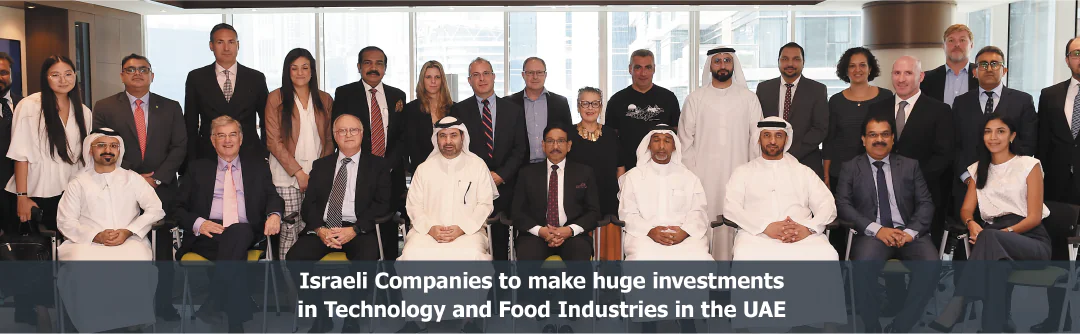 Kreston Menon
As the bilateral trade relations between the UAE and Israel are steadily growing, more Israeli companies are looking for major investments in the UAE. According to Prof. Ehud Menipaz, Chairman of International Advisory Committee, Israel Directors Union (IDU) the focus sectors would be Fintech and Digital Security, Food and Agriculture as well as in Energy. He was talking at the “UAE-Israel Business Meet 2021 – A Hybrid Event” hosted by Kreston Menon and Israeli Directors Union (IDU).
Ibrahim Ali, Director of the Investment Promotion Division of Dubai FDI presented the ‘Dubai Advantage’ and invited the Israeli investors to partner with Dubai to shape the future. He interacted with the visiting Israeli delegation of 26 investors in person and with over 200 delegates who attended this hybrid event online.
Jamal Bin Marghoob, Senior Director – Sales, Dubai Airport Free Zone (DAFZA), Faisal Jassim, Senior Manager – Sales, Jebel Ali Free Zone (JAFZA) and Rashid Al Mulla, Vice President – Marketing, Dubai Commercity presented the sector wise advantages that the Free Zones can offer to Israeli businesses. They reiterated rather than being a passive facility provider they are committed to be active partners to the growth and expansion plans of Israeli investors by being a gateway to the world markets.
Dr. Gritt Gur-Gershgoren, Chair of the Chairman Club IDU reiterated that the progress made in the first year of signing the Abraham Accords Peace Agreement, is bound to grow beyond expectations.
According to Shmulik Ben Tovim, President of the Fintech Community of Israel, major partnerships are in the pipeline in the Fintech sector, as Dubai is considered as the region’s hub for financial services and Israel as the tech capital of the world.
Speakers from diverse industry sectors including Banking, Taxation, Real Estate, Legal and Healthcare talked about the investment opportunities in the UAE. Pushpakaran Parambath gave an overview of 100% Foreign Ownership in the UAE while Surandar Jesrani, Managing Partner and CEO of MMJS Consulting made a presentation on the VAT Scenario in the UAE.
Other speakers included Ali Imran, Head of Transaction Banking & Digital Services, Comemrcial Bank of Dubai, Benjamin David Martin, Chief Commercial Officer of VPS Healthcare, Michael Ghaderi, CEO of Aaronz & Co Real Estate, Mohammad Maria, Managing Partner of Just Wills and Gilles Gamon, CEO of BioMeat FoodTech Ltd from Israel.
Doron Rozenblum, Managing Partner of Kreston IL expressed his confidence that more bilateral business partnerships will emerge and Israeli companies with global plans will be looking at UAE as a launching pad.
Raju Menon, Chairman and Managing Partner of Kreston Menon and Sudhir Kumar, Senior Partner and Head of Corporate Communications assured that Kreston Menon, who has supported and guided more than 8000 investors to setup operations in the UAE, will partner with IDU and Kreston IL to promote FDI in both the UAE and Israel.
Virginia Cook
, Marketing Director - Kreston Global
What is a name?
We all have our favourite brands, don’t we? Ones that resonate with us, that speak to us and to whom we are loyal regardless of our “sensible” heads telling us that we could probably find a cheaper or better alternative elsewhere.
But why do we get so “hooked” on certain brands? Have you ever tried to analyse why something generates an “emotional” response when we are able to be very factual and pragmatic about other aspects of our lives?
I quite like this definition of a brand from Investopedia. “A brand is the collective impact or lasting impression from all that is seen, heard, or experienced by customers who encounter a company and its products and services. In creating a brand, a business is managing the effect that the product or service is having on the customer.”
In my younger days, it was always the consumer brands that shaped branding theory (although these days we have incredibly powerful business brands); then it was all about being a “bundle of wants and desires in the mind of the customer.” Either way as we know, it is so much more than the visual. What we talk about now is the “experience” that we, the consumer, have when we use the brand/s that we love.
What do we mean by experience? It is every single activity, online manifestation, printed brochure, customer interaction that had with every part of our product that will create that “lasting impression”; the “collective impact” we seek in a strong and compelling brand. It’s that “managing the effect” as the definition above articulates.
When it comes to professional services brands, what is being “used” or purchased is the deep technical, specialist, business advice that is customised to our clients’ specific problem. So, creating a differentiated brand in this case means ensuring every single point at which our customer interacts with us reinforces those special characteristics. This is really saliant when clients need advice and solutions from different parts of the network. Managing that experience for our clients across international boundaries and jurisdictions is hyper-important.
The word “Kreston” means “responsible, trustworthy” in ancient Greek, and our member firms take that very seriously. Our name is fundamental to the promise our brand offers our clients and the experience we need to give them.
Kreston: Our whole is greater than the sum of our parts
As a worldwide network of accounting and business advisory firms, Kreston advisers want to be compelling to ambitious, entrepreneurial, interesting clients who seek to expand their business operations around the world. These sorts of clients want to move fast, need on-the-ground support, and require local savvy business advisers who know how to get the job done, and the right business connections to make that happen. Independent, ambitious, and fiercely entrepreneurial, Kreston firms are ideally placed for clients like these across the world. The key is to manage that experience so that it is consistent and reliable for our clients wherever they are in the world.
Kreston has a powerful backstory that reinforces the drive and energy that exists in the network today. Formed in 1971 by 2 entrepreneurial accountants, one from our German firm, Kreston Bansbach, and one from an English firm, Finnie & Co, that is now part of BDO, these 2 accountants were early pioneers of both an international mindset and the concept of a network of firms around the world who collaborate to help clients expand overseas. Fifty years on, Kreston is an energetic community of like-minded people who love working together to help their clients succeed.
Five Steps to Building a Global Brand
We know from member surveys and feedback that building our global brand is a key priority for our membership.
As a network we have wide and varied audiences. Our people, our firm leadership, our firms’ clients, our potential clients, our potential future recruits and all the people involved in helping us deliver work and value as suppliers and referrers.
That’s a lot of people to try and influence. Which is why we are in this together and we are working on a 5-step programme to build that worldwide global brand.
- A shared vision and ambition – one brand worldwide
- A compelling proposition that unites us – a purpose that we all agree with
- A consistent experience across our people and our clients – online is now king
- A reputation and narrative that is compelling to our clients and our people
- Ambassadors and advocates who help create and spread our culture
There isn’t the space to go into the detail for all these steps now. But we already know our shared ambition is a strong worldwide brand: entrepreneurial firms united in a collegiate, collaborative, community-minded enterprise, fuelling ambition and walking shoulder-to-shoulder with our clients. Our members will hear more in October about our shared vision, ambition, and purpose at our first world conference for 3 years in the wonderful city of Madrid.
Let’s take a closer look at steps 3, 4 and 5 and how we work on these essential areas of the digital challenge, a strong narrative to clients, and engagement of our younger people involved in the network, so they feel a sense of ownership, pride, and opportunity.
Why Digital is King in the Battle for Hearts and Minds
The Covid pandemic changed our lives fundamentally. We were becoming digitally adept, used to doing research online, fact finding, comparing providers. But suddenly in early 2020, that was the only way we could work – the only way we could buy – and the only way we could find out any information. And we haven’t looked back. Statista.com’s April 2022 analysis confirms “As of April 2022, there were five billion internet users worldwide, which is 63 percent of the global population. Of this total, 4.65 billion were social media users.” We will never return to a world where we are not “digital first.”
Although accounting firms may rely heavily on personal recommendations to grow business locally, growing a business regionally and globally takes a robust digital brand. 62% of businesses make decisions about who to do business with using just digital content to make their shortlists (Forrest Group, 2021). There are almost 2 billion websites in the digital landscape. Getting people to come to our websites is important – creating campaigns and stories that are interesting to read and add value to our clients’ research is critical. We have a great bank of client case studies that demonstrate the way that Kreston firms help their clients and regularly send our international clients update on tax, audit, and other international topics of interest.
Lynsey Thornthwaite, Kreston Global Digital Brand and Content Manager, gives us a view of our digital performance so far, “The Kreston Global website is growing rapidly; we have doubled the organic traffic in six months, and we could do that again over the next six months. Watching how users on the website clearly indicates that these new users are in that research phase, top of the funnel. They are navigating through the website, checking the “Doing Business In” pages, then navigating the country firms’ pages.”
“The traffic coming from member websites to the Kreston Global website is a great example of buyer intent in that research phase. The Kreston Menon website is the number one firm website referring traffic to the Kreston Global website. This is due to a combination of offline activity; there is an incredible amount of work going in to raising the profile of the firm – and the online activity, and a simple to navigate website that signposts users through the customer journey effectively. We can see that users from Kreston Menon are finding the journey fluid and the content meets their needs. The audience locations are not just regional, but global and the percentage of those visitors who return is third highest overall, a positive indication of interest and engagement.” Kreston Menon is part of our group of firms who really understand the power of digital engagement.
Understanding the “Interpreneur”
A professional brand stands and falls on the quality of its reputation and the way it shows how it understands its core client buyer. So, we focus a lot on enhancing our reputation with media and content creation. Our global group experts in Corporate and HNWI Tax, VAT, Audit, Transfer Pricing, Global Mobility and Corporate Finance write and publish expert advice to demonstrate our collective knowledge in these areas. This helps our reputation as a strong business advisory brand.
As well as topical and expert content, we have recently commissioned research across 6 main global markets to probe the way in which business owners decide to expand their businesses globally, what challenges they see as key and what are the characteristics found in successful “interpreneurs.”
We call these types of business owners/investors and directors “Interpreneurs,” and the results were fascinating, giving us real insight into what type of geographies, age and gender profile makes a more likely interpreneur and what they want from governments and advisers to help them success.
We will be running a series of podcasts with our advisers and clients looking more closely at the steps to success and have developed a web tool so that clients and prospects can see if they share the characteristics for success.
Ambassadors and advocates
Our culture is forged and strengthened the more our members interact with each in communities of interest. By building more ambassadors for Kreston through involving our younger people more in the network, we gain so much from their input and energy. It is so important that they can see Kreston as a network of opportunity for future career development, where they can work on interesting and ambitious clients and with enthusiastic committed professionals and peers from around the globe. All of whom are important advocates for the Kreston brand.
We are fortunate to have Kreston Menon in our network as they are true exemplars of what it means to have a strong, strategic brand focus – it is not by chance that they have a recognised “Superbrand” status in the UAE. They are energetic business builders in their own country of course, but through forging strong relationships with government bodies in the region, by investing in an international strategy abroad to get the most out of the network, and by being very supportive and involved in Kreston’s community building activities, they have gained a big following and strong relationships with colleagues across the world in the Kreston network.
“You have to invest to see a return” is the mantra of many business advisers when helping their client to think long-term. This is very much our attitude at Kreston Global – when our firms invest in the network and in helping us to build our global brand – like Kreston Menon – then together we will be stronger, compelling, and connected together by our shared ambition.
No Items.
No Items.
His Excellency Carel Richter
, Consul General of the Kingdom of the Netherlands for Dubai & Commissioner General of the Netherlands
This year, 2022, marks fifty years of bilateral relations between the United Arab Emirates and the Kingdom of the Netherlands. Our ties are warm and friendly, and we are full of anticipation for the next fifty years. With our successful Expo 2020 Dubai participation still fresh in mind, we have a lot to look forward to.
Food Security
As I am writing this article, H.E. Minister Mariam Almheiri is heading a trade delegation to the Netherlands, focused on food security and horticulture. More than 30 representatives from the Emirati horticultural sector joined her to visit GreenTech – a leading 3-day horticultural technology exhibition in Amsterdam – and the Floriade Expo 2022. On the first day of her visit, Minister Almheiri addressed the pressing topic of food security in her keynote opening speech at GreenTech: “Just as the Netherlands have looked at innovation and technology, we are doing the same — to really look into what kind of foods make sense to grow in the UAE, harnessing the power of technology.”
The Netherlands is the second largest exporter of agricultural produce in the world, while also one of the most densely populated countries. By co-creating technologies with partners from the private sector and knowledge institutions, we work to find solutions to global challenges, using expertise from areas such as artificial intelligence and robotics. Optimizing local production with a minimal usage of scarce resources, is key in what the Netherlands stands for.
Being a partner for other countries in increasing food security, be it through knowledge or technology transfer, is very important for the Netherlands. Logistical costs make global supply less economically feasible. The pandemic has shown us how fragile supply chains can be. The war in Ukraine not only impacts the people of Ukraine. In our region, food prices are increasing and foreign powers knock on the door to secure energy supply.
Floriade Expo 2022
The city of Almere in the Netherlands is the stage for the seventh edition of the international horticulture exhibition – Floriade Expo 2022. Floriade is organized only once every ten years and the main theme of this edition is ‘Growing Green Cities’. This outdoor Expo lasts six months and is open till October 9th, 2022.
The UAE is a prominent participant, with a stunning 3D printed pavilion, with the theme ‘Salt Water Cities: Where land meets the sea’. The pavilion exhibits how the UAE has been resilient and was able to overcome the challenging environment of desert and sea to grow into sustainable and thriving communities. Featuring interactive sculptures and immersive installations, the UAE pavilion is a living lab encouraging visitors to learn about the abundance of salt-loving plants that thrive in the country’s challenging arid climate.
Uniting Water, Energy and Food
The UAE and the Netherlands share many commonalities, including the importance of innovation and “making the best of what we have”. The UAE has done an outstanding job in the execution of the mega project Expo 2020 Dubai, especially given the challenges the pandemic posed. It was an honor to be part of this world exhibition, where the whole world was represented, highlighting the aspirations of humankind. Our participation in Expo 2020 Dubai is exemplary of the Dutch approach when it comes to innovation. With the multi-year, regional strategy themed “Uniting Water, Energy and Food”, architect V8 led a consortium that put together a fully circular biotope in the Dubai desert. The “SunGlacier” machine on the roof of the pavilion captured 1,200 liters of water per day from the air.
This water was used for three purposes: cooling the pavilion, as drinking water, and for watering the edible herbs and leafy greens that grew on the central cone in the pavilion. On the inside of the cone, we grew delicious oyster mushrooms. The water harvesting machine was powered by beautiful organic solar cells, built into the skylights of the pavilion. All the construction materials for the pavilion were sourced locally. We are deconstructing the pavilion and repurposing all the materials, preferably in the form they were originally intended for. The characteristic sheet piles, for instance, will be used in other construction projects up to ten times!
As a result of all the innovation and hard work done in the Netherlands pavilion, we can proudly share with you that we have received over 10 awards including the “Best Sustainability innovation” and “Best Architecture & Landscape”.
Continued Focus
In our journey to unite Water, Energy and Food, Expo 2020 Dubai was instrumental. We have had the honor to host many VVIPS, delegations and over 950,000 visitors. Our national day was an absolute highlight, with the visit of our royal couple, as well as a trade mission headed by our minister for Foreign Trade and Development Cooperation. The MoU for the Joint Economic Committee was signed during this visit, with the aim to intensify bilateral trade. We have hosted 125+ events at our Expo pavilion, all with a focus to further develop the ties between the UAE and the Gulf region and the Netherlands.
With the progressive measures the UAE takes to be an even more business friendly destination, we see increased interest in the UAE by our Dutch clients, the Netherlands’ businesses. Building on the facilities freezones have to offer, the initiatives taken facilitate FDI and 100% foreign ownership, and the excellent positioning as a hub, we see a steady increase in business set-up and expansion. The UAE is an important trading partner for the Netherlands, ranking 3rd in the EU as trade partner and being one of the top priority countries in our foreign economic policy. Moreover, the Gulf region is a priority region for the Netherlands, providing the proverbial magnifying glass for all opportunities that arise here.
Momentum
Building on the strategy of Uniting Water, Energy and Food, where Expo 2020 Dubai has proven to be an accelerator for our bilateral interests, we’re now in the midst of celebrating our 50 years of bilateral relations with the UAE. This momentum is worth treasuring, especially with more relevant events coming up. With anticipation we’re looking out to the next big climate conference COP28. This theme is at the core of what drives us; jointly developing solutions for global challenges, that make a difference for the generation of today as well as for those to come.
No Items.
 H.E. Andrew Tsepo Lebona
, Head of Mission & Consul General of South Africa to Dubai and Northern Emirates
H.E. Andrew Tsepo Lebona
, Head of Mission & Consul General of South Africa to Dubai and Northern Emirates
ASSALAMU ALAIKUM
My African heritage obliges me to first extend my respect to His Highness Sheikh Mohammed Bin Rashid Al-Maktoum, UAE Vice President, Prime Minister, Ruler of Dubai and his fellow Members of The Supreme Council, Rulers of The Northern Emirates.
I am honoured to be the Consul-General of the Republic of South Africa to Dubai and The Northern Emirates. This is my first diplomatic posting and I suppose seasoned colleagues in the government and diplomatic communities would consider me a ‘newbie’. Thank you all for your warm welcome and kindness.
It has been a whirlwind four months since my arrival and I am enjoying finding my feet and experiencing the vibrancy of Dubai and this interesting and extraordinary part of the world. My first impressions are a kaleidkresoscope of sound and light, diverse nationalities and cultures, amazing architecture, and an abundance of commercial opportunities. It is my great pleasure to kick-off 2023 as Kreston Menon’s first guest article contributor. My aim is to outline South Africa’s economic relations with the UAE, what we can learn from Dubai and my vision for the next four years.
Trade and Investment Partnerships
Economic Diplomacy is a cornerstone of South Africa’s foreign policy as it aims to address the triple challenges of Poverty, Unemployment and Inequality, all a legacy of our apartheid and colonial past. South Africa’s national interests and foreign policy objectives are cushioned in promoting peace, security and economic development on the African continent. South Africa and the UAE have maintained a strong bilateral relationship with a strong economic focus since formal diplomatic ties were first established in 1994.
Trade and Investment are integral parts of our Economic Diplomacy. South Africa occupies a strategic position as Africa’s most industrialised country with its advanced financial systems, modern infrastructure, world class educational institutions and a vibrant Stock Exchange. It provides a valuable springboard for UAE enterprises to invest in the country, the region and the continent within the ambit of the newly-established African Continental Free Trade Area (AfCFTA) flagship project. AfCTA can enhance UAE companies to invest and trade with Africa’s vast sectors in mining, telecommunication, agriculture and financial services with Dubai at the helm.
The UAE is South Africa’s main trading partner within the Gulf Cooperation Council (GCC) countries since both countries agreed in 2016 to work towards considering South Africa as a strategic partner on the African continent and a preferred investment destination.
Further cementing of this relationship was made during President Cyril Ramaphosa’s visits to the UAE, first during his State Visit in 2018 during which numerous Memoranda of Understanding (MOUs) were signed; second was his Working Visit last year during Expo 2020. Great emphasis was placed on bolstering bi-lateral relations particularly in the areas of Tourism, Trade and Investment, High Tech, Renewable Energy, Agriculture and Infrastructure Development.
May I congratulate the Government and people of the Emirate of Dubai for hosting an exceptionally successful Expo 2020. The Official Motto “Connecting Minds, Creating the Future via Sustainability, Mobility and Opportunity” cemented Dubai’s vision of being the global centre of Innovation, Digitalisation, Robotics and Artificial Intelligence. South Africa’s participation provided a significant opportunity to further solidify our economic relationship with the UAE and further develop South Africa’s trade and investment partnerships.
From our Mission in Dubai, one of my responsibilities is to provide leadership to bring substance to our economic relationship on the ground in the areas of Trade Investments and Tourism. This includes renewed engagement with the Northern Emirates, namely Sharjah, Ajman, Umm Al Quwain, Fujairah and Ras Al Khaimah and expanding our ties with them. Although the limelight generally shines on Dubai and Abu Dhabi Emirates, they also present extensive business opportunities for South African enterprises.
According to the South African Business Council (SABCO), there are over 2,400 SA affiliated or registered companies with the Dubai Chambers of Commerce. South Africa has invested ZAR 10 billion in the UAE creating more than 2000 jobs in the petroleum, healthcare and financial services. In turn, the UAE has invested ZAR 1 billion in South Africa creating in excess of 1,500 jobs in the petroleum and new energy sectors.
South Africa will assume the 15th BRICS presidency this year and host the BRICS Summit in the second half of the year. BRICS countries (Brazil, Russia, India, China and South Africa) account for 17% of global trade and 33% of global GDP. South Africa joined this important bloc in December 2010, in line with the country’s foreign policy to strengthen South-South relations. South Africa is also keen to expand membership to include other progressive countries. UAE would be a prime candidate.
Post-Covid19 Economic Reconstruction and Recovery
Our Mission will continue to play a key role in South Africa-UAE relations as part of the South African Government’s implementation of the Economic Reconstruction and Recovery Plan to provide capable and effective public infrastructure development, secure and affordable energy supply and a significant employment stimulus to recover job losses in the aftermath of Covid-19 by creating jobs and supporting livelihoods.
Tourism: Dubai Airport tops the global list for international passenger figures, 25 million in 2022 and the highest aircraft movements exceeding 400,000. As a result of bilateral agreements with Emirates and Etihad to give them access to South Africa’s domestic routes while they promote South Africa abroad, South Africa is well-placed to tap into this hub with Emirates offering direct daily flights to Johannesburg (flagship Airbus A380) and Cape Town and Durban (Boeing 777). Dubai and the Gulf region is an untapped market with huge potential for the high-end income category, corporates and the general population. This partnership is expected to boost visitor arrivals and promote tourism and inbound traffic to South Africa from key markets across the Emirates network.
Agriculture: Dubai, the UAE and the Gulf states are lucrative export markets for South Africa’s agricultural and agro-processing produce. Food security in the UAE is a strategic national priority and that is a great opportunity for South African produce as the country imports 95% of demand.
The Blue Economy: South Africa is the only country on the continent to have two coastal water masses – the Atlantic Ocean on the West and the Indian Ocean on the East. With the importance of Biodiversity and Climate Change and the UAE’s remarkable knowledge base and Future Science pedigree, South Africa can enhance its Maritime Science.
Public service: The embodiment of South Africa’s public service motto “Batho Pele” (The People First), can forge ties with the UAE’s Department of Happiness and Tolerance in promoting a just and functioning society.
Healthcare: With its ailing healthcare system and tremendous challenges especially post-Covid19 pandemic, South Africa can benefit immensely from the example of Dubai’s many state-of-the-art institutions.
Global participation: Dubai will host two strategic global conferences this year – the World Police Summit in March and COP 28 in November. Through our Mission, South Africa’s participation will enhance the country’s activities in combating crime and corruption, and continuing to address the challenges of climate change.
Cultural Diplomacy
Cultural Diplomacy or ‘Soft Power’ brings warmth to bilateral relations. “La Cultura e come l’aria, non ha confine” (Culture is like air, it has no borders). There are 114,000 South African expatriates in the UAE, the majority of them resident in Dubai and operating in the healthcare, hospitality, petroleum and financial sectors. Properly supported, this group can be Goodwill Ambassadors spreading positive stories of our Rainbow nation.
Hosting our very own sensational swimmer Tatjana Schoenmaker, Olympic Gold and World Record Holder would allow her to inspire young Emiratis to excel in swimming.
South African authors have frequently participated in the Emirates Literary Awards with much success. Improving contacts with UAE institutions especially those in Future Science such as Artificial Intelligence, Robotics, Digitalisation, Innovation and Space exploration is top on my list.
In conclusion, it is my fervent desire to see South Africa-UAE relations elevated to a High Level Strategic Partnership focusing on New Energy, Innovation and Future Technology as Dubai remains an unrivalled leader in this domain. Dubai has an immense global stature and a track record that includes its vibrant people and lifestyle. Iconic landmarks that ensure Dubai remains a premium destination are Burj Khalifa, Dubai Fountain, Burj Al Arab, Dubai Mall, The Palm Jumeirah, Museum of the Future, Emirates Airline, Expo City, DWTC, DMCC to name a few. His Highness Sheikh Mohammed Bin Rashid Al-Maktoum has set ambitious goals to make it the most important global business centre. Our Mission in Dubai will continue to play its part in fostering and enhancing South Africa-UAE relations in myriad spheres.
As we move forward in strengthening bi-lateral relations, we are guided by Doctrines of The Founding Fathers of our two nations – elder statesmen His Highness Sheikh Zayed Bin Sultan Al Nahyan and His Excellency President Nelson Mandela.
“Nkosi sikelel’ iAfrika” (God Bless Africa)
HE Dinesh Kumar Patnaik
, Ambassador of India to the Kingdom of Spain
I am delighted that Kreston Global is having their Annual conference in Spain. While the UAE-Spain trade and business corridor is quite active, I would like to talk here a bit about the India-Spain economic & commercial relationship.
India and Spain share a very close relationship, both being strong democracies and without any bilateral, geopolitical irritants. Relations between India and Spain go back to the 20th century and Christopher Colombus, who discovered America, was actually sent by the Spanish Queen to look for a route to India. In 1937, Rabindranath Tagore wrote a Pamphlet titled “Conscience of Humanity”, which appealed to Indians to help in the fight for democracy during the Spanish civil war. In modern times, we established democratic relations in 1956 and today we have a vibrant political and economic relationship, which also encompasses considerable interaction in the field of Education, Science & Technology, Culture and other fields.
Economic & Trade relations have been extremely vibrant and Spain is India´s 6th largest trading partner in the EU. Bilateral trade, which registered a drop of 19 per cent during the pandemic, has rebounded and crossed 2019 figure of US$ 6.5 billion. India has a surplus of about
US$ 3 billion in its trade balance with Spain, but this is offset to a large extent by the large number of Spanish companies present in India who are doing very good business.
There are about 250 Spanish companies in India, with multi-sector presence across infrastructure & construction, auxiliary products and industrial engineering, renewable energy and environmentally sustainable products, EICT (electronic information and communication technologies), automotive components and automotive accessories. Spain has also invested more than US$ 3.56 billion as cumulative FDI in India. Recently, the Ferrovial Group of Spain invested US$ 425 million in the infrastructure sector through Prime Minister’s Gati Shakti Master Plan.
In addition, India has recently signed a major contract with Airbus Spain for procurement of 56 C-295 military transport aircrafts. This is one of the biggest ´Make in India´ contracts signed as 40 of the 56 aircrafts would be completely made in India with almost 13,000 plus parts of the aircrafts to be manufactured and assembled in India. This will see a relocation of the entire supply chain for Aerospace industries, especially for the C-295 aircrafts to India.
As I had mentioned before, India has a surplus in its bilateral trade with Spain with the main items of export being organic chemicals, textiles and garments, steel, fuels & mineral oils, aluminium and other articles, leather and leather goods, marine products, vehicles, auto components, pharmaceutical, pigments, inorganic chemicals, etc.
India has also made considerable investment in Spain of almost US$ 1 billion. There are more than 50 Indian companies in Spain mainly in Software & IT services, automotive parts & automobile industries, pharmaceuticals, chemicals and logistics.
The future looks bright for India-Spain collaboration and there are many sectors in which there is considerable scope for cooperation among entrepreneurs of Spain in India, with a maximum potential being in the start-up business. Spanish entrepreneurship ecosystem increased between 2015 to 2021 from €10 billion to €46 billion. This provides considerable opportunity for start-ups in India to upscale in Spain and Spanish speaking countries as well as for Spanish start-ups to do the same in India. The future is bright for India-Spain relations and companies and organizations active in this corridor, especially in UAE should take advantage of this opportunity.
 Ravishanker V
, Director - Taxation, Kreston Menon
Ravishanker V
, Director - Taxation, Kreston Menon
Background
According to the UAE Federal Decree-Law No. 47 of 2022 on taxation of corporations and businesses (UAE CT Law), businesses will become subject to Corporate Tax UAE (CT) from the beginning of their first financial year which starts on or after 1 June 2023. Executive Regulations of the Decree Law containing interpretations and implementation guidelines of the Articles are forthcoming from the Ministry in the form of various Cabinet Decisions.
A few key areas have been reproduced below.
Registration of Taxable Persons
Who is liable to register for UAE CT Law?
All Taxable Persons (Persons subject to CT), including Free Zone Persons and Taxable Persons eligible for Small Business Relief are liable to register for UAE CT Law. It has been clarified by way of various Decisions that the following Persons need not register under UAE CT Law:
• A Government Entity
• A Government Controlled Entity
• A Person engaged in Extractive Business
• A Person engaged in Non-Extractive Natural Resources Business
• A Non-Resident Person that derives only State Sourced Income and has no Permanent Establishment in the UAE
• A Natural Person deriving income less than AED 1 million from Business or Business Activities
When can one register for UAE CT?
The Federal Tax Authority (FTA) is adopting a staggered approach with respect to registration. In early January, the FTA launched an early bird registration drive for CT through the EmaraTax platform. Subsequently, The FTA vide a press release on 14 May 2023 has announced the launch of registration for CT for Public Joint Stock Companies and Private Companies from 15 May 2023.
It should be noted that the Frequently Asked Questions (FAQs) published on the website have clarified that taxpayers are required to register before the prescribed due date of the first CT return without any penalties.
Tax Period
What is my first Tax Period?
For the purposes of the UAE CT Law, the Tax Period is the Financial Year of a Person which shall be the calendar year or the 12-month period for which the Taxable Person prepares financial statements.
The Decree Law applies to all financial years commencing on or after 1 June 2023. For most businesses, the financial year commences either on 1 January or 1 April. Accordingly, a bulk of the first tax years would either be
1 January 2024 to 31 December 2024, or 1 April 2024 to 31 March 2025, respectively. Further, the due date of filing returns is within 9 months from the end of the tax period i.e., 30 September 2025 and 31 December 2025, respectively.
Can a Taxable Person change their Tax Period?
It has been clarified by a recent decision that the Taxable Persons are eligible to change their Tax Periods for extending the same to up to 18 months or shortening the same to 6 to 12 months subject to meeting specified conditions.
Qualifying Free Zone Persons (QFZPs)
What are the conditions under which a Free Zone Person qualifies to be a Qualifying Free Zone Person (QFZP)?
A Free Zone Person who meets the pre-conditions for availing of the incentive mentioned under the law is termed QFZPs.
The pre-conditions to be regarded as a QFZP include:
• maintaining adequate substance in the UAE.
• complying with the transfer pricing requirements
• electing not to be taxed under the normal UAE CT regime i.e., at 9%.
The QFZPs would incur 0% UAE CT on ‘Qualifying Income’ and 9% on ‘Non-Qualifying Income’.
What is Qualifying Income?
While the term ‘Qualifying Income’ is expected to be clarified in specific regulations, the overview of the Decree published in the UAE Government Portal indicates that all income earned by the Free Zone Person which is in compliance with the restrictions on business by the Free Zone Authority particularly on transactions with the Mainland could constitute ‘Qualifying Income’.
Are there special considerations that are likely to apply to QFZPs?
It may also be noted that since the QFZPs are eligible for a tax incentive, the FTA is likely to monitor the returns and documents of such taxpayers closely. Accordingly, despite payment of Nil tax, there would be a need to maintain adequate documentation. Further, it has also been clarified that all QFZPs, irrespective of turnover, must maintain audited financial statements.
Small Business Reliefs
Are there special measures that have been introduced for small businesses including startups?
Resident small businesses having an annual revenue of less than AED 3 million in the relevant tax period or any preceding tax periods can avail themselves of Small Business Relief (SBR). Under this relief, such Taxable Person can elect to be treated as not having any Taxable Income. It may be noted that this relief is available for financial years commencing from 1 June 2023 and continues for subsequent tax periods ending up to 31 December 2026. Further, it may be noted that such relief is not available for a QFZP or a component of a Multinational Enterprises Group i.e a group with a consolidated revenue of more than AED 3.15 billion.
Are there any disadvantages of claiming such relief?
The Taxable Person claiming SBR would not be eligible to carry forward unclaimed interest costs or taxable losses in such tax periods where SBR is availed. Accordingly, it is pertinent to evaluate the claiming of this relief holistically and not in isolation.
Are there reliefs provided for small businesses with respect to Transfer Pricing (TP)?
By way of a recent Ministerial Decision, the requirement for maintaining a Master file and a Local file has been restricted to the following category of Persons:
• Component of a Multinational Enterprises Group that has a total consolidated revenue of AED 3.15 billion or more in the relevant tax period; or
• A Taxable Person whose revenue in the relevant Tax Period is AED 200 million or more.
This provides significant relief to small businesses with regard to the maintenance of extensive TP documentation. However, it may be noted that the requirement for application of the Arm’s Length Principle would continue to be applicable to international as well as local controlled transactions for all Taxable Persons.
Are there reliefs provided to small businesses pertaining to Accounting Standards and methods of accounting?
In a recent decision, relaxations have been granted to small businesses with regard to the Accounting Standards and method of accounting wherein a taxable person whose revenue does not exceed AED 3 million is allowed to maintain accounts on a cash basis and a taxable person whose revenue does not exceed AED 50 million may apply IFRS for SMEs.
Tax Grouping
What is a Tax Group?
A UAE CT Tax Group, in short, can be constituted by two or more resident juridical persons (other than a QFZP or an Exempt Person) having a parent-subsidiary relationship with at least 95% shareholding and control among other criteria. The conditions for UAE CT Tax Grouping are very different from tax grouping provisions available under UAE VAT Law wherein entities under common ownership, even if the shareholders are natural persons, are eligible to be grouped.
Is a Tax Group the same as a Qualifying Group?
The CT Law introduced two distinct grouping structures – ‘Qualifying Group’ and ‘Tax Group’. A fine reading of the relevant provisions identifies the following differences:
• While a ‘Qualifying Group’ is a de-facto status i.e., requires no application or election, a ‘Tax Group’ can be formed only through an application to the FTA.
• A qualifying group may also be constituted even if the common shareholder is an individual. The Tax Group can only be constituted of Juridical Persons.
• The constituents of the qualifying group will continue to be different taxpayers and file separate returns which will be assessed separately. In the case of a tax group, the ‘Parent company’ files one return on behalf of the group i.e., the group is assessed as a single entity basis consolidated financial statements.
• The basic exemption of AED 375,000 will apply to the tax group as an entity and not to each of its components.
Key Business Considerations
What are the key areas of the UAE CT Law that businesses will have to consider in their day-to-day operations and for making long-term strategic decisions?
CT, unlike VAT, would have a direct effect on the profits of the businesses and requires due consideration. Further, being a new introduction, the Decree Law also would introduce new concepts which would mandate businesses to recalibrate their traditional business practices.
The businesses should take due cognizance of the following major aspects introduced by the Decree and closely monitor the developments in these areas:
• Conformity to OECD Transfer Pricing (TP) guidelines for transactions with related parties and connected parties, including capturing the same in the opening balance.
• Maintenance of records supporting the information provided in the returns.
• Evaluation of any arrangement or agreement in the light of the General Anti-Abuse Rules (GAAR) prescribed by the Decree.
• The provisions relating to Place of Effective Management, Permanent Establishment or State Sourced Income may result in a business falling within the purview of this Decree, even if registered outside the UAE.
• Careful evaluation of various elections or applications prescribed under various provisions.
Are further decisions awaited from the Ministry and/or the Authority?
While a large trench of clarifications has been received over the last few weeks, the impending Cabinet Decision and regulations can add new requirements and provisions leading to multiple new interpretations and discussions.
A few key clarifications that are expected from the Ministry include:
• Specific requirements and format of documentation for transfer pricing.
• Definitions and procedures associated with QFZPs.
• Penal provisions and quantum of such penalty.
• Formats for annual returns, applications, and other statements.
Conclusion
UAE has always been known for its ease of doing business and business friendly ecosystem. The introduction of CT is a radical change, albeit essential. Apart from the effect of the additional expenditure in the Income Statement, the businesses are also concerned about the burden of compliance that they would be expected to bear.
The inclusion of provisions facilitating seeking clarifications from the FTA indicates the commitment of the Ministry and the Authority in undertaking this radical change in partnership with all the stakeholders, including all the taxpayers. This is a source of massive reassurance to the taxpayers
gulfnews
, Gulf News
Those with Mainland Operations Await Signal on Extent of their ‘QUALIFYING INCOME'
Businesses operating out of UAE free zones and with a considerable presence on the mainland are thinking of possible restructures to the organization to absorb the upcoming Corporate Tax.
But any such changes to the business must stay on the right side of the ‘anti-abuse rules’ that form part of the UAE CT regulations, top tax consultants add.
“Yes, restructuring existing operations (of free zone enterprises with mainland operations) needs serious consideration,” said Nimish Goel, Partner at Dubai-based WTS Dhriva Consultants. “However, any restructuring or hiving off (of mainland operations) needs to factor in operational and commercial realities.
“The general anti-abuse rules need to be suitably factored.”
The anti-abuse rules are clear enough – businesses in the UAE cannot make changes solely to gain a tax advantage and thus hope to pay less on their annual income.
Hiving off mainland operations
In their consultations ahead of registering for the UAE CT regime, free zone businesses have talked of the possibility of hiving off their mainland operations to be standalone enterprises. Especially where these businesses operate separate licenses for their free zone and mainland operations.
Free zones represent one of the more significant contributors to the UAE GDP, and the UAE CT rules gives businesses there ample flexibility.
‘Qualifying income’
Under these rules, pure-play free zone businesses/their owners are exempt from the 9 per cent tax payment commitment based on their ‘qualifying income’. And this is to be confirmed by a UAE Cabinet decision that is expected shortly. (The UAE Corporate Tax comes into effect June 1, 2023.)
Raju Menon, Chairman and Managing Partner at Dubai-based consultancy Kreston Menon, emphasizes the point about ‘qualifying income’. “The UAE federal decree stipulated that free zone ‘persons’ could benefit by incurring a 0 per cent corporate tax only on the ‘qualifying income’, which is still to be defined,” said Menon. “Based on available guidance from the UAE Ministry of Finance, the qualifying income should include offshore as well as onshore sources of income of free zone persons (but) subject to strict conditions.
“Hence, there should be detailed guidance forthcoming on this aspect.” (When the decision comes on qualifying income, tax specialists hope it will also address ‘transfer pricing’ issues, which is ‘relevant as entities restructure to have standalone operations between free zone and mainland enterprises’.)
Fairly big incentive for free zone businesses
The ‘free zone person’ incentive is a substantial tax break for eligible businesses, according to Menon. (Apart from businesses engaged in extracting natural resources, government, and government-controlled entities also enjoy exemptions under the Federal Decree Law subject to eligibility criteria and conditions.)
Relief for small businesses
In addition, the Federal Decree Law does contain relief for small businesses ‘where a resident taxable person generating revenue up to a threshold – to be decided by the UAE Minister of Finance – may elect to be regarded as not having derived any taxable income for the relevant tax period,” said Menon. “Accordingly, there will not be any tax cost for such small businesses.
“Any new substantive legislation necessitates businesses to take cognizance of its applicability and plan for efficient change management. Businesses in the UAE should consider undertaking a deep review and documentation of revenue operations, assessing the impact of corporate tax, and completing requisite changes well in time of the effective date.”
Source: “UAE’s free zone companies have lots of tax planning to do”, by Manoj Nair, Business Editor, Business Section, Gulf News newspaper, 4 April 2023 and online article here.
Surandar Jesrani
, CEO & Managing Partner - MMJS Consulting
Following an announcement on 31 January 2022, the UAE Government released Federal Decree Law No. 47 of 2022 on Taxation of Corporations and Businesses (UAE CT Law) on 9 December 2022. This follows a first of its kind public consultation drive which began on 28 April 2022 seeking feedback from stakeholders on key features and principles of the planned UAE CT regime. The UAE CT Law has been supplemented by 158 Frequently Asked Questions (FAQs) which provide further guidance regarding the intent and principles of the legislation.
Though largely in line with principles contained in the public consultation document, provisions contained in UAE CT Law have addressed issues on key aspects which is indicative of the positive approach of the UAE Government for implementing a cohesive, straightforward and transparent legislative framework.
UAE CT is applicable on taxable income of resident and non-resident persons for financial years beginning on or after 1 June 2023. UAE CT will be applied at a rate of 0 percent on taxable income upto AED 375,000 and a general rate of 9 percent for taxable income above AED 375,000. Resident entities are taxable on worldwide income whereas non-residents would be taxable on UAE sourced income which could include income from a resident in the UAE, income derived from the UAE or income from activities performed or benefitted in the UAE.
The personal income of natural persons has been kept outside the scope of UAE CT, however, business income of individuals is within the ambit of UAE CT. The meaning of business and commercial activities in respect of natural persons would be notified in a separate Cabinet Decision.
UAE CT Law provides for exemptions for businesses engaged in extraction of natural resources, Government and Government controlled entities, charities and public benefit entities, investment funds, pension and social security funds, subject to conditions. Certain exempted categories are required to claim the exemption through an application process to be notified.
Free Zones are a key economic driver for the UAE and this fact has been appropriately addressed in the UAE CT regime through an incentive to Free Zone registered persons being taxed at the rate of 0 percent on Qualifying Income. Qualifying Income would be detailed in a specific Cabinet Decision which is expected imminently at the time of going to press. However the Free Zone Person incentive carries stringent conditions including maintaining substance in the Free Zone License, satisfying transfer pricing requirements and other compliances. These conditions may not be straightforward for many businesses to comply given existing holding structures, business models and operations.
Provisions for taxable income and its computation largely follow internationally accepted best practices including exemptions to dividends from domestic companies and participation interests, a cap on net interest deduction at 30 percent of EBITDA and a cap on business entertainment expenses at 50 percent. Reliefs for small businesses, intra-group transactions and restructuring has been provided. It is important to note that UAE CT Law explicitly states that expenditure is deductible only if it is incurred exclusively for business purposes and accordingly, expenditure which is personal in nature, or incurred for exempt or incentivized income may not be deductible.
The parent entity of a resident group of companies can make an application to form a tax group with its UAE subsidiaries, subject to meeting strict conditions. These conditions include a 95 percent ownership requirement and neither the parent nor a subsidiary can be an exempt or a Qualifying Free Zone person. The parent company of a tax group is responsible for administrative mandates under law and would submit a single tax return.
The UAE CT Law has been generous in respect of tax losses providing for indefinite carry forward for setoff against future taxable income capped at 75 percent of such taxable income provided certain conditions are met. Tax losses may also be transferred between resident companies with 75 percent common shareholding subject to the specified cap for set-off.
Persons subject to UAE CT are mandated to register with the Federal Tax Authority (FTA) and obtain a Tax Registration Number. Early bird registrations have been activated by the FTA on the Emara Tax portal. However, it is understood from authorities that a registration should be obtained prior to filing of tax returns.
All Taxable Persons subject to UAE CT, including Qualifying Free Zone Persons, will be required to file a tax return and pay any due tax within 9 months from the end of a tax year (which is the current financial year followed by such taxpayers).
As per Law, transactions with associated enterprises (related parties) and connected persons are required to comply with the arm’s-length principle which would be in line with OECD Transfer Pricing (TP) Guidelines. However, the definitions of related parties and connected persons are customized to suit the socio-economic climate of UAE and include kinship up to the fourth degree which may trigger TP requirements. UAE CT Law requires UAE businesses to maintain TP documentation which will be prescribed under a Ministerial Decision. TP documentation must be submitted to the FTA within 30 days of a request. Further, all taxpayers would be required to submit a TP disclosure form along with the UAE CT return detailing the controlled transactions of a tax year.
As per UAE CT Law, documentary evidence supporting tax positions taken by the taxpayer should be maintained for at least 7 years from the end the relevant tax year.
Additionally, UAE business may be requested to submit financial statements and other documentary evidence including transfer pricing to the FTA.
UAE CT Law includes a detailed general anti-abuse rule (GAAR) intended to disregard transactions or arrangements undertaken with the purpose of obtaining a tax advantage. GAAR applies from the date of publication of UAE CT Law in the Official Gazette.
As part of transitional provisions, the UAE CT Law also provides that the opening tax balance sheet would be the closing accounting balance sheet for the financial year immediately before the first tax year and should conform to the arm’s length principle.
The impact of a new business law or regime are far-reaching for an economy and considering that tax legislation is relatively new for UAE businesses, additional care should be taken while assessing implications under UAE CT Law. As further details would be forthcoming over the coming months through a series of Ministerial and Cabinet Decisions, businesses should closely monitor developments and prepare for change management well in advance to mitigate the probability of unfavorable outcomes. As part of the run up to the effective date of UAE CT on business activities, investors and entrepreneurs alike may consider assessing the impact of UAE CT on as is basis, structural changes (keeping in mind GAAR), modelling cash flow implications, consider exemption regimes, and developing processes and related procedures to manage compliance.
Natural persons undertaking a business activity should assess whether income earned could be regarded as business or commercial in nature and take steps to structure such activities to be tax efficient.
Every change is an opportunity to become more efficient in the way we do things and I believe this is true even in the case of implementing UAE CT in your business activities.
Surandar Jesrani
, CEO & Managing Partner - MMJS Consulting
The Ministry of Finance (MOF) has released high level details on the proposed UAE Corporate Tax (CT) regime in the form of a press release and Frequently Asked Questions (FAQs) published on web portal of tax authorities i.e. UAE MOF and the Federal Tax Authority (FTA). This is motivated by UAE’s desire to integrate into the global business community and meeting international tax standards, while minimizing compliance burden for UAE businesses and shielding small businesses and start-ups.
His Excellency Younis Haji Al Khoori, Undersecretary of MOF, stated that “the certainty of a competitive and best in class Corporate Tax regime, together with the UAE’s extensive double tax treaty network, will cement the UAE’s position as a world-leading hub for business and investment”. The relevant legislation for the CT regime (UAE CT Law) is currently being finalized and is expected to be promulgated during 2022. Once released, the UAE CT Law will provide details and guidance on several critical aspects.
UAE businesses will be subject to UAE Corporate Tax in a staggered manner from Financial Years (FYs) beginning on or after 1 June 2023. An entity having a FY beginning on 1 July 2023 and ending on 30 June 2024 will be subject to CIT from 1 July 2023. While, entities having a FY beginning on 1 January 2023 and ending on 31 December 2023, will be subject to UAE CT from 1 January 2024.
Scope
UAE CT is a federal tax and consequently, will apply to all businesses and commercial activities in the UAE except for extraction of natural resources which will continue to be taxed at the Emirate level. Likewise, the UAE CT regime will apply to individuals to the extent that they hold (or are legally required to hold) a business license or permit to carry out commercial, industrial and/or professional activities in UAE. This includes income earned by freelance professionals for activities carried out under a freelance license or permit.
Rates and Computation
Adopting a slab rate system, the headline UAE CT rate has been fixed at 9% to be calculated on taxable income as below:
An increased UAE CT rate would be applicable for large multinationals that meet specific criteria set with reference to pillar two of the OECD BEPS 2.0. Taxable income for a tax year is to be computed based on accounting net profit/income of a business reported in financial statements prepared in accordance with internationally acceptable accounting standards, after the prescribed adjustments. With a 9% standard tax rate, UAE CT regime will remain one of the most competitive tax jurisdictions in the world.
Exemptions from UAE CT
As per the issued FAQs, certain incomes have been kept outside the ambit of the UAE CT including:
• Foreign investors will not be subject to UAE CT if income is not earned from a regular trade/business in UAE;
• UAE CT will not apply on capital gains and dividends received by a UAE business from ‘qualifying shareholdings’; and
• UAE CT will not be applicable to qualifying intragroup transactions and restructuring subject to certain conditions to be specified under the legislation.
It has also been announced that UAE CT will honour tax incentives committed to businesses located in Free Zones, to the extent that eligible entities comply with applicable regulatory requirements and do not conduct business in mainland UAE. Further, current business models for trade in goods and/or provision of services may need to be restructured once further guidance is released by MOF. Free Zone businesses will nevertheless have to comply with certain obligations under UAE CT regime, including the obligation to register and file a Corporate Tax return and claim exempt as applicable.
Other key noteworthy aspects from the announcement
The UAE CT regime will allow a business to utilize tax losses incurred (from the date UAE CT is effective) to offset taxable income in subsequent tax years. Based on current guidance, it seems that eligibility for tax losses would be applied on a prospective basis i.e. from the first tax year onwards. Further, a ‘Fiscal Unity’ concept would be implemented as part of UAE Corporate Income Tax (CIT) law i.e. eligible UAE group of companies may elect form a tax group and file a single (consolidated) tax return subject to conditions to be specified.
A tax withholding regime has not been included in proposed UAE CT law. In other words, there will be no withholding tax on domestic and cross border payments. This can be seen as a substantial relief to UAE business as introduction of a withholding tax regime increases compliance burden and other administrative complexities. Foreign Tax Credit (FTC) will be allowed against UAE CT liability. This is in line with corporate tax regimes followed by most of the countries across the globe.
UAE businesses will need to comply with international Transfer Pricing (TP) rules and documentation requirements contained in OECD TP Guidelines (as amended in 2022) for related party transactions. It would be interesting to see if domestic transfer pricing rules are introduced similar to other tax jurisdictions in the region.
Accounting considerations
As per the FAQs, accounting profits/income of a business (which is the starting point of a taxable income computation) should be as per internationally acceptable accounting standards. Hence, it will be obligatory for all businesses under UAE CT regime to maintain accounting records as per International Financial Reporting Standards or prevalent GAAP in UAE. It would be interesting to see whether UAE CT law mandate annual financial statements to be audited in the absence of a mandatory requirement under commercial law for a large section of businesses in the UAE.
Key takeaways and what business in UAE should do in the interim
The announcements and guidance released by UAE MOF has clarified key design features of UAE CT, however, several uncertainties remain awaiting clarity in UAE CT law and its implementing regulations. Whilst the announcement implicates that large multinational groups (MNEs) will be taxed at a higher rate, it remains to be seen how this will be implemented from a policy perspective (e.g., increase in tax rate or a domestic minimum tax/ parallel tax) which is yet to be announced.
Businesses operating in UAE should consider the following to get ready well in advance of the UAE CIT go-live date:
• Finance functions should begin preliminary assessment of existing business operations to identify broad areas which could pose challenges from UAE Corporate Tax perspective
• Discuss the issues identified with relevant departments and plan an approach/ methodology to be adopted for implementing UAE CT
• Identifying possibility to restructure business operations and optimize the current business structure to minimize the impact of the proposed UAE CT and envisaged TP regulations
• Perform gap analysis to identify required system changes to meet financial information requirements for UAE CT compliance.
 Surandar Jesrani
, CEO & Managing Partner - MMJS Consulting
Surandar Jesrani
, CEO & Managing Partner - MMJS Consulting
BACKGROUND
The Transfer Pricing landscape in the Middle East region has been continuously evolving in the last couple of years largely as a consequence of developments arising out of the OECD’s Base Erosion and Profit Shifting (‘BEPS’) project. Several countries in the ME have committed to implement minimum tax standards under the BEPS Implementation Framework (‘IF’), one of which includes Action 13 – TP documentation and Country by Country Reporting (‘CbCR’). As a result, countries such as Bahrain, Egypt, Jordan, Kingdom of Saudi Arabia (‘KSA’), Oman, Qatar and United Arab Emirates (‘UAE’) now have detailed TP and / or CbCR laws in place.
The complexity posed by new laws has meant that businesses operating in the region have more tax thinking to do. It has meant increased TP/CbCR related compliances, more scrutiny/disputes, need to create additional documentation and the need to remodel or do away with existing company structures and intercompany dealings which will no longer work.
The interplay of Transfer Pricing with the Economic Substance Regulations introduced in UAE and Bahrain under BEPS Action 5 – Addressing Harmful Tax Regimes is another factor that can’t be ignored. The more the substance housed in a particular location/entity, the more profits the entity needs to earn. Multinationals have all along made use of UAE & Bahrain’s zero tax regimes to have centralized hubs in terms of headquarter, procurement or intellectual property for their Middle East operations. With the introduction of the first set of BEPS reforms, multinationals in the region have already had to change their strategies but with the upcoming reforms expected as part of BEPS 2.0, their problems will be even more accentuated.
BEPS 2.0
On 1 July 2021, most of the BEPS IF member countries committed to a new overhaul tax reforms referred to as BEPS 2.0 which consist of two Pillars.
Pillar One is initially expected to be applicable only to multinationals with global turnover above EUR 20 billion. It calls for a certain pre-determined share of the consolidated profits of such multinationals to be allocated to markets where proportionate sales arise. Where consolidated profits exceed 10% of revenues, the profit to be reallocated (Amount A) will be 20 to 30% of the excess profit. This profit reallocation is expected to happen regardless of any intra-group Transfer Pricing mechanisms the group may have set in place. Another Amount B aims to set standard margins for group entities that perform low risk marketing and distribution functions.
Under Pillar Two, member countries agree a system whereby multinationals are to be taxed at a global minimum tax rate of 15%. This would apply to groups with global turnover above EUR 750 million (same threshold as for CbCR) but jurisdictions could decide to apply a lower threshold. Pillar Two reforms could manifest as:
- A top-up tax in the jurisdiction of the multinational’s parent entity in respect of any lower-taxed income of a group entity (i.e., where income has not been subject to an effective minimum tax of at least 15%).
- Where such top-up tax has not been applied, a secondary rule ensuring that lower-taxed group entities pay an effective minimum tax rate of at least that 15%.
- An additional tax on royalties, interest and other defined payments made to a member jurisdiction that applies a corporate tax rate lower than the minimum prescribed rate of between 7.5 – 9%.
The application of Pillar One and Pillar Two appears restricted to the largest multinationals initially however actual implementation needs to be awaited. In addition, certain exemptions areas have been factored under both Pillar Oneand Pillar Two. Initial indications are that both Pillars could become effective as early as 2023.
BEPS 2.0 – ME Impact
Middle East countries such as Bahrain, Egypt, Jordan, KSA, Oman, Qatar and UAE have expressed support for these proposals. UAE in particular issued an official statement issued on 26 July 2021 stating its support for Pillar Two.
- Through Pillar One, excess profits of multinationals based in Bahrain/UAE could be reallocated to jurisdictions with higher tax rates, resulting in increased group taxes.
- Through Pillar Two, there is higher potential impact for multinationals headquartered/operating in the ME. Profits of businesses in Bahrain/UAE, where statutory tax rates are currently below the proposed global minimum tax of 15% could become subject to the top-up tax in an overseas jurisdiction. ME countries will in all likelihood themselves introduce local legislation to ramp up tax rates in order to protect their tax base.
Conclusion
For large multinationals operating in the region, firstly we recommend that they track and address all the new country-specific tax compliance requirements that have arisen in the last couple of years and factor in the consequences of non-compliance i.e., adjustments and/or penalties into their tax planning. Secondly, we recommend that businesses be closely aware of the constant developments in the BEPS, TP and CbCR space so they are fore-warned and pre-prepared to develop appropriate future-oriented policies in response to these shifting variables.
No Items.
 gulfnews
, Gulf News
gulfnews
, Gulf News
Demand runs high for auditors, with more corporate tax focused firms set for launch
If anyone asks about the job category with the fastest and highest hiring rates in the UAE, don’t look beyond tax auditors and specialists. The hiring process continues even as the UAE Corporate Tax formally launched on June 1, with industry sources saying there are still more positions to be filled.
Where they are not getting filled internally, businesses are contracting those tasks to outside audit firms, which are expanding their own workforce to cope with the demand rush.
At the manager level, the salary structure for a tax auditor would vary between Dh18,000 to Dh24,000 a month depending on the firm.
Entry level salaries and incentives too have improved in the last 6-8 months, while candidates are lining up 10-25 per cent increases in their take-homes when they make the jump to a new employer.
Hiring in ‘surge’ mode
So, is hiring of tax auditors in ‘surge’ mode? Shibu Abraham, Director – Human Resources at the consultancy Kreston Menon, stops short of saying that a surge is on.
“There is demand for qualified and experienced tax consultants and auditors,” he said. “We have seen an increase of 10 percent in our staff strength this year, mostly at entry and mid-level.
“We have a structured career path for auditors, where most of them join as trainees or associates and who over time get promoted to senior auditors, supervisors and managers.”
Audit industry sources say that more specialist tax firms will launch in the coming weeks, and they too will get onto the hiring spree.
“Not every business can afford to have an in-house team of tax specialists, which is why outsourcing offers a big opportunity,” said an auditor.
“These new businesses are either launching on their own and hope to gradually build up a clientele, or opt for joint ventures to speed up the process.”
“Companies are increasingly outsourcing their tax functions to external tax consultants or firms,” said Abraham. “This approach is prevalent among many businesses, especially SMEs that might not have the resources or expertise to handle complex tax matters in-house.”
– Shibu Abraham, Director – Human Resources at Kreston Menon
More graduates enter the fray
It’s also a good time for new tax professionals to seek their chances in a trending job market. This week, Dubai’s DIFC Academy saw the passing out of the first 28 candidates who went through the UAE Corporate Tax Diploma Programme, run in tandem with PwC Middle East. Some of them had already passed the Final Certificate Examination provided by ATT-UK.
Focus on awareness
At the DIFC Academy, they went through a ‘condensed’ 30-day programme that equips them ‘to guide companies in complying with the new UAE corporate tax requirements’.
That’s exactly what the market wants.
“Finance professionals have gained the practical knowledge and skills to successfully ensure that all practices, systems, and processes of their respective companies comply with the new tax regime,” said Christian Kunz, Chief Strategy, Innovation and ventures Officer at DIFC Authority.
Everyone’s hiring
“The Big 4 and other top accounting firms are looking for qualified and experienced auditors and tax consultants who can combine tech know-how with their finance and taxation skills,” said Abraham.
“We had seen many individual tax consultants moving to the UAE to capitalize on the opportunities thrown open by the introduction of VAT a few years ago. We have also recently seen the emergence of tax boutique firms.
”Other industry sources say that the current buzz around hiring tax professionals far exceeds anything during the launch of the VAT regime in 2018.
“It will be no exaggeration to say that tax professionals are among the most active when it comes to registering for UAE’s Golden Visa program,” said a consultant. “The rush is unprecedented.”
Is every UAE business up to speed on tax?
Registering for the corporate tax UAE continues apace, but there is still time to start the process towards tax filings and making sure the books are in order.
“Companies are increasingly outsourcing their tax functions to external tax consultants or firms,” said Abraham. “This approach is prevalent among many businesses, especially SMEs that might not have the resources or expertise to handle complex tax matters in-house.”
This is why ‘to attract and retain the right talent, there is always a cost involved.”
It’s all showing up in the frenetic hiring in the UAE for auditors. Particularly those who specialise on tax matters.
Source: “More jobs, salary hikes: Is UAE’s demand boom for tax professionals only getting started? ’” by Manoj Nair, Business Editor, Business Section, Gulf News newspaper, 23 August 2023 and online article here.
No Items.
No Items.
No Items.
Ravishanker V
, Director - Taxation, Kreston Menon
Background
According to the UAE Federal Decree-Law No. 47 of 2022 on taxation of corporations and businesses (UAE CT Law), businesses will become subject to Corporate Tax UAE (CT) from the beginning of their first financial year which starts on or after 1 June 2023. Executive Regulations of the Decree Law containing interpretations and implementation guidelines of the Articles are forthcoming from the Ministry in the form of various Cabinet Decisions.
A few key areas have been reproduced below.
Registration of Taxable Persons
Who is liable to register for UAE CT Law?
All Taxable Persons (Persons subject to CT), including Free Zone Persons and Taxable Persons eligible for Small Business Relief are liable to register for UAE CT Law. It has been clarified by way of various Decisions that the following Persons need not register under UAE CT Law:
• A Government Entity
• A Government Controlled Entity
• A Person engaged in Extractive Business
• A Person engaged in Non-Extractive Natural Resources Business
• A Non-Resident Person that derives only State Sourced Income and has no Permanent Establishment in the UAE
• A Natural Person deriving income less than AED 1 million from Business or Business Activities
When can one register for UAE CT?
The Federal Tax Authority (FTA) is adopting a staggered approach with respect to registration. In early January, the FTA launched an early bird registration drive for CT through the EmaraTax platform. Subsequently, The FTA vide a press release on 14 May 2023 has announced the launch of registration for CT for Public Joint Stock Companies and Private Companies from 15 May 2023.
It should be noted that the Frequently Asked Questions (FAQs) published on the website have clarified that taxpayers are required to register before the prescribed due date of the first CT return without any penalties.
Tax Period
What is my first Tax Period?
For the purposes of the UAE CT Law, the Tax Period is the Financial Year of a Person which shall be the calendar year or the 12-month period for which the Taxable Person prepares financial statements.
The Decree Law applies to all financial years commencing on or after 1 June 2023. For most businesses, the financial year commences either on 1 January or 1 April. Accordingly, a bulk of the first tax years would either be
1 January 2024 to 31 December 2024, or 1 April 2024 to 31 March 2025, respectively. Further, the due date of filing returns is within 9 months from the end of the tax period i.e., 30 September 2025 and 31 December 2025, respectively.
Can a Taxable Person change their Tax Period?
It has been clarified by a recent decision that the Taxable Persons are eligible to change their Tax Periods for extending the same to up to 18 months or shortening the same to 6 to 12 months subject to meeting specified conditions.
Qualifying Free Zone Persons (QFZPs)
What are the conditions under which a Free Zone Person qualifies to be a Qualifying Free Zone Person (QFZP)?
A Free Zone Person who meets the pre-conditions for availing of the incentive mentioned under the law is termed QFZPs.
The pre-conditions to be regarded as a QFZP include:
• maintaining adequate substance in the UAE.
• complying with the transfer pricing requirements
• electing not to be taxed under the normal UAE CT regime i.e., at 9%.
The QFZPs would incur 0% UAE CT on ‘Qualifying Income’ and 9% on ‘Non-Qualifying Income’.
What is Qualifying Income?
While the term ‘Qualifying Income’ is expected to be clarified in specific regulations, the overview of the Decree published in the UAE Government Portal indicates that all income earned by the Free Zone Person which is in compliance with the restrictions on business by the Free Zone Authority particularly on transactions with the Mainland could constitute ‘Qualifying Income’.
Are there special considerations that are likely to apply to QFZPs?
It may also be noted that since the QFZPs are eligible for a tax incentive, the FTA is likely to monitor the returns and documents of such taxpayers closely. Accordingly, despite payment of Nil tax, there would be a need to maintain adequate documentation. Further, it has also been clarified that all QFZPs, irrespective of turnover, must maintain audited financial statements.
Small Business Reliefs
Are there special measures that have been introduced for small businesses including startups?
Resident small businesses having an annual revenue of less than AED 3 million in the relevant tax period or any preceding tax periods can avail themselves of Small Business Relief (SBR). Under this relief, such Taxable Person can elect to be treated as not having any Taxable Income. It may be noted that this relief is available for financial years commencing from 1 June 2023 and continues for subsequent tax periods ending up to 31 December 2026. Further, it may be noted that such relief is not available for a QFZP or a component of a Multinational Enterprises Group i.e a group with a consolidated revenue of more than AED 3.15 billion.
Are there any disadvantages of claiming such relief?
The Taxable Person claiming SBR would not be eligible to carry forward unclaimed interest costs or taxable losses in such tax periods where SBR is availed. Accordingly, it is pertinent to evaluate the claiming of this relief holistically and not in isolation.
Are there reliefs provided for small businesses with respect to Transfer Pricing (TP)?
By way of a recent Ministerial Decision, the requirement for maintaining a Master file and a Local file has been restricted to the following category of Persons:
• Component of a Multinational Enterprises Group that has a total consolidated revenue of AED 3.15 billion or more in the relevant tax period; or
• A Taxable Person whose revenue in the relevant Tax Period is AED 200 million or more.
This provides significant relief to small businesses with regard to the maintenance of extensive TP documentation. However, it may be noted that the requirement for application of the Arm’s Length Principle would continue to be applicable to international as well as local controlled transactions for all Taxable Persons.
Are there reliefs provided to small businesses pertaining to Accounting Standards and methods of accounting?
In a recent decision, relaxations have been granted to small businesses with regard to the Accounting Standards and method of accounting wherein a taxable person whose revenue does not exceed AED 3 million is allowed to maintain accounts on a cash basis and a taxable person whose revenue does not exceed AED 50 million may apply IFRS for SMEs.
Tax Grouping
What is a Tax Group?
A UAE CT Tax Group, in short, can be constituted by two or more resident juridical persons (other than a QFZP or an Exempt Person) having a parent-subsidiary relationship with at least 95% shareholding and control among other criteria. The conditions for UAE CT Tax Grouping are very different from tax grouping provisions available under UAE VAT Law wherein entities under common ownership, even if the shareholders are natural persons, are eligible to be grouped.
Is a Tax Group the same as a Qualifying Group?
The CT Law introduced two distinct grouping structures – ‘Qualifying Group’ and ‘Tax Group’. A fine reading of the relevant provisions identifies the following differences:
• While a ‘Qualifying Group’ is a de-facto status i.e., requires no application or election, a ‘Tax Group’ can be formed only through an application to the FTA.
• A qualifying group may also be constituted even if the common shareholder is an individual. The Tax Group can only be constituted of Juridical Persons.
• The constituents of the qualifying group will continue to be different taxpayers and file separate returns which will be assessed separately. In the case of a tax group, the ‘Parent company’ files one return on behalf of the group i.e., the group is assessed as a single entity basis consolidated financial statements.
• The basic exemption of AED 375,000 will apply to the tax group as an entity and not to each of its components.
Key Business Considerations
What are the key areas of the UAE CT Law that businesses will have to consider in their day-to-day operations and for making long-term strategic decisions?
CT, unlike VAT, would have a direct effect on the profits of the businesses and requires due consideration. Further, being a new introduction, the Decree Law also would introduce new concepts which would mandate businesses to recalibrate their traditional business practices.
The businesses should take due cognizance of the following major aspects introduced by the Decree and closely monitor the developments in these areas:
• Conformity to OECD Transfer Pricing (TP) guidelines for transactions with related parties and connected parties, including capturing the same in the opening balance.
• Maintenance of records supporting the information provided in the returns.
• Evaluation of any arrangement or agreement in the light of the General Anti-Abuse Rules (GAAR) prescribed by the Decree.
• The provisions relating to Place of Effective Management, Permanent Establishment or State Sourced Income may result in a business falling within the purview of this Decree, even if registered outside the UAE.
• Careful evaluation of various elections or applications prescribed under various provisions.
Are further decisions awaited from the Ministry and/or the Authority?
While a large trench of clarifications has been received over the last few weeks, the impending Cabinet Decision and regulations can add new requirements and provisions leading to multiple new interpretations and discussions.
A few key clarifications that are expected from the Ministry include:
• Specific requirements and format of documentation for transfer pricing.
• Definitions and procedures associated with QFZPs.
• Penal provisions and quantum of such penalty.
• Formats for annual returns, applications, and other statements.
Conclusion
UAE has always been known for its ease of doing business and business friendly ecosystem. The introduction of CT is a radical change, albeit essential. Apart from the effect of the additional expenditure in the Income Statement, the businesses are also concerned about the burden of compliance that they would be expected to bear.
The inclusion of provisions facilitating seeking clarifications from the FTA indicates the commitment of the Ministry and the Authority in undertaking this radical change in partnership with all the stakeholders, including all the taxpayers. This is a source of massive reassurance to the taxpayers
 gulfnews
, Gulf News
gulfnews
, Gulf News
Businesses, their owners, and auditors in the UAE are awaiting the next big update on the corporate tax – the one related to ‘qualifying income’ for free zone entities and on which they get the 0 per cent tax benefit. A decision on this is ‘imminent’, according to multiple audit industry sources.
Any income that these free zone-based businesses generate outside of that qualifying income will come under the 9 per cent corporate tax coverage. And there lies the crux, which is why these businesses are awaiting the guidelines on QI with such a heightened sense of anticipation.
The confirmation of the qualifying income benchmark will also be of significance to the many UAE free zones, given the clarity it brings in their dealings with existing entities licensed by them and prospective ones they are looking to sign up.
The UAE Corporate Tax comes into effect on June 1.
What could make up the qualifying income?
Raju Menon, Chairman and Group Managing Partner at Kreston Menon, says : “Income that conforms to business ‘restrictions’ of each free zone authority should be regarded as QI.
“Accordingly, export of goods from a free zone, the trade in goods within a free zone or between free zones – and without any ‘contamination’ in the UAE mainland – may be regarded as qualifying income for the ‘qualifying free zone person’.”
“So would any ‘passive income’ earned by free zone companies.”
These are the confirmations that all stakeholders are looking to from the Ministry of Finance. In recent weeks, debates have intensified over whether businesses should retain their free zone status or go for a full license from the mainland. Particularly among those businesses with a heavy chunk of their income derived direct from operations or services rendered on the mainland.
Deepak Bansal of Ask Pankaj Tax Advisors says, “The scope of qualifying income is an evolving issue. The crucial point is to understand the subtle difference between honoring the promised tax incentives (given to free zone licensed companies) and offering a new set of tax incentives.”
What makes up a ‘Qualifying Free Zone Person’?
The entity must maintain ‘adequate substance’ in the UAE, or in other words have a definable direct exposure in the local market.
Derive qualifying income as specified in a Cabinet Decision.
Comply with ‘transfer pricing’ rules and maintain relevant transfer pricing documentation.
Not have made an election to be subject to corporate tax in full.
‘Proportionate’ or ‘activity’ based incentives?
“The concept of proportionate taxation is prevalent in India for tax incentives to companies based in Special Economic Zones (SEZs) and certain other countries,” said Bansal. Singapore offers ‘activity-based’ tax incentives as compared to ‘entity-based’ incentives, requiring a proportionate determination of eligible/ineligible taxable income.”
The UAE model on qualifying income – and subsequent free zone incentives – would be based on best-of-breed regulations from other jurisdictions on how they treat income generated by such entities.
“Free zones were conceptualized as international trading/manufacturing hubs,” said Bansal. “The income from exports (goods and services), and trading within free zones, is likely to be treated as QI. “The fenced areas of free zones (connected to ports) are treated as outside UAE for VAT/custom purposes. Import of goods from such areas to the mainland may also be categorized as QI, i.e., at par with non-resident suppliers’ income from goods imported into mainland UAE.
“Certain passive incomes may also qualify as QI. Any other income may be taxed at 9 per cent resulting in proportionate taxation principles. The concept of ‘disqualifying income’, if introduced, could, however, have ramifications on business operations.”
Read more from our Taxation Services.
Source: “UAE’s free zone businesses await 0% ‘qualifying income’ ’” by Manoj Nair, Business Editor, Business Section, Gulf News newspaper, 9 May 2023 and online article here.
gulfnews
, Gulf News
UAE AND INDIA MARK THE FIRST YEAR UNDER THE LANDMARK AGREEMENT
A year after the UAE-India Cepa deal came into effect, the stage is set for the next big bang in trade and investment flows between the countries – a dirham-rupee payment mechanism.
When that happens, multiple categories – and businesses within them – would benefit from the closing deals in the two currencies and not have to use US dollars to make it happen. What that does is cushion trade between the countries from foreign exchange volatility brought on by the dollar’s movements.
“India is looking to ways that can speed up and smoothen out trade with its biggest economic partners,” said a senior Indian government source. “We have learnt the processes well in using the rupee in financing imports from Russia, and it’s been a major factor in limiting inflationary pressures in the economy.”
“If India and UAE sign a deal confirming rupee-dirham, it will further expand the scope of Cepa.”
Meeting CEPA targets
It was with India that the UAE entered into its first CEPA – or the Comprehensive Economic Partnership Agreement – that immediately brought down import duty across categories and opened up new investment possibilities for entities in these countries.
What UAE and India are looking for are to go in for immediate benefits from CEPA where possible and then work on those areas where they can make steady progress.
“I’m not aware of any UAE imports that are subject to 0 per cent import duty in India,” said Raju Menon, Chairman and Managing Partner at Kreston Menon, the audit consultancy.
“However, under CEPA, India has agreed to reduce or eliminate tariffs on a range of products imported from the UAE.”
“The UAE has agreed to provide tariff concessions to India on 60 per cent of items traded between the two, including on basmati rice, textiles, and pharmaceuticals.” (India last week reworked the processes involved for the country’s gold trade to source bullion from the UAE under CEPA. This could in the coming months see UAE provide up to 140 tonnes of bullion to India, and which will consolidate its status as the second biggest supplier of gold to that market after Switzerland.)
Trade is on the up
Trade gains have been there from the start of the CEPA becoming effective from May 1. Between April to November 2022, two-way movements totalled $57.8 billion from $45.3 billion a year prior to that. That’s a rise of $12.5 billion in value terms and 27.5 per cent in percentage terms.
India’s exports to the UAE went past $20 billion during this period, leveraging a 19.32 per cent increase.
“As per the CEPA agreement, there would be periodic reviews to assess progress and identify areas for further cooperation,” said Menon. “The UAE has set up a dedicated task force to ensure the smooth implementation of the agreement, while India has created a website to provide information about the CEPA and facilitate trade between the countries.”
Beyond $100b in trade
Boosting two-way trade to $100 billion is the stated aim before the end of this decade, but there is also the greater emphasis on generating more from trade in services, with a target of $15 billion.
The cable-maker Ducab Group recently opened an office in the south Indian metropolis of Bengaluru, and its CEO Mohammed Abdul Rahman Al Mutawa was there on the ground. And he’s liking what’s showing up as possibilities post-CEPA.
“India is our new home market,” said Al Mutawa. “India has always been of interest to us and CEPA made the decision of opening an office in Bengaluru easier.”
“Ducab has been supplying to the Indian market since 1988, with its first project being the Nhava Sheva Port in Mumbai. Ducab has supplied 263,000 MT of of CuEq (copper equivalent) of metals to the market through the years. This is equal to powering approximately 3 million houses.
The other big investments or commitments made by UAE businesses are by the likes of Emaar, LuLu and the Sharaf Group, while DP World is expanding the scope of its already substantial interests in that market.
But business chiefs say it is still too early to fully realise the full possibilities that come with CEPA. “The impact of such agreements can take time to be felt, as businesses need to navigate through the legal and regulatory requirements of investing in a foreign country,” said Abdul Jebbar P. B., Group Managing Director at Dubai-based Hotpack Global, currently on a major expansion in the UAE and Saudi Arabia.
India is becoming one of the most desirable markets for businesses from all over the world due to its sheer size. And the government has been prudent in encouraging investment.”
With CEPA, UAE businesses with an India focus might have that extra edge.
gulfnews
, Gulf News
Those with Mainland Operations Await Signal on Extent of their ‘QUALIFYING INCOME'
Businesses operating out of UAE free zones and with a considerable presence on the mainland are thinking of possible restructures to the organization to absorb the upcoming Corporate Tax.
But any such changes to the business must stay on the right side of the ‘anti-abuse rules’ that form part of the UAE CT regulations, top tax consultants add.
“Yes, restructuring existing operations (of free zone enterprises with mainland operations) needs serious consideration,” said Nimish Goel, Partner at Dubai-based WTS Dhriva Consultants. “However, any restructuring or hiving off (of mainland operations) needs to factor in operational and commercial realities.
“The general anti-abuse rules need to be suitably factored.”
The anti-abuse rules are clear enough – businesses in the UAE cannot make changes solely to gain a tax advantage and thus hope to pay less on their annual income.
Hiving off mainland operations
In their consultations ahead of registering for the UAE CT regime, free zone businesses have talked of the possibility of hiving off their mainland operations to be standalone enterprises. Especially where these businesses operate separate licenses for their free zone and mainland operations.
Free zones represent one of the more significant contributors to the UAE GDP, and the UAE CT rules gives businesses there ample flexibility.
‘Qualifying income’
Under these rules, pure-play free zone businesses/their owners are exempt from the 9 per cent tax payment commitment based on their ‘qualifying income’. And this is to be confirmed by a UAE Cabinet decision that is expected shortly. (The UAE Corporate Tax comes into effect June 1, 2023.)
Raju Menon, Chairman and Managing Partner at Dubai-based consultancy Kreston Menon, emphasizes the point about ‘qualifying income’. “The UAE federal decree stipulated that free zone ‘persons’ could benefit by incurring a 0 per cent corporate tax only on the ‘qualifying income’, which is still to be defined,” said Menon. “Based on available guidance from the UAE Ministry of Finance, the qualifying income should include offshore as well as onshore sources of income of free zone persons (but) subject to strict conditions.
“Hence, there should be detailed guidance forthcoming on this aspect.” (When the decision comes on qualifying income, tax specialists hope it will also address ‘transfer pricing’ issues, which is ‘relevant as entities restructure to have standalone operations between free zone and mainland enterprises’.)
Fairly big incentive for free zone businesses
The ‘free zone person’ incentive is a substantial tax break for eligible businesses, according to Menon. (Apart from businesses engaged in extracting natural resources, government, and government-controlled entities also enjoy exemptions under the Federal Decree Law subject to eligibility criteria and conditions.)
Relief for small businesses
In addition, the Federal Decree Law does contain relief for small businesses ‘where a resident taxable person generating revenue up to a threshold – to be decided by the UAE Minister of Finance – may elect to be regarded as not having derived any taxable income for the relevant tax period,” said Menon. “Accordingly, there will not be any tax cost for such small businesses.
“Any new substantive legislation necessitates businesses to take cognizance of its applicability and plan for efficient change management. Businesses in the UAE should consider undertaking a deep review and documentation of revenue operations, assessing the impact of corporate tax, and completing requisite changes well in time of the effective date.”
Source: “UAE’s free zone companies have lots of tax planning to do”, by Manoj Nair, Business Editor, Business Section, Gulf News newspaper, 4 April 2023 and online article here.
gulfnews
, Gulf News
Raju Menon, founder, chairman, and managing partner of Kreston Menon talks to Pranitha Menon about dreaming big, his management principles, and his autobiography The View from My Perch
Rajagopalan Menon, better known as Raju Menon, was 29 years old when he boarded his first-ever flight– from Mumbai to Dubai in 1991. Armed with a degree in Chartered Accountancy and a year’s work experience, he arrived on a visit visa with hope and courage to seek a life and livelihood in the UAE. ‘I was unsure of what the future held even though I had very clear visions of what it should be. There was no apprehension, just excitement,’ says Raju, who hails from a tiny hamlet called Edavilangu in the southern Indian state of Kerala.
Over three decades in the UAE, he would go on to found and helm the Kreston Menon Group, a leading audit and business consulting firm with operations in UAE, India, Qatar, and Oman; gather a long list honours; be named one of top 100 Indian Leaders in the Arab world, and pen an autobiography that is eliciting rave reviews.
Released late last year at the Sharjah International Book Fair, The View From My Perch chronicles his story of consistency and perseverance. Neatly demarcating his life into different phases, each represents a struggle and a step towards his destination and dream.
What led him to pen this story?
‘I never thought of writing a book and I felt I was too young to be writing an autobiography,’ says Raju, with a smile. However, the seed of a book was first sown by Sudhir Kumar, his senior partner Kreston Menon. A book, Sudhir was sure, could inspire students and young entrepreneurs.
‘Whether that happens or not, the thought convinced me to give it a try,’ recalls Raju.
The pandemic acted as a catalyst. Keen to use the free time that he had productively, he decided to pen his memoir. ‘To compile my experiences, thoughts, and vision into this compendium of life, I remember spending hours and days in the office meeting room, aptly named Maydan, which became my haven for ferreting into the past to dig out nuggets buried in the deep recesses of my mind.’
Once he got going, he wanted to ensure that the book would be perfect in all senses of the term. To that end, he made a few trips to Kerala to relive and experience once again firsthand some elements that had shaped his personality, and meet a few key people who in some way had had a bearing on his life.
Insightful vignettes of all of these feature in his book giving it a deeply personal feel.
‘Like everything else I do, I just gave it my very best,’ says the man who started out life in the UAE as an audit manager in a modest firm in Dubai.
What motivated him to set up Kreston Menon, a company that has bagged the Super Brand status for nine consecutive years? I ask.
‘To excel and never to be content with the ordinary,’ says Raju, with a smile. It is a mantra that pushes him to make his choices. It is a lesson, he says, he learned the hard way.
Need to think big
Forced to pursue higher studies in a privately-owned educational institution after performing poorly in his Grade 10 board examination, Raju watched with envy his friends heading off to vibrant, exciting environs of reputed colleges.
Realizing that his lack of focus at a crucial juncture of his studies had cost him the opportunity to continue education in a well-known college, he resolved ‘never to settle for the mundane again.
‘Even today, I hold that character trait dear. Think big, do big, execute big. You can break beyond the limits by thinking big. Once you think big and set your goals high, it will widen the horizon of your life, and bring you greater opportunities and greater success,’ he asserts.
Pursuing academics with a vengeance of sorts, he cleared his Chartered Accountancy exams in the first attempt, an achievement that made his parents proud.
Encouraged, he decided to set up an entrepreneurial venture in Kozhikode, Kerala. However, it did not take off as planned.
Not one to give up, he decided to look beyond the boundaries of his state to realize his dream of making it big in life. Heading off to Mumbai, he landed a job in a multinational company and earned valuable experience.
However, Raju’s dreams were big.
‘People get comfortable in their little successes and trapped in them for eternity, unable to realize their full potential. To succeed and achieve the maximum, one has to take risks and venture out into the challenging world… outside their safe haven,’ says Raju. Practicing what he preaches, he decided to move out of his safe job and took a flight to Dubai.
Raju was aware that it is a new place where he would have to put in long and hard hours to make a mark in his field. But he was willing to do that and more.
‘Upskill yourself and stay competitive. A successful entrepreneur needs to be a constant learner,’ he advises before adding, ‘Hard work is the cardinal principle for me.’
Is it not – work smart, not hard? I ask.
Hard work is the base. It is that first step that you must take before you work smart.
It was Raju’s mother, Susheela Menon, a midwife, who had a strong influence in shaping him into who he is today. ‘She was hard-working, willing to help people at any hour of the day or night, and was empathetic.’
The first job he got was in a company named Mak&Partners, in Dubai. For close to a decade here, he worked 14 hours every day. ‘I was never a clock watcher but used the flexibility given to me by my boss, Khalid Bhai, as an opportunity to gain knowledge and experience.’
In 1995, he set up the Kreston Menon Group. From a small team of three people, the firm today has grown into an enterprise employing more than 400 Chartered Accountants, internal auditors, and accountancy professionals. Raju’s wife, Girija Menon, is a senior partner at Kreston Menon and a certified internal auditor.
Even today, he believes in working hard… and smart. ‘Now, I head an organization that is structured and runs like a well-oiled machine. All I must do is manage it well.’
Delegation, he believes, is the key to effective management. ‘I have learned that micromanagement of people and business is self-defeating. When given the freedom, people bloom,’ he points out.
Trusting, empowering, incentivizing, and giving employees the freedom to creatively develop the business in their own style could work wonders, he says.
As an entrepreneur, he stands by the management principle of the People First approach and values work-life balance for all employees. ‘If you do not empower your leaders (partners, directors, managers) and give the freedom to operate, you won’t be successful,’ he says. ‘I am supported by a great team that shares the same objectives and strives for a common goal.’
Raju believes that there are no shortcuts to success. ‘My success will definitely be counted on how effectively I am creating a unique experience for each of my clients by providing them with the right and timely business advice.’
He goes on to explain that in an ever-evolving business environment, his success also lies in how effectively he leads his team to stay relevant, updated, and ahead of the competition.
The going– and growing– however, was not easy.
A legal issue in 2011 threatened his firm’s survival but Raju fought the case and won it.
The pandemic too affected them, but that was a great teacher, says Raju. ‘The lesson that it left in its wake that had to be put into practice was to be prepared for unpredictability and rework on short-term and long-term planning and strategies.’
The first break
Over the years, Raju says that he has witnessed and experienced that getting that first break is the most difficult task. He has noticed that once a person gets the right break, they move up very fast, provided they are willing to work hard.
‘Wiser by having undergone such ordeals, I believe in giving the first break to people who are known to me or have been referred even if they may not be up to par in their qualifications but have the fire in them to do well and succeed.’
One initiative that he is extremely proud of is partnering with the Expo 2020 team, as early as 2013, to support their bid to organize the world-renowned, unique, and historic event, the Expo, in Dubai.
A firm believer of women empowerment, the father of three mentions that 45 percent of the total workforce at Kreston Menon are women.
‘Life has been very kind and generous to me. Now, in turn, I try to spread happiness in people around me,’ he says.
To give focus to their philanthropic efforts, Raju and Girija have started the CA Girija & CA Raju Menon Foundation in Kozhikode, Kerala, providing support for education, marriage, and healthcare for individuals who approach them for help.
To empower women, they conduct training courses to enhance their communication and public speaking skills, which will give them the confidence to contribute to society.
‘Both of us wholeheartedly believe that all human beings are equal and equally capable of achieving and contributing to the community, society, and humanity,’ says Raju.
Source: “Think big, do big, execute big”, AuthorSpeak Section, Friday Magazine, Gulf News, 31 March 2023 and online article here.
Swati Arora
, Partner at Kreston Menon and Hayford Integral Training Institute
TRENDS FOR TOMORROW
The Abu Dhabi Sustainability Week Future Skills 2030 Report identified the driving sources that will shape the future of jobs and skills in the world. The technological advancement is bound to open new horizons in the fields of automation, artificial intelligence and robotics, big data and data analysis, virtual reality and augmented reality. The global drive towards sustainability will create a new set of green jobs in alternative energy and waste management.
The current Fourth Industrial Revolution has forced every industry to undergo rapid changes and the existence of businesses will depend on how well they adapt to the new unique skills that do not exist today.
INVESTING IN YOUR PEOPLE
It is true that organizations are keeping pace with the market and technological advancements to capitalize on the business opportunities, but they can have a significant competitive advantage only if they have the ability to address the skill gaps and upskill their workforce.
Rapid advancements in technology have brought in the need of training existing employees on new technologies and tools, and upskilling existing workers who already know the organization, processes and clients will be much effective than bringing in new people. It is a universally proven fact that reskilling is a smaller investment than hiring and training a new worker. There will be a positive impact on the morale of the employees as they are given the opportunity to stay relevant, productive and effective in the competitive and constantly changing job market, where many industries are being disrupted by new technologies.
How to Upskill Your Workforce
Organizations should have a comprehensive upskilling strategy in order to cater to the requirements of the future. The strategy should lay down concrete plans and programs to provide the employees with the necessary knowledge and skills to adapt to changing technologies, work situations and job profiles. The various methods to Reskill and Upskill your workforce include:
Training programs: Specific training programs that focus on developing the skills and knowledge relevant to the requirements and objectives of the organization. The cost the organization incurs for in-house training programs, or the financial support provided for the employees to attend external courses will prove as the right investment decision to stay competitive.
Cross training and Job rotation: Progressive companies train and develop their team members to take up totally different roles within the organization, allowing them to develop their career by equipping them to acquire new skills and gain new experiences.
E-Learning programs: Organizations can encourage and support employees to enroll for specialized online learning programs which will help them learn new technologies and practices.
Conferences and workshops: Providing opportunities for employees to attend industry specific conferences and workshops can provide them with opportunities to learn from industry experts.
INVESTING IN YOURSELF
It is critical for any professional to learn new skills or improve existing ones to increase their knowledge, expertise and value in the job market.
Professional upskilling opportunities are available to individuals at all levels of their careers in the UAE. Universities, colleges, and vocational training centers provide formal education. These institutions offer various courses, including short-term certificates and long-term diplomas.
Besides formal education, there are many other ways to upskill individuals. Professional training companies offer professional development programs ranging from professional degree preparation to leadership and management courses to technology courses. Individuals can also upskill themselves online through a variety of platforms and resources which can be accessed from anywhere.
Professional upskilling, and thereby remaining updated, is a critical factor for anyone looking to grow their career in the UAE’s rapidly evolving job market. Remember, upskilling is an ongoing process. Make it a habit to continuously learn and develop your skills to stay competitive in your industry.
SKILLS IN DEMAND IN UAE
The UAE job market is quite diverse and very futuristic. As the economy is seeing a surge in investments in technology, infrastructure and energy, there is a huge demand for highly skilled workforce.
Digital and Technology Skills – The UAE is rapidly moving towards digitalization, which has increased the demand for professionals with digital and technology skills such as data analysis, artificial intelligence, cybersecurity, digital marketing and software development.
Healthcare – Healthcare professionals especially doctors, nurses, pharmacists and researchers in pharmaceuticals are in high demand.
Digital Marketing – No longer a novel field, it has now evolved into a must-have function for organizations and skill for marketeers. Every organization need digital marketing professionals to help them connect with the world.
Blockchain – The understanding of this technology with huge multi-function application possibilities is still in the process of being probed and discovered. It has applications in Finance, HR, Procurement, Quality management, Contract management… the list is growing!
Cryptocurrency Management – This is a rapidly evolving and growing field. With greater exposure and greater number of players, its great flexibility and security in use, cryptocurrency is poised to become an indelible part of finance function in most companies.
Metaverse – Only a few institutions have the expertise to provide training in the Metaverse. This is touted as a parallel universe in the days ahead.
Finance and Accounting – Finance and accounting professionals, particularly those with qualifications such as Chartered Accountant (CA), Certified Public Accountant (CPA) or Certified Management Accountant (CMA) are in high demand in the UAE.
Hospitality and Tourism – Job opportunities for trained hospitality professionals are plenty, as the hospitality and tourism industry is a significant contributor to the country’s economy.
Human Resources – Employers in the UAE are looking for professionals with strong people management and recruitment skills to help them attract, manage and retain talent.
Sales and Marketing – We talk about bots taking away sales and customer care jobs, but professionals with strong communication, negotiation and customer relationship management skills are still sought after.
ENGAGE A PROFESSIONAL TRAINING COMPANY
Engaging a professional training company to upskill your workforce has its own benefits. Their expertise and experience give them the edge in designing and delivering effective training programs apt for your field. Many training companies design training programs designed for the specific needs of your workforce.
Efficiency and effectiveness: Professional training companies can save your organization time and money by delivering training programs efficiently and effectively. They can ensure that the training programs align with your business objectives, are delivered on time and have a measurable impact on performance.
Such institutions having access to a range of resources, including industry-specific research, cutting-edge technologies and best trainers can help your organization stay up to date with the latest trends and advancements in your industry.
 Pushpakaran Parambath
, Senior Partner - Kreston Menon Corporate Services
Pushpakaran Parambath
, Senior Partner - Kreston Menon Corporate Services
During these immediate past two years UAE witnessed a wide range of reforms, modifications, amendments in the country’s legal and regulatory framework aiming to bolster economic, investment and commercial prospects. The reforms intend to keep the momentum of the developmental achievements of the country and to reflect its impending aspirations. Over 40 laws are included in the changes, which together represent the largest legal reform in the young nation’s 50-year history. The repealing/amendments aim to develop the legislative and regulatory structure in various sectors, including investment, trade, industry, as well as commercial company, regulation and protection of industrial property, copyright, trademarks, commercial register, electronic transactions, trust services, factoring and residency. The new legislative changes came after intensive coordination at both the local and federal levels and adopting global best practices in the global legal system.
Here are some of the earlier laws and their revised versions:
| Revised Laws | Annulled/Amended Laws | Significant Reform |
| Federal Decree Law No. 46 of 2021 on Electronic Transactions and Trust Services | Federal Law No. 1 of 2006 on Electronic Commerce and Transactions. | Keeping pace with technological development and enhance ongoing digital transformation. The law gives digital signatures the same weight as a handwritten signature, a step that obviates the need for personal presence to seal transactions. |
| Federal Law No. 11 of 2021 on the Regulation and Protection of Industrial Property Rights | Federal Law No. 17 of 2002 on Regulation and Protection of Industrial Property of Patents, Industrial Drawings and Designs | Dedicated to patents, industrial designs, integrated circuits, non-disclosure agreements and utility certificates. It applies across the UAE (including free zones). |
| Federal Decree Law No. 38 of 2021 on Copyrights And Neigbouring Rights | Federal Law No. 7 of 2002 on Copyright | The amendments offer special benefits for people of determination to enhance their benefit and participation in this vital sector. |
| Federal Decree Law No. 36 of 2021 on Trademarks | Federal Law No. 37 of 1992 on Trademarks | The amendments offer protection to three-dimensional trademarks, holograms, sound trademarks such as musical tones associated with a company and that distinguish its products, and smell trademarks such as creating a distinctive scent for the company or brand. The updates also include registering geographical names of trademarks or products. |
| Federal Decree Law No. 37 of 2021 on the Commercial Register | Federal Law No. 5 of 1975 on the Commercial Register | Allowing local authorities in each emirate to retain the right to establish and manage their commercial records, including registration, data monitoring and change. |
| Federal Decre Law No. 32 of 2021 on Commercial Companies | Federal Law No. 2 of 2015 on Commercial Companies | The law allows investors and entrepreneurs to establish and fully own onshore companies in all sectors, excluding a small number of reserved “strategic activities”. |
| Federal Decree Law No. 25 of 2022 – UAE Industrial Law | Federal Law No. 1 of 1979 – Industrial Law | The law strengthens the UAE’s position as an industrial global hub that attracts quality investments through incentives and enablers, including the National In-Country Value program (ICV), Industry 4.0 and Technology Transformation Program. |
| Federal Law No. 42 of 2022 – UAE Civil Code | Federal Law No. 11 of 1992 – UAE Civil Code | Whilst the new law does not overhaul civil procedure in the UAE, it introduces some significant changes. In particular the New Law provides for a change to service outside the jurisdiction; a confirmation that cheques are “enforceable instruments” and changes in relation to appeals, including the manner in which the Court of Appeal will deal with appeals before it and changes to the period for appeals to the Court of Cassation. |
| Federal Decree Law No. 50 of 2022 –the Commercial Transactions Law | Federal Law No. 18 of 1993 – the Commercial Transactions Law | The new law adopts advanced and flexible legislative mechanisms and keeps pace with the modern reality of real and virtual businesses. |
| Federal Decree Law No. 35 of 2021 on Bankruptcy | Replaces the Federal Law No. 9 of 2016 – Bankruptcy Law | This amendment seeks to clarify when a debtor’s directors and managers can be held personally liable for the company’s debts if they cannot be repaid. |
| Federal Decree Law No. 18 of 2022 (Amended Decree Law) relating to Value Added Tax | Federal Decree Law No. 8 of 2017 relating to Value Added Tax | Amended Decree Law to allow the FTA an additional four years to undertake an audit provided that it has issued a notice for audit or assessment before the expiration of the general statute of limitations of five years. |
| Federal Decree Law No. 33 of 2021 on Regulation of Employment Relationship | Federal Law No. 8 of 1980 – UAE Labour Law | The new Law abolished unlimited term contracts and replaced with fixed – term contracts. |
| Federal Law No. 3 of 2022 on Commercial Agencies | Federal Law No. 18 of 1981 – Commercial Agency Law | The New Commercial Agency Law adopts a more balanced approach between principal and agent such as i) the type of companies which can act as a registered commercial agent has been expanded; ii) the reasons for which a principal can terminate a registered commercial agency agreement have been expanded in certain circumstances; and iii) parties can agree to resolve agency disputes through arbitration, an option which was not permissible under the old Commercial Agency Law. |
Surandar Jesrani
, CEO & Managing Partner - MMJS Consulting
Following an announcement on 31 January 2022, the UAE Government released Federal Decree Law No. 47 of 2022 on Taxation of Corporations and Businesses (UAE CT Law) on 9 December 2022. This follows a first of its kind public consultation drive which began on 28 April 2022 seeking feedback from stakeholders on key features and principles of the planned UAE CT regime. The UAE CT Law has been supplemented by 158 Frequently Asked Questions (FAQs) which provide further guidance regarding the intent and principles of the legislation.
Though largely in line with principles contained in the public consultation document, provisions contained in UAE CT Law have addressed issues on key aspects which is indicative of the positive approach of the UAE Government for implementing a cohesive, straightforward and transparent legislative framework.
UAE CT is applicable on taxable income of resident and non-resident persons for financial years beginning on or after 1 June 2023. UAE CT will be applied at a rate of 0 percent on taxable income upto AED 375,000 and a general rate of 9 percent for taxable income above AED 375,000. Resident entities are taxable on worldwide income whereas non-residents would be taxable on UAE sourced income which could include income from a resident in the UAE, income derived from the UAE or income from activities performed or benefitted in the UAE.
The personal income of natural persons has been kept outside the scope of UAE CT, however, business income of individuals is within the ambit of UAE CT. The meaning of business and commercial activities in respect of natural persons would be notified in a separate Cabinet Decision.
UAE CT Law provides for exemptions for businesses engaged in extraction of natural resources, Government and Government controlled entities, charities and public benefit entities, investment funds, pension and social security funds, subject to conditions. Certain exempted categories are required to claim the exemption through an application process to be notified.
Free Zones are a key economic driver for the UAE and this fact has been appropriately addressed in the UAE CT regime through an incentive to Free Zone registered persons being taxed at the rate of 0 percent on Qualifying Income. Qualifying Income would be detailed in a specific Cabinet Decision which is expected imminently at the time of going to press. However the Free Zone Person incentive carries stringent conditions including maintaining substance in the Free Zone License, satisfying transfer pricing requirements and other compliances. These conditions may not be straightforward for many businesses to comply given existing holding structures, business models and operations.
Provisions for taxable income and its computation largely follow internationally accepted best practices including exemptions to dividends from domestic companies and participation interests, a cap on net interest deduction at 30 percent of EBITDA and a cap on business entertainment expenses at 50 percent. Reliefs for small businesses, intra-group transactions and restructuring has been provided. It is important to note that UAE CT Law explicitly states that expenditure is deductible only if it is incurred exclusively for business purposes and accordingly, expenditure which is personal in nature, or incurred for exempt or incentivized income may not be deductible.
The parent entity of a resident group of companies can make an application to form a tax group with its UAE subsidiaries, subject to meeting strict conditions. These conditions include a 95 percent ownership requirement and neither the parent nor a subsidiary can be an exempt or a Qualifying Free Zone person. The parent company of a tax group is responsible for administrative mandates under law and would submit a single tax return.
The UAE CT Law has been generous in respect of tax losses providing for indefinite carry forward for setoff against future taxable income capped at 75 percent of such taxable income provided certain conditions are met. Tax losses may also be transferred between resident companies with 75 percent common shareholding subject to the specified cap for set-off.
Persons subject to UAE CT are mandated to register with the Federal Tax Authority (FTA) and obtain a Tax Registration Number. Early bird registrations have been activated by the FTA on the Emara Tax portal. However, it is understood from authorities that a registration should be obtained prior to filing of tax returns.
All Taxable Persons subject to UAE CT, including Qualifying Free Zone Persons, will be required to file a tax return and pay any due tax within 9 months from the end of a tax year (which is the current financial year followed by such taxpayers).
As per Law, transactions with associated enterprises (related parties) and connected persons are required to comply with the arm’s-length principle which would be in line with OECD Transfer Pricing (TP) Guidelines. However, the definitions of related parties and connected persons are customized to suit the socio-economic climate of UAE and include kinship up to the fourth degree which may trigger TP requirements. UAE CT Law requires UAE businesses to maintain TP documentation which will be prescribed under a Ministerial Decision. TP documentation must be submitted to the FTA within 30 days of a request. Further, all taxpayers would be required to submit a TP disclosure form along with the UAE CT return detailing the controlled transactions of a tax year.
As per UAE CT Law, documentary evidence supporting tax positions taken by the taxpayer should be maintained for at least 7 years from the end the relevant tax year.
Additionally, UAE business may be requested to submit financial statements and other documentary evidence including transfer pricing to the FTA.
UAE CT Law includes a detailed general anti-abuse rule (GAAR) intended to disregard transactions or arrangements undertaken with the purpose of obtaining a tax advantage. GAAR applies from the date of publication of UAE CT Law in the Official Gazette.
As part of transitional provisions, the UAE CT Law also provides that the opening tax balance sheet would be the closing accounting balance sheet for the financial year immediately before the first tax year and should conform to the arm’s length principle.
The impact of a new business law or regime are far-reaching for an economy and considering that tax legislation is relatively new for UAE businesses, additional care should be taken while assessing implications under UAE CT Law. As further details would be forthcoming over the coming months through a series of Ministerial and Cabinet Decisions, businesses should closely monitor developments and prepare for change management well in advance to mitigate the probability of unfavorable outcomes. As part of the run up to the effective date of UAE CT on business activities, investors and entrepreneurs alike may consider assessing the impact of UAE CT on as is basis, structural changes (keeping in mind GAAR), modelling cash flow implications, consider exemption regimes, and developing processes and related procedures to manage compliance.
Natural persons undertaking a business activity should assess whether income earned could be regarded as business or commercial in nature and take steps to structure such activities to be tax efficient.
Every change is an opportunity to become more efficient in the way we do things and I believe this is true even in the case of implementing UAE CT in your business activities.
H.E. Andrew Tsepo Lebona
, Head of Mission & Consul General of South Africa to Dubai and Northern Emirates
ASSALAMU ALAIKUM
My African heritage obliges me to first extend my respect to His Highness Sheikh Mohammed Bin Rashid Al-Maktoum, UAE Vice President, Prime Minister, Ruler of Dubai and his fellow Members of The Supreme Council, Rulers of The Northern Emirates.
I am honoured to be the Consul-General of the Republic of South Africa to Dubai and The Northern Emirates. This is my first diplomatic posting and I suppose seasoned colleagues in the government and diplomatic communities would consider me a ‘newbie’. Thank you all for your warm welcome and kindness.
It has been a whirlwind four months since my arrival and I am enjoying finding my feet and experiencing the vibrancy of Dubai and this interesting and extraordinary part of the world. My first impressions are a kaleidkresoscope of sound and light, diverse nationalities and cultures, amazing architecture, and an abundance of commercial opportunities. It is my great pleasure to kick-off 2023 as Kreston Menon’s first guest article contributor. My aim is to outline South Africa’s economic relations with the UAE, what we can learn from Dubai and my vision for the next four years.
Trade and Investment Partnerships
Economic Diplomacy is a cornerstone of South Africa’s foreign policy as it aims to address the triple challenges of Poverty, Unemployment and Inequality, all a legacy of our apartheid and colonial past. South Africa’s national interests and foreign policy objectives are cushioned in promoting peace, security and economic development on the African continent. South Africa and the UAE have maintained a strong bilateral relationship with a strong economic focus since formal diplomatic ties were first established in 1994.
Trade and Investment are integral parts of our Economic Diplomacy. South Africa occupies a strategic position as Africa’s most industrialised country with its advanced financial systems, modern infrastructure, world class educational institutions and a vibrant Stock Exchange. It provides a valuable springboard for UAE enterprises to invest in the country, the region and the continent within the ambit of the newly-established African Continental Free Trade Area (AfCFTA) flagship project. AfCTA can enhance UAE companies to invest and trade with Africa’s vast sectors in mining, telecommunication, agriculture and financial services with Dubai at the helm.
The UAE is South Africa’s main trading partner within the Gulf Cooperation Council (GCC) countries since both countries agreed in 2016 to work towards considering South Africa as a strategic partner on the African continent and a preferred investment destination.
Further cementing of this relationship was made during President Cyril Ramaphosa’s visits to the UAE, first during his State Visit in 2018 during which numerous Memoranda of Understanding (MOUs) were signed; second was his Working Visit last year during Expo 2020. Great emphasis was placed on bolstering bi-lateral relations particularly in the areas of Tourism, Trade and Investment, High Tech, Renewable Energy, Agriculture and Infrastructure Development.
May I congratulate the Government and people of the Emirate of Dubai for hosting an exceptionally successful Expo 2020. The Official Motto “Connecting Minds, Creating the Future via Sustainability, Mobility and Opportunity” cemented Dubai’s vision of being the global centre of Innovation, Digitalisation, Robotics and Artificial Intelligence. South Africa’s participation provided a significant opportunity to further solidify our economic relationship with the UAE and further develop South Africa’s trade and investment partnerships.
From our Mission in Dubai, one of my responsibilities is to provide leadership to bring substance to our economic relationship on the ground in the areas of Trade Investments and Tourism. This includes renewed engagement with the Northern Emirates, namely Sharjah, Ajman, Umm Al Quwain, Fujairah and Ras Al Khaimah and expanding our ties with them. Although the limelight generally shines on Dubai and Abu Dhabi Emirates, they also present extensive business opportunities for South African enterprises.
According to the South African Business Council (SABCO), there are over 2,400 SA affiliated or registered companies with the Dubai Chambers of Commerce. South Africa has invested ZAR 10 billion in the UAE creating more than 2000 jobs in the petroleum, healthcare and financial services. In turn, the UAE has invested ZAR 1 billion in South Africa creating in excess of 1,500 jobs in the petroleum and new energy sectors.
South Africa will assume the 15th BRICS presidency this year and host the BRICS Summit in the second half of the year. BRICS countries (Brazil, Russia, India, China and South Africa) account for 17% of global trade and 33% of global GDP. South Africa joined this important bloc in December 2010, in line with the country’s foreign policy to strengthen South-South relations. South Africa is also keen to expand membership to include other progressive countries. UAE would be a prime candidate.
Post-Covid19 Economic Reconstruction and Recovery
Our Mission will continue to play a key role in South Africa-UAE relations as part of the South African Government’s implementation of the Economic Reconstruction and Recovery Plan to provide capable and effective public infrastructure development, secure and affordable energy supply and a significant employment stimulus to recover job losses in the aftermath of Covid-19 by creating jobs and supporting livelihoods.
Tourism: Dubai Airport tops the global list for international passenger figures, 25 million in 2022 and the highest aircraft movements exceeding 400,000. As a result of bilateral agreements with Emirates and Etihad to give them access to South Africa’s domestic routes while they promote South Africa abroad, South Africa is well-placed to tap into this hub with Emirates offering direct daily flights to Johannesburg (flagship Airbus A380) and Cape Town and Durban (Boeing 777). Dubai and the Gulf region is an untapped market with huge potential for the high-end income category, corporates and the general population. This partnership is expected to boost visitor arrivals and promote tourism and inbound traffic to South Africa from key markets across the Emirates network.
Agriculture: Dubai, the UAE and the Gulf states are lucrative export markets for South Africa’s agricultural and agro-processing produce. Food security in the UAE is a strategic national priority and that is a great opportunity for South African produce as the country imports 95% of demand.
The Blue Economy: South Africa is the only country on the continent to have two coastal water masses – the Atlantic Ocean on the West and the Indian Ocean on the East. With the importance of Biodiversity and Climate Change and the UAE’s remarkable knowledge base and Future Science pedigree, South Africa can enhance its Maritime Science.
Public service: The embodiment of South Africa’s public service motto “Batho Pele” (The People First), can forge ties with the UAE’s Department of Happiness and Tolerance in promoting a just and functioning society.
Healthcare: With its ailing healthcare system and tremendous challenges especially post-Covid19 pandemic, South Africa can benefit immensely from the example of Dubai’s many state-of-the-art institutions.
Global participation: Dubai will host two strategic global conferences this year – the World Police Summit in March and COP 28 in November. Through our Mission, South Africa’s participation will enhance the country’s activities in combating crime and corruption, and continuing to address the challenges of climate change.
Cultural Diplomacy
Cultural Diplomacy or ‘Soft Power’ brings warmth to bilateral relations. “La Cultura e come l’aria, non ha confine” (Culture is like air, it has no borders). There are 114,000 South African expatriates in the UAE, the majority of them resident in Dubai and operating in the healthcare, hospitality, petroleum and financial sectors. Properly supported, this group can be Goodwill Ambassadors spreading positive stories of our Rainbow nation.
Hosting our very own sensational swimmer Tatjana Schoenmaker, Olympic Gold and World Record Holder would allow her to inspire young Emiratis to excel in swimming.
South African authors have frequently participated in the Emirates Literary Awards with much success. Improving contacts with UAE institutions especially those in Future Science such as Artificial Intelligence, Robotics, Digitalisation, Innovation and Space exploration is top on my list.
In conclusion, it is my fervent desire to see South Africa-UAE relations elevated to a High Level Strategic Partnership focusing on New Energy, Innovation and Future Technology as Dubai remains an unrivalled leader in this domain. Dubai has an immense global stature and a track record that includes its vibrant people and lifestyle. Iconic landmarks that ensure Dubai remains a premium destination are Burj Khalifa, Dubai Fountain, Burj Al Arab, Dubai Mall, The Palm Jumeirah, Museum of the Future, Emirates Airline, Expo City, DWTC, DMCC to name a few. His Highness Sheikh Mohammed Bin Rashid Al-Maktoum has set ambitious goals to make it the most important global business centre. Our Mission in Dubai will continue to play its part in fostering and enhancing South Africa-UAE relations in myriad spheres.
As we move forward in strengthening bi-lateral relations, we are guided by Doctrines of The Founding Fathers of our two nations – elder statesmen His Highness Sheikh Zayed Bin Sultan Al Nahyan and His Excellency President Nelson Mandela.
“Nkosi sikelel’ iAfrika” (God Bless Africa)
HE Dinesh Kumar Patnaik
, Ambassador of India to the Kingdom of Spain
I am delighted that Kreston Global is having their Annual conference in Spain. While the UAE-Spain trade and business corridor is quite active, I would like to talk here a bit about the India-Spain economic & commercial relationship.
India and Spain share a very close relationship, both being strong democracies and without any bilateral, geopolitical irritants. Relations between India and Spain go back to the 20th century and Christopher Colombus, who discovered America, was actually sent by the Spanish Queen to look for a route to India. In 1937, Rabindranath Tagore wrote a Pamphlet titled “Conscience of Humanity”, which appealed to Indians to help in the fight for democracy during the Spanish civil war. In modern times, we established democratic relations in 1956 and today we have a vibrant political and economic relationship, which also encompasses considerable interaction in the field of Education, Science & Technology, Culture and other fields.
Economic & Trade relations have been extremely vibrant and Spain is India´s 6th largest trading partner in the EU. Bilateral trade, which registered a drop of 19 per cent during the pandemic, has rebounded and crossed 2019 figure of US$ 6.5 billion. India has a surplus of about
US$ 3 billion in its trade balance with Spain, but this is offset to a large extent by the large number of Spanish companies present in India who are doing very good business.
There are about 250 Spanish companies in India, with multi-sector presence across infrastructure & construction, auxiliary products and industrial engineering, renewable energy and environmentally sustainable products, EICT (electronic information and communication technologies), automotive components and automotive accessories. Spain has also invested more than US$ 3.56 billion as cumulative FDI in India. Recently, the Ferrovial Group of Spain invested US$ 425 million in the infrastructure sector through Prime Minister’s Gati Shakti Master Plan.
In addition, India has recently signed a major contract with Airbus Spain for procurement of 56 C-295 military transport aircrafts. This is one of the biggest ´Make in India´ contracts signed as 40 of the 56 aircrafts would be completely made in India with almost 13,000 plus parts of the aircrafts to be manufactured and assembled in India. This will see a relocation of the entire supply chain for Aerospace industries, especially for the C-295 aircrafts to India.
As I had mentioned before, India has a surplus in its bilateral trade with Spain with the main items of export being organic chemicals, textiles and garments, steel, fuels & mineral oils, aluminium and other articles, leather and leather goods, marine products, vehicles, auto components, pharmaceutical, pigments, inorganic chemicals, etc.
India has also made considerable investment in Spain of almost US$ 1 billion. There are more than 50 Indian companies in Spain mainly in Software & IT services, automotive parts & automobile industries, pharmaceuticals, chemicals and logistics.
The future looks bright for India-Spain collaboration and there are many sectors in which there is considerable scope for cooperation among entrepreneurs of Spain in India, with a maximum potential being in the start-up business. Spanish entrepreneurship ecosystem increased between 2015 to 2021 from €10 billion to €46 billion. This provides considerable opportunity for start-ups in India to upscale in Spain and Spanish speaking countries as well as for Spanish start-ups to do the same in India. The future is bright for India-Spain relations and companies and organizations active in this corridor, especially in UAE should take advantage of this opportunity.
Virginia Cook
, Marketing Director - Kreston Global
What is a name?
We all have our favourite brands, don’t we? Ones that resonate with us, that speak to us and to whom we are loyal regardless of our “sensible” heads telling us that we could probably find a cheaper or better alternative elsewhere.
But why do we get so “hooked” on certain brands? Have you ever tried to analyse why something generates an “emotional” response when we are able to be very factual and pragmatic about other aspects of our lives?
I quite like this definition of a brand from Investopedia. “A brand is the collective impact or lasting impression from all that is seen, heard, or experienced by customers who encounter a company and its products and services. In creating a brand, a business is managing the effect that the product or service is having on the customer.”
In my younger days, it was always the consumer brands that shaped branding theory (although these days we have incredibly powerful business brands); then it was all about being a “bundle of wants and desires in the mind of the customer.” Either way as we know, it is so much more than the visual. What we talk about now is the “experience” that we, the consumer, have when we use the brand/s that we love.
What do we mean by experience? It is every single activity, online manifestation, printed brochure, customer interaction that had with every part of our product that will create that “lasting impression”; the “collective impact” we seek in a strong and compelling brand. It’s that “managing the effect” as the definition above articulates.
When it comes to professional services brands, what is being “used” or purchased is the deep technical, specialist, business advice that is customised to our clients’ specific problem. So, creating a differentiated brand in this case means ensuring every single point at which our customer interacts with us reinforces those special characteristics. This is really saliant when clients need advice and solutions from different parts of the network. Managing that experience for our clients across international boundaries and jurisdictions is hyper-important.
The word “Kreston” means “responsible, trustworthy” in ancient Greek, and our member firms take that very seriously. Our name is fundamental to the promise our brand offers our clients and the experience we need to give them.
Kreston: Our whole is greater than the sum of our parts
As a worldwide network of accounting and business advisory firms, Kreston advisers want to be compelling to ambitious, entrepreneurial, interesting clients who seek to expand their business operations around the world. These sorts of clients want to move fast, need on-the-ground support, and require local savvy business advisers who know how to get the job done, and the right business connections to make that happen. Independent, ambitious, and fiercely entrepreneurial, Kreston firms are ideally placed for clients like these across the world. The key is to manage that experience so that it is consistent and reliable for our clients wherever they are in the world.
Kreston has a powerful backstory that reinforces the drive and energy that exists in the network today. Formed in 1971 by 2 entrepreneurial accountants, one from our German firm, Kreston Bansbach, and one from an English firm, Finnie & Co, that is now part of BDO, these 2 accountants were early pioneers of both an international mindset and the concept of a network of firms around the world who collaborate to help clients expand overseas. Fifty years on, Kreston is an energetic community of like-minded people who love working together to help their clients succeed.
Five Steps to Building a Global Brand
We know from member surveys and feedback that building our global brand is a key priority for our membership.
As a network we have wide and varied audiences. Our people, our firm leadership, our firms’ clients, our potential clients, our potential future recruits and all the people involved in helping us deliver work and value as suppliers and referrers.
That’s a lot of people to try and influence. Which is why we are in this together and we are working on a 5-step programme to build that worldwide global brand.
- A shared vision and ambition – one brand worldwide
- A compelling proposition that unites us – a purpose that we all agree with
- A consistent experience across our people and our clients – online is now king
- A reputation and narrative that is compelling to our clients and our people
- Ambassadors and advocates who help create and spread our culture
There isn’t the space to go into the detail for all these steps now. But we already know our shared ambition is a strong worldwide brand: entrepreneurial firms united in a collegiate, collaborative, community-minded enterprise, fuelling ambition and walking shoulder-to-shoulder with our clients. Our members will hear more in October about our shared vision, ambition, and purpose at our first world conference for 3 years in the wonderful city of Madrid.
Let’s take a closer look at steps 3, 4 and 5 and how we work on these essential areas of the digital challenge, a strong narrative to clients, and engagement of our younger people involved in the network, so they feel a sense of ownership, pride, and opportunity.
Why Digital is King in the Battle for Hearts and Minds
The Covid pandemic changed our lives fundamentally. We were becoming digitally adept, used to doing research online, fact finding, comparing providers. But suddenly in early 2020, that was the only way we could work – the only way we could buy – and the only way we could find out any information. And we haven’t looked back. Statista.com’s April 2022 analysis confirms “As of April 2022, there were five billion internet users worldwide, which is 63 percent of the global population. Of this total, 4.65 billion were social media users.” We will never return to a world where we are not “digital first.”
Although accounting firms may rely heavily on personal recommendations to grow business locally, growing a business regionally and globally takes a robust digital brand. 62% of businesses make decisions about who to do business with using just digital content to make their shortlists (Forrest Group, 2021). There are almost 2 billion websites in the digital landscape. Getting people to come to our websites is important – creating campaigns and stories that are interesting to read and add value to our clients’ research is critical. We have a great bank of client case studies that demonstrate the way that Kreston firms help their clients and regularly send our international clients update on tax, audit, and other international topics of interest.
Lynsey Thornthwaite, Kreston Global Digital Brand and Content Manager, gives us a view of our digital performance so far, “The Kreston Global website is growing rapidly; we have doubled the organic traffic in six months, and we could do that again over the next six months. Watching how users on the website clearly indicates that these new users are in that research phase, top of the funnel. They are navigating through the website, checking the “Doing Business In” pages, then navigating the country firms’ pages.”
“The traffic coming from member websites to the Kreston Global website is a great example of buyer intent in that research phase. The Kreston Menon website is the number one firm website referring traffic to the Kreston Global website. This is due to a combination of offline activity; there is an incredible amount of work going in to raising the profile of the firm – and the online activity, and a simple to navigate website that signposts users through the customer journey effectively. We can see that users from Kreston Menon are finding the journey fluid and the content meets their needs. The audience locations are not just regional, but global and the percentage of those visitors who return is third highest overall, a positive indication of interest and engagement.” Kreston Menon is part of our group of firms who really understand the power of digital engagement.
Understanding the “Interpreneur”
A professional brand stands and falls on the quality of its reputation and the way it shows how it understands its core client buyer. So, we focus a lot on enhancing our reputation with media and content creation. Our global group experts in Corporate and HNWI Tax, VAT, Audit, Transfer Pricing, Global Mobility and Corporate Finance write and publish expert advice to demonstrate our collective knowledge in these areas. This helps our reputation as a strong business advisory brand.
As well as topical and expert content, we have recently commissioned research across 6 main global markets to probe the way in which business owners decide to expand their businesses globally, what challenges they see as key and what are the characteristics found in successful “interpreneurs.”
We call these types of business owners/investors and directors “Interpreneurs,” and the results were fascinating, giving us real insight into what type of geographies, age and gender profile makes a more likely interpreneur and what they want from governments and advisers to help them success.
We will be running a series of podcasts with our advisers and clients looking more closely at the steps to success and have developed a web tool so that clients and prospects can see if they share the characteristics for success.
Ambassadors and advocates
Our culture is forged and strengthened the more our members interact with each in communities of interest. By building more ambassadors for Kreston through involving our younger people more in the network, we gain so much from their input and energy. It is so important that they can see Kreston as a network of opportunity for future career development, where they can work on interesting and ambitious clients and with enthusiastic committed professionals and peers from around the globe. All of whom are important advocates for the Kreston brand.
We are fortunate to have Kreston Menon in our network as they are true exemplars of what it means to have a strong, strategic brand focus – it is not by chance that they have a recognised “Superbrand” status in the UAE. They are energetic business builders in their own country of course, but through forging strong relationships with government bodies in the region, by investing in an international strategy abroad to get the most out of the network, and by being very supportive and involved in Kreston’s community building activities, they have gained a big following and strong relationships with colleagues across the world in the Kreston network.
“You have to invest to see a return” is the mantra of many business advisers when helping their client to think long-term. This is very much our attitude at Kreston Global – when our firms invest in the network and in helping us to build our global brand – like Kreston Menon – then together we will be stronger, compelling, and connected together by our shared ambition.
His Excellency Carel Richter
, Consul General of the Kingdom of the Netherlands for Dubai & Commissioner General of the Netherlands
This year, 2022, marks fifty years of bilateral relations between the United Arab Emirates and the Kingdom of the Netherlands. Our ties are warm and friendly, and we are full of anticipation for the next fifty years. With our successful Expo 2020 Dubai participation still fresh in mind, we have a lot to look forward to.
Food Security
As I am writing this article, H.E. Minister Mariam Almheiri is heading a trade delegation to the Netherlands, focused on food security and horticulture. More than 30 representatives from the Emirati horticultural sector joined her to visit GreenTech – a leading 3-day horticultural technology exhibition in Amsterdam – and the Floriade Expo 2022. On the first day of her visit, Minister Almheiri addressed the pressing topic of food security in her keynote opening speech at GreenTech: “Just as the Netherlands have looked at innovation and technology, we are doing the same — to really look into what kind of foods make sense to grow in the UAE, harnessing the power of technology.”
The Netherlands is the second largest exporter of agricultural produce in the world, while also one of the most densely populated countries. By co-creating technologies with partners from the private sector and knowledge institutions, we work to find solutions to global challenges, using expertise from areas such as artificial intelligence and robotics. Optimizing local production with a minimal usage of scarce resources, is key in what the Netherlands stands for.
Being a partner for other countries in increasing food security, be it through knowledge or technology transfer, is very important for the Netherlands. Logistical costs make global supply less economically feasible. The pandemic has shown us how fragile supply chains can be. The war in Ukraine not only impacts the people of Ukraine. In our region, food prices are increasing and foreign powers knock on the door to secure energy supply.
Floriade Expo 2022
The city of Almere in the Netherlands is the stage for the seventh edition of the international horticulture exhibition – Floriade Expo 2022. Floriade is organized only once every ten years and the main theme of this edition is ‘Growing Green Cities’. This outdoor Expo lasts six months and is open till October 9th, 2022.
The UAE is a prominent participant, with a stunning 3D printed pavilion, with the theme ‘Salt Water Cities: Where land meets the sea’. The pavilion exhibits how the UAE has been resilient and was able to overcome the challenging environment of desert and sea to grow into sustainable and thriving communities. Featuring interactive sculptures and immersive installations, the UAE pavilion is a living lab encouraging visitors to learn about the abundance of salt-loving plants that thrive in the country’s challenging arid climate.
Uniting Water, Energy and Food
The UAE and the Netherlands share many commonalities, including the importance of innovation and “making the best of what we have”. The UAE has done an outstanding job in the execution of the mega project Expo 2020 Dubai, especially given the challenges the pandemic posed. It was an honor to be part of this world exhibition, where the whole world was represented, highlighting the aspirations of humankind. Our participation in Expo 2020 Dubai is exemplary of the Dutch approach when it comes to innovation. With the multi-year, regional strategy themed “Uniting Water, Energy and Food”, architect V8 led a consortium that put together a fully circular biotope in the Dubai desert. The “SunGlacier” machine on the roof of the pavilion captured 1,200 liters of water per day from the air.
This water was used for three purposes: cooling the pavilion, as drinking water, and for watering the edible herbs and leafy greens that grew on the central cone in the pavilion. On the inside of the cone, we grew delicious oyster mushrooms. The water harvesting machine was powered by beautiful organic solar cells, built into the skylights of the pavilion. All the construction materials for the pavilion were sourced locally. We are deconstructing the pavilion and repurposing all the materials, preferably in the form they were originally intended for. The characteristic sheet piles, for instance, will be used in other construction projects up to ten times!
As a result of all the innovation and hard work done in the Netherlands pavilion, we can proudly share with you that we have received over 10 awards including the “Best Sustainability innovation” and “Best Architecture & Landscape”.
Continued Focus
In our journey to unite Water, Energy and Food, Expo 2020 Dubai was instrumental. We have had the honor to host many VVIPS, delegations and over 950,000 visitors. Our national day was an absolute highlight, with the visit of our royal couple, as well as a trade mission headed by our minister for Foreign Trade and Development Cooperation. The MoU for the Joint Economic Committee was signed during this visit, with the aim to intensify bilateral trade. We have hosted 125+ events at our Expo pavilion, all with a focus to further develop the ties between the UAE and the Gulf region and the Netherlands.
With the progressive measures the UAE takes to be an even more business friendly destination, we see increased interest in the UAE by our Dutch clients, the Netherlands’ businesses. Building on the facilities freezones have to offer, the initiatives taken facilitate FDI and 100% foreign ownership, and the excellent positioning as a hub, we see a steady increase in business set-up and expansion. The UAE is an important trading partner for the Netherlands, ranking 3rd in the EU as trade partner and being one of the top priority countries in our foreign economic policy. Moreover, the Gulf region is a priority region for the Netherlands, providing the proverbial magnifying glass for all opportunities that arise here.
Momentum
Building on the strategy of Uniting Water, Energy and Food, where Expo 2020 Dubai has proven to be an accelerator for our bilateral interests, we’re now in the midst of celebrating our 50 years of bilateral relations with the UAE. This momentum is worth treasuring, especially with more relevant events coming up. With anticipation we’re looking out to the next big climate conference COP28. This theme is at the core of what drives us; jointly developing solutions for global challenges, that make a difference for the generation of today as well as for those to come.
Surandar Jesrani
, CEO & Managing Partner - MMJS Consulting
The Ministry of Finance (MOF) has released high level details on the proposed UAE Corporate Tax (CT) regime in the form of a press release and Frequently Asked Questions (FAQs) published on web portal of tax authorities i.e. UAE MOF and the Federal Tax Authority (FTA). This is motivated by UAE’s desire to integrate into the global business community and meeting international tax standards, while minimizing compliance burden for UAE businesses and shielding small businesses and start-ups.
His Excellency Younis Haji Al Khoori, Undersecretary of MOF, stated that “the certainty of a competitive and best in class Corporate Tax regime, together with the UAE’s extensive double tax treaty network, will cement the UAE’s position as a world-leading hub for business and investment”. The relevant legislation for the CT regime (UAE CT Law) is currently being finalized and is expected to be promulgated during 2022. Once released, the UAE CT Law will provide details and guidance on several critical aspects.
UAE businesses will be subject to UAE Corporate Tax in a staggered manner from Financial Years (FYs) beginning on or after 1 June 2023. An entity having a FY beginning on 1 July 2023 and ending on 30 June 2024 will be subject to CIT from 1 July 2023. While, entities having a FY beginning on 1 January 2023 and ending on 31 December 2023, will be subject to UAE CT from 1 January 2024.
Scope
UAE CT is a federal tax and consequently, will apply to all businesses and commercial activities in the UAE except for extraction of natural resources which will continue to be taxed at the Emirate level. Likewise, the UAE CT regime will apply to individuals to the extent that they hold (or are legally required to hold) a business license or permit to carry out commercial, industrial and/or professional activities in UAE. This includes income earned by freelance professionals for activities carried out under a freelance license or permit.
Rates and Computation
Adopting a slab rate system, the headline UAE CT rate has been fixed at 9% to be calculated on taxable income as below:
An increased UAE CT rate would be applicable for large multinationals that meet specific criteria set with reference to pillar two of the OECD BEPS 2.0. Taxable income for a tax year is to be computed based on accounting net profit/income of a business reported in financial statements prepared in accordance with internationally acceptable accounting standards, after the prescribed adjustments. With a 9% standard tax rate, UAE CT regime will remain one of the most competitive tax jurisdictions in the world.
Exemptions from UAE CT
As per the issued FAQs, certain incomes have been kept outside the ambit of the UAE CT including:
• Foreign investors will not be subject to UAE CT if income is not earned from a regular trade/business in UAE;
• UAE CT will not apply on capital gains and dividends received by a UAE business from ‘qualifying shareholdings’; and
• UAE CT will not be applicable to qualifying intragroup transactions and restructuring subject to certain conditions to be specified under the legislation.
It has also been announced that UAE CT will honour tax incentives committed to businesses located in Free Zones, to the extent that eligible entities comply with applicable regulatory requirements and do not conduct business in mainland UAE. Further, current business models for trade in goods and/or provision of services may need to be restructured once further guidance is released by MOF. Free Zone businesses will nevertheless have to comply with certain obligations under UAE CT regime, including the obligation to register and file a Corporate Tax return and claim exempt as applicable.
Other key noteworthy aspects from the announcement
The UAE CT regime will allow a business to utilize tax losses incurred (from the date UAE CT is effective) to offset taxable income in subsequent tax years. Based on current guidance, it seems that eligibility for tax losses would be applied on a prospective basis i.e. from the first tax year onwards. Further, a ‘Fiscal Unity’ concept would be implemented as part of UAE Corporate Income Tax (CIT) law i.e. eligible UAE group of companies may elect form a tax group and file a single (consolidated) tax return subject to conditions to be specified.
A tax withholding regime has not been included in proposed UAE CT law. In other words, there will be no withholding tax on domestic and cross border payments. This can be seen as a substantial relief to UAE business as introduction of a withholding tax regime increases compliance burden and other administrative complexities. Foreign Tax Credit (FTC) will be allowed against UAE CT liability. This is in line with corporate tax regimes followed by most of the countries across the globe.
UAE businesses will need to comply with international Transfer Pricing (TP) rules and documentation requirements contained in OECD TP Guidelines (as amended in 2022) for related party transactions. It would be interesting to see if domestic transfer pricing rules are introduced similar to other tax jurisdictions in the region.
Accounting considerations
As per the FAQs, accounting profits/income of a business (which is the starting point of a taxable income computation) should be as per internationally acceptable accounting standards. Hence, it will be obligatory for all businesses under UAE CT regime to maintain accounting records as per International Financial Reporting Standards or prevalent GAAP in UAE. It would be interesting to see whether UAE CT law mandate annual financial statements to be audited in the absence of a mandatory requirement under commercial law for a large section of businesses in the UAE.
Key takeaways and what business in UAE should do in the interim
The announcements and guidance released by UAE MOF has clarified key design features of UAE CT, however, several uncertainties remain awaiting clarity in UAE CT law and its implementing regulations. Whilst the announcement implicates that large multinational groups (MNEs) will be taxed at a higher rate, it remains to be seen how this will be implemented from a policy perspective (e.g., increase in tax rate or a domestic minimum tax/ parallel tax) which is yet to be announced.
Businesses operating in UAE should consider the following to get ready well in advance of the UAE CIT go-live date:
• Finance functions should begin preliminary assessment of existing business operations to identify broad areas which could pose challenges from UAE Corporate Tax perspective
• Discuss the issues identified with relevant departments and plan an approach/ methodology to be adopted for implementing UAE CT
• Identifying possibility to restructure business operations and optimize the current business structure to minimize the impact of the proposed UAE CT and envisaged TP regulations
• Perform gap analysis to identify required system changes to meet financial information requirements for UAE CT compliance.
Pushpakaran Parambath
, Senior Partner - Kreston Menon Corporate Services
The United Arab Emirates government published the Federal Decree No. 32 of 2021 concerning UAE Commercial Companies Law (CCL 2021) which came into force on 2nd January 2022, on which date the Federal Decree Law No. 2 of 2015 and its amendments (CCL 2020) were repealed.
Prominent provisions and amendments to the Law:
Public Joint Stock Companies (PJSC)
(a) Allows the establishment of companies for the purposes of acquisition or merger, and SPVs, and establishes a legal framework for these new legal forms and excludes them from some provisions of the Companies Law through a decision issued by the SCA to regulate the work of these forms of companies.
(b) Abolishes the maximum and minimum percentage of the founders’ contribution to the company’s capital at the time of the public offering as well as cancels the legal limitation of the subscription period and leaving the two matters to what is specified in the prospectus.
(c) Eliminates the requirement for the nationality of the members of the board of directors and upholds the organization shareholders’ decisions in the election of board members, in accordance with the terms and conditions set by the competent authority.
(d) Allows companies to transform into a Public Joint Stock Company and sell its shares or offer new shares in a public subscription without being restricted to a certain percentage by following the price-building mechanism of the security.
(e) Allows companies to divide and create legal rules governing division operations, thus contributing to diversifying the company’s activities and fields of work and increasing its projects and growth opportunities.
(f) Allows companies to determine the face value and to determine the percentage of the offering. The CCL 2021 allows shareholders to determine the nominal value of shares as specified in accordance with the PJSC’ Articles of Association thus removing the range of AED 1 to AED 100 prescribed by the CCL 2020.
(g) Finds financing solutions for companies through the issuance of other types of shares.
(h) Allow companies to issue discounted shares in case the market value of a company’s share price falls below the nominal value subject to (a) passing a special resolution; and (b) obtaining the approval of the Securities & Commodities Authority (SCA). However, the result of issuance of shares at a discount will cause a negative reserve, which must be settled from its future profits before any profit can be distributed amongst the shareholders.
Limited Liability Companies (LLC)
(a) Expiration of the Board of Managers’ term If the term of the Board of Managers expires, and a new Board of Managers is not appointed, then the existing board will continue to manage the LLC for a period of 6 months. At the end of this term a new board must be appointed by the LLC, and if not appointed, the Department of Economic Development (DED) can appoint a board whose term will not exceed one year, during which, the LLC must appoint a new Board of Managers. Therefore, the appointment of the Board of Managers by the DED is a stopgap arrangement that will be regularised if the LLC fails to appoint the board itself.
(b) Appointment of the Supervisory Board CCL 2020 obligated LLCs to appoint a Supervisory Board when the company consists of more than 7 shareholders. CCL 2021 has increased the number of required shareholders to 15. The Supervisory Board is appointed from at least three shareholders to supervise the company’s annual reports, budgets, distribution of profits and to also supervise the LLCs’ managers and submit a report in this regard to the General Assembly.
(c) Decrease in Legal Reserve CCL 2021 has decreased the extent of allocating a legal reserve from 10% to 5%, and as prescribed by the CCL 2020, the CCL 2021 emphasized that shareholders can stop this allocation if the legal reserve reaches 50% of the share capital.
Foreign Company Branches
Allows branches of foreign companies licensed in the country to transform into a commercial company with UAE citizenship.
H.E. Noboru Sekiguchi
, Consul-General of Japan in Dubai
In this year of 2022, Japan and the United Arab Emirates are celebrating the 50th anniversary of the diplomatic relations which was established on 4th May 1972. The two nations have been fostering strong and friendly relationships for the past 50 years.
The trade relationship between Japan and the UAE have been traditionally highlighted by the cooperation in the energy field. However, in recent years both the governments have worked together on expanding the scope of cooperation in various fields such as education, renewable energy and space explorations. Let me point out the importance of the “Comprehensive Strategic Partnership Initiative (CSPI)” between our two countries, which is designed as a new cooperation framework based on the Joint Statement issued on the occasion of the visit by the then Prime Minister, Mr. Shinzo ABE to the UAE in 2018. The CSPI framework covers 12 fields of cooperation, not only traditional fields such as energy and business but also advanced technologies and women empowerment.
The bilateral cooperation has now flourished beyond the earth to the space. The UAE became the first Arab country to reach Mars in February last year with its Mars Mission named Hope Probe, and this made the people in the UAE and Japan excited. The HOPE was launched from the Tanegashima Space Center in Japan with an H2A rocket which was made in Japan by the Mitsubishi Heavy Industries, a renowned Japanese company. This is one among many contributions by Japan to the UAE’s space explorations, and the achievement gives us literally a “hope” for the future of our bilateral cooperation.
When we turn our eyes to the Expo, we can find interesting links between the two countries. The Emirate of Abu Dhabi participated in an Expo for its first time, even before the founding of the UAE, when the City of Osaka in Japan hosted the Expo in 1970. Half a century later, the UAE hosted the Expo 2020 Dubai, the very first Expo in the MENA region which saw the largest global gathering since the start of the pandemic, came to an end on March 31, 2022. Then, the baton of the Expo-host was handed over from Dubai to Expo 2025 Osaka, Kansai.
Relations on Trade and Commerce
Let me give you an overview of the trade relations between Japan and the UAE. The total value of imports from Japan to the UAE was USD 7.1 billion and that of exports from the UAE to Japan was USD 26.2 billion in 2019, which was before the pandemic. While the total value of both imports from Japan and exports to Japan dropped to USD 5.5 billion and to USD 16.3 billion respectively in 2020, the UAE is still one of the ten biggest importing partners for Japan and maintains strong trade ties with Japan. Transportation equipments account for the majority of Japan’s exports to the UAE. For Japanese industrial products, the UAE is an important destination because it has always been a re-exporting base to the markets abroad for these products. The importance of the UAE for Japan as a close trading partner would remain unchanged in the foreseeable future.
As for business and commerce relationships between our two nations, approximately 290 Japanese companies are currently operating in Dubai and the Northern Emirates, which cover a wide range of industries including manufacturing, wholesale and retail and transportation services. Many Japanese enterprises have established their regional headquarters for business in the Middle East and Africa in Dubai, owing to business-friendly environment for foreign companies created and enhanced by the UAE over the past 30 to 40 years, which consists of the stable social and political situation, the well maintained public safety and security and excellent infrastructure such as electricity, water, telecommunications, medical care and educational system, to name a few.
Furthermore, there are many free zones with much less restrictions for foreign investors and English is widely spoken as a business language in the UAE. These are the factors that have contributed to the UAE ranking first in the MENA region and 16th in the world in the business environment ranking issued by the World Bank. However, I believe the most important reason is that Dubai has created a diverse and tolerant society where people from different cultures and backgrounds find it easy to reside. The expat business community finds it welcoming that they have access to non-halal food and alcoholic beverages at select places in the emirate.
In addition, Dubai has succeeded in mitigating socio-economic impact of the pandemic since the early 2020, by starting PCR tests widely in the emirate while strengthening its medical systems, by having resumed to accommodate travelers including tourists from abroad as early as July 2020 and by accelerating the vaccination process at the fastest pace possible. Then, the Expo 2020 Dubai opened doors to the world, adopting effective preventive measures against the COVID-19 in October 2021. The event which was forced to be postponed for a year due to the pandemic, came to the grand finale with a great success at the end of March 2022. This success proved that those preventive measures by Dubai were correct and appropriate.
The government of Dubai has been standing firm with its policy of managing society “with COVID-19” since the early stage of the pandemic. This policy has made it possible for Dubai to continue to be a valuable and attractive investment destination not only for Japan, but also for countries all over the world.
Contribution to FDI from both sides
We, Japanese, welcome the trend of revamping the regulations on foreign investments in the UAE over the past few years. The abolishment of the required majority shareholding ratio of the UAE nationals in the foreign investments with the amendment to the Commercial Companies Law in September 2020 could be a tailwind policy for Japanese corporations who generally prefer 100% capital investments. Even the Japanese companies who have established their offices in the free zones see the new policy as a positive development in the UAE as it allows them to operate their businesses not only inside but also outside of the free zones.
It is noteworthy that each emirate is very proactive in attracting start-up companies from abroad. In this context, I could mention a few examples in Dubai – the Dubai Silicon Oasis, the Dubai Start-up Hub, and the Dubai International Financial Centre. Moreover, events such as GITEX and the Sharjah Entrepreneurship Festival are being held at various locations in the UAE to bring together the latest technologies and ideas from around the globe and Japanese start-ups are also turning their attention to the UAE.
Furthermore, I would like to point out that there is a growing business relationship between Japan and the UAE, not only at the national level but also at the local level, for example between Dubai and the Osaka Prefecture or the City of Osaka, the next host city of the Expo and the sister city of Dubai. Last December, the Osaka Chamber of Commerce and Industry co-hosted an online event with the Dubai Chamber of Commerce and Industry for business exchanges including a pitch session by enterprises located in Dubai and the other Middle Eastern countries who are keen to entering the Japanese market. Also, the Osaka Prefecture hosted a symposium in February 2022 connecting Japan and Dubai to encourage Japanese corporations to expand their operations into overseas as part of the commemoration events of the 50th anniversary of the diplomatic relations between Japan and the UAE.
Future Vision
As aforementioned, this year marks the 50th anniversary of the establishment of the diplomatic relations between Japan and the UAE. I, as the Consul-General of Japan in Dubai and the Northern Emirates, would like to emphasize my efforts in the following areas to make our relationship more multilayered and multifaceted towards the 50 years to come.
First, let me take up the economic area. I would like to bring new Japanese companies, especially start-up companies to the UAE, in addition to supporting Japanese enterprises who have been already operating in the UAE. On one hand, I believe that there are many start-ups in Japan which could provide solutions to the needs of the governmental organizations as well as private companies in the UAE.
On the other hand, I strongly feel that efforts have to be taken to make Japanese start-ups aware of the attractiveness of the UAE as an operation base and the business opportunities which the UAE is offering to foreign entrepreneurs. I would, therefore, like to promote exchanges between companies including start-ups from both nations and contribute to further economic development of our countries.
Secondly, I would like to increase the number of inbound tourists from the UAE by introducing them to various charms of Japan, especially food related ones such as wide variety of culinary in Japan and high-quality Japanese ingredients. We offered Saroma Wagyu which is one of the premium beef produced in the Hokkaido prefecture, Anpogaki (persimmons) from the Fukushima prefecture, and Crown Melon from the Shizuoka prefecture, when I hosted our Emperor’s Birthday Reception on the occasion of the 62nd birthday of His Majesty the Emperor Naruhito in February. After witnessing the long queue and receiving positive feedback from the guests, I found once again the tremendous market potential our food products have.
Lastly, I would like to develop platforms for further exchanges between the youths of Japan and the UAE who will lead the next generation of our great nations. In this context, I am strongly interested in promoting exchanges in new areas such as e-sports and e-games. The UAE Olympic Committee has recently recognized e-sports as an official event, and this proves the growing popularity of e-sports in the UAE. I have high expectations for young people to play a key role for deepening mutual understanding between Japan and the UAE and for being the driving force to further enhance our existing harmonious relationship for the next 50 years.
 Andrew Griggs
, Senior Partner of Kreston Reeves, Board member of Kreston Global
Andrew Griggs
, Senior Partner of Kreston Reeves, Board member of Kreston Global
The UK and the UAE have long and deep ties that extend back 50 years. Those ties are built on friendship, cultural and economic relationships. At the heart of the current relationship is the initiative, known as the Partnership for the Future, announced earlier this year by the Prime Minister Boris Johnson and HH Sheikh Mohamed bin Zayed, Crown Prince of Abu Dhabi and Deputy Supreme Commander of the UAE Armed Forces. It is a partnership that embraces 10bn of investment in innovation-led sectors over the next five years that are of strategic importance to both countries.
Open for business
The UK boasts the world’s fifth largest economy and is predicted to continue to grow throughout 2022 and 2023. It is home to over 66 million people, to one of the world’s leading financial centres and Europe’s largest venture capital community, so it is perhaps not surprising that, on average, more than 600,000 new businesses are started in or relocate to the UK every year. Over 2bn has been invested in UK businesses to date, with the UAE accessing world-leading R&D. Companies in the UAE can look to the UK for opportunities to grow where we understand one another business culture. The UK, redefining its position on the world stage following its exit from the European Union and rebuilding post-Covid economy, is open for business.
Why should international businesses choose the UK?
The UAE and the UK has long enjoyed a flow of bilateral business relationships. Many of the cities in the UAE have a large UK expat community, and in turn many UAE citizens come to the UK to live, work and do business. The UK remains the most popular European country for foreign direct investment, attracting some 56.9bn of investment in 2018. Whilst that will have understandably fallen in 2020 due to the global pandemic, the post Covid picture is encouraging and for good reason. The UK offers UAE businesses a world-class legal and regulatory system and a leading financial services environment needed to support growth. It is also home to a strong and forward-thinking advisory community. It is easy to establish a business in the UK, taking on average, just four days yet can be achieved in as little as 24 hours. Businesses are attracted by the flexibility of company structures, low regulatory burdens and the UK’s competitive tax regime.
For many founders, the quality of the UK’s education system, its universities and its cultural pull, together with a highly educated workforce, a time zone that reaches across the globe and its proximity to Europe are all important factors. The UK government works hard to ensure the UK remains competitive on the world stage, offering incentives and grants for businesses looking to grow and expand internationally. Our dedicated grants and funding team at Kreston Reeves is on hand to help. A new visa programme is in place designed to encourage exceptional talent to relocate to the UK, with visa decisions often given in as little as 15 days. Visa routes are also available for business leaders in certain industry sectors, technology being one example, making it easier for founders and their families to establish a UK footprint.
London and the South East
The UK government is proactively encouraging international businesses to relocate across the UK regions, yet it is London and the South East that continue to have the strongest pull. Alongside its renowned financial centre, London is home to Europe’s largest tech hub, TechCity, with a mix of global technology giants and a community of more than 375,000 developers. Venture capital investment into the technology sector reached 7.9bn in 2018, with IPOs and mergers raising over 49bn. The South East is home to thriving life sciences, high value manufacturers, aerospace and IT clusters, naming just a few, attracted by first class infrastructure, a high quality of living and a ready pool of 21m people. Kreston Reeves, with a footprint across London and the South East, is perfectly placed to help relocating businesses find the ideal location.
Competitive tax and regulatory environment
While the UK does not have the same low tax levels as the UAE there is still a good story to tell. The UK Government has announced its intention to increase Corporation Tax rates from the current 19% to 25% from April 2023. Despite this increase, the UK continues to offer businesses a competitive and relatively low rate when compared to other G20 nations. There are generous tax reliefs on research and development (R&D), with Patent Box effectively lowering corporate tax to just 10% on qualifying patented innovations. R&D tax credits can offer up to 230% on allowable research and development for small businesses, and the research and development expenditure credit offers 13% on allowable costs for large businesses. Individuals looking to relocate to the UK can also benefit from significant tax reliefs through the non-domicile regime and with additional reliefs available for those seconded to the UK and apportionment of taxable income if their work is outside of the UK.
Sector strengths

London and the South East offers real strength and depth across many industry sectors that reflect the expertise at Kreston Reeves. London is home to world class financial services and technology businesses, with the city ranked as the most connected place for tech after Silicon Valley. It also boasts a creative industries sector that is valued over 101bn, with TV and film production companies attracted to the expertise offered. The gaming sector is recognised as a global leader. UK Healthcare and life sciences continue to lead the world. London and the South East home to both the largest pharmaceutical businesses and to entrepreneurial biotechnology businesses. The opportunity to partner with the NHS continues to remain a strong pull. The UK and the UAE are aligned in many ways and across many industry sectors. Both countries continue to define business on the world stage and increasingly in partnership.
Why choose Kreston Reeves and the UK
Kreston Reeves is the perfect partner for individuals and businesses in the UAE looking to invest or with business interests in the UK. Our team of highly experienced financial, tax and accounting specialists offer:
- International tax planning advice to avoid and resolve complex cross-border tax issues.
- Indirect tax and duty expertise, whether supplying services between countries or importing or exporting goods.
- Outsourcing all financial functions, offering a virtual office in the UK.
- Corporate finance expertise to help buyers and sellers with cross border deals.
We are proud to be appointed by the Department of International Trade, the government body that promotes trade overseas, as one of its champions to help overseas businesses grow. We have been included in the government’s UK Investment Support Directory as one of its chosen experts, in supporting the government’s aim to ensure the UK remains the number one destination for foreign direct investment in Europe.
Sudhir Kumar
, Senior Partner & Head of Corporate Communications - Kreston Menon and Director - Kreston Global Board
World’s Mega Event
The UAE has taken the global center stage with the opening of Expo 2020 Dubai which is termed rightly as the extravaganza of business, technology, connectivity, and culture. One may wonder on the long term objectivity of this mega event, but the policymakers of the UAE are confident about the long term economic legacy the Expo is bound to create.
With 191 country pavilions and themed exhibitions at the Opportunity, Mobility and Sustainability pavilions, the eagerly awaited Expo 2020 Dubai is expected to draw in more than 25 million visitors.
Many countries and large companies are looking to the expo, which is the first major global event open to visitors since the pandemic, to spur economic activity and boost investor confidence.
Expo 2020 Dubai will showcase the latest and boldest innovations across the globe and will be a platform to present solutions to the future for the world in quest for remedies.
UAE – Today and Future
UAE’s approach to future and progress are reflected in the words of His Highness Sheikh Mohammed Bin Rashid Al Maktoum, Prime Minister of the UAE and Ruler of Dubai, “The future belongs to those who can imagine it, design it, and execute it. It isn’t something you await, but rather create.”
The UAE has set its target high to be the numero uno in all the competitive indexes by the centennial anniversary of the Union in 2071. The aspiring national strategy “Towards the next 50” aims to represent the UAE’s next 50 years, building on the foundation of the progress made in the past 50 years.
The roadmap chartered by the UAE for the future includes visionary initiatives like the UAE Centennial Plan 2071, Food Security Strategy 2051, Dubai Clean Energy Strategy, Fujairah 2040 plan, National Advanced Sciences Agenda 2031, Abu Dhabi Economic Vision 2030, Environment Vision 2030, Dubai Industrial Strategy 2031, Plan Abu Dhabi 2030, Dubai 2040 Urban Master Plan, United Global Emirates and Make it in the Emirates and these programs will be guided by the recently announced ‘Principles of the 50′.
Currently, the UAE is placed very high on World Bank’s annual ease of doing business ranking and is always streamlining the processes to better the position. The UAE is the only Arab Country to be listed in the top 10 competitive countries for 4 consecutive years. Dubai has been ranked the fifth best city in the world and was hailed for its innovation, infrastructure, iconic landmarks and world class entertainment.
The credit of the UAE being ranked third among 27 emerging global economies goes to the leadership’s long term strategies on being a testbed for imagining, designing and executing future innovations.
The economic and political environments which are highly conducive for businesses to thrive make the nation a favourable destination for enterprises across the spectrum – from large multinational conglomerates, small and medium businesses to fleet-footed, innovative startups.
The decisive economic measures and new amendments to the residency and investment legislations initiated by the leadership of UAE has stimulated the flow of foreign investments into the country.
The word ‘futuristic’ has become synonymous with the UAE, as a country that not only embraces the future, but courageously create it!
Expo and the UAE Economy
The positive impact of Expo 2020 Dubai, which is arguably the world’s largest event is already visible in almost all the spheres of life, especially among businesses in the UAE. The local businesses are showing immense confidence and strong optimism and the immediate results are seen in key sectors such as travel and tourism and hospitality, with the influx of foreign visitors arriving for the mega event.
The global investment forums, investor pitching conferences and the networking opportunities at the Expo 2020 Dubai is set to create lot of investment interests from across the globe. Even if 0.5% of the visitors decide to invest in businesses in the UAE, we are talking about 125,000 new set ups!
The International Monetary Fund (IMF) has forecasted an economic growth of 3.1% this year for the country, which is higher than the Central Bank’s estimate which projected that the UAE economy will expand 2.1% this year.
The second-biggest Arab economy is expected to reap benefits of the Expo for the next nine years as the Expo legacy is going to drive more international investments. Expo 2020 is expected to give a significant boost of USD33 billion to the UAE economy and is estimated to add more than 900,000 jobs between 2013 (Expo awarded year) and 2031.
UAE’s banking assets are expected to grow by 10% next year, as the Expo has given a much needed impetus to the UAE economy, while other economies are still trying hard to recover from the pandemic-driven slowdown.
A diversified portfolio of public-private partnership (PPP) projects worth more than 25 billion Dirhams was recently announced by Dubai on the sidelines of Expo, which includes projects in the urban development, road and transport as well as health and safety sectors. It is noteworthy that the total value of Dubai’s existing and announced PPP projects now exceeds 65 billion Dirhams. In addition to the fiscal benefits, PPP is a way forward in involving private capital for economic diversification, attracting FDI and promoting local businesses and start-ups, thus help Dubai in creating a sustainable economic growth model.
As the stage is set with the 100% foreign ownership legislation, the visa reforms, ease of arbitration and excellent infrastructure, Dubai is set to see a transformation of industries from fintech to food production. Foreign investments are expected in key sectors particularly those associated with the knowledge economy and advanced technologies which includes Artificial Intelligence, the Internet of Things, Blockchain, innovative medical technologies, high-speed transportation, augmented virtual reality, self-driving cars and renewable energy.
The Expo 2020 will definitely attract more investment and talent to Dubai and the UAE, as this mega show will be showcasing the exciting opportunities not only for entrepreneurs and businesses but also for creative and innovative individuals.
His Excellency Omar Ahmed
, Suwaina Al Suwaidi
When His Highness Sheikh Mohammed bin Rashid Al Maktoum, Vice President and Prime Minister of the UAE and Ruler of Dubai, launched the UAE’s National Strategy for Industry and Advanced Technology earlier this year, he ushered in a new era.
Known as Operation 300bn, the strategy provides a clear roadmap for the UAE to become a world-leading industrial hub within the next decade. With its focus on developing our capabilities in industries of the future like space, green hydrogen and biotechnology, the announcement instantly attracted widespread attention from a swathe of international investors, policymakers and commentators. The consensus that emerged was that this latest – in a long line – of bold moves from the UAE’s leadership, marked a quantum leap for the nation’s industrial sector.
At its heart, the strategy aims to increase the industrial sector’s GDP contribution to AED300 billion by 2031 by accelerating the adoption of advanced technology across the value chain. This, we firmly believe, will boost productivity, generate added in-country value, create a raft of new, highly skilled jobs for the nation’s emerging talents, further diversify our economy and enhance global competitiveness.
In short, we are setting out to transform the industrial sector into a key driver of sustainable growth – and a pillar of the national economy. We will turbocharge existing industries where we have an established presence, and we will venture to new frontiers by leveraging advanced technologies and Fourth Industrial Revolution (4IR) solutions and applications. We will research what the future could look like, and we will develop the technologies to take us there.
Under the new strategy, innovation will not be a mere buzzword. It will be our de facto approach to industry as we cultivate a culture of ingenuity and entrepreneurship, and encourage everyone, from around the world, to come and make it in The Emirates.
Solid grounds
Though it sets a new tone for the UAE, this strategy was not developed out of the blue. Boasting the strongest credit ratings in the region, the UAE has long enjoyed investment safe haven status, with enviable economic stability and a promising growth landscape; bolstered by its strategic location, robust financial reserves, huge sovereign wealth funds, and sustainable government spending that ensures a healthy economic cycle.
Energy resources and raw materials required for industrial use are also available at competitive costs. Furthermore, UAE-based manufacturers can take advantage of laws that guarantee full ownership rights for foreigners in 122 economic activities across 13 sectors – soon to be expanded to cover the majority of industrial sectors – which will come into full effect as of 1 June 2021. Combine this with zero percent corporation tax and a wealth of accessible geographic locations and specific business zones ready to boost further industrial development, and it is easy to see why so many global, regional and local manufacturers were already developing their businesses in the UAE. Simply put, the UAE is an ideal strategic market for the world’s most innovative companies, reached new levels of high-tech excellence worldwide.
An appealing business landscape
As part of our journey towards enhanced economic diversification, the UAE has long sought to develop policies, procedures and practices that foster the growth of both the national economy and the private sector.
Our efforts here speak for themselves. The UAE is consistently ranked among the top countries around the world in key economic competitiveness and ease of doing business indices. This is largely as a result of the many incentives, legal and logistical facilities, and collaborative regulatory environment we have introduced for businesses over the years. The results speak for themselves; we are proud to support a stable private sector with an ambitious growth agenda.
The UAE has a transport and logistics ecosystem that’s considered the most efficient and comprehensive in the region, and one of the easiest to reach from anywhere in the world, via 10 airports and 12 seaports. With a handling capability of more than 17 million tons annually and a cargo capacity of 80 million tons, the UAE sits at the intersection of Asia, Europe and Africa, giving its manufacturers easy access to markets where more than five billion people live.
Enabling Operation 300bn
The Ministry of Industry and Advanced Technology will be the enabler of Operation 300bn. We will be responsible for developing legislative and regulatory frameworks, providing energy at competitive prices, and developing an advanced technology roadmap, a framework for research and development (R&D), and launching the National In-Country Value (ICV) program.
The ICV program is a core component of the UAE’s industrial transformation. It aims to redirect expenditure on procuring goods and services into the national economy. In parallel, the metrology standards developed by Ministry will ensure local industrial infrastructure meets international standards and enable the ICV Program to enhance the competitiveness of local products and services and boost collaboration between the public and private sectors.
To achieve these targets, industry players should prepare to work with the Ministry on the adoption of new and updated industrial laws, the roll-out of digital platforms for services and licensing, the promotion of locally produced goods and the enablement of an R&D ecosystem.
Priority sectors
The strategy leaves no single industry behind but has established a framework through which the current industrial landscape can continue to thrive. Industries with existing national significance, such as energy, petrochemicals, plastics, heavy industries and manufacturing; strategic industries that aim to enhance economic resilience and reduce dependence on global supply chains, such as food, water, agriculture and healthcare; and future industries, such as space, biotechnology, medical technology, sustainable products and sectors that can be supported by 4IR applications.
Enabling these sectors and facilitating the entry of innovators and investors are some of the key pillars of the strategy. Furthermore, the role of the Emirates Development Bank (EDB) as the financial engine of the strategy is crucial. By 2025, the bank will expand its financing portfolio to AED30 billion to support entrepreneurs, startups, SMEs and large corporates, who will help spur the nation’s transition to a knowledge-based economy.
Make it in The Emirates: Gateway to the Future
The strategy is complemented by the first-of-its-kind industrial campaign, ‘Make it in The Emirates’. It’s an open invitation to investors, industrialists and innovators to participate in the growth of the industrial sector in the UAE. The UAE has always been a land of opportunity for those with the talent and imagination to realize their dreams. Our investment environment and openness to global markets and competitive advantages ensure a capital-rich landscape for the industry-minded creator. Consider this your invitation to come and make it in The Emirates. It’s your opportunity to engage with the ministry and to invest in a forward-thinking, industrious, global future.
Sameer M Nawani
, Chief Representative of Dubai Chamber International Office - India
India and Dubai share historic and strong trade and cultural ties. The non-oil trade between India and Dubai has consistently increased over years from $26 billion in 2017 to $36 billion in 2019, making India the second largest trading partner for Dubai. Indians are the largest investors in Dubai’s real estate sector and make up the largest segment of tourists visiting the emirate. The city also is home to over a million Indian nationals, who account for over 30% of the population of the Emirate.
Since 2015, India and the UAE have exchanged several high-level visits, which strengthened the relationship and led to the signing of the Comprehensive Strategic Partnership, an agreement that aims to expand economic cooperation and boost bilateral trade and investment. Given the role Chambers play in mobilizing businesses and promoting trade and investments, India’s Prime Minister Narendra Modi during his visit to Dubai in February 2018, welcomed the idea of Confederation of Indian Industries (CII) opening an office in Dubai and Dubai Chamber of Commerce & Industry opening an office in India. Dubai Chamber opened its first representative office in Mumbai, India, in June 2018. The main objective of the office in India is to identify bilateral business opportunities that businesses in India and Dubai can capitalize on and benefit from.
The year 2020 has not been an easy one. It has put the healthcare systems of global economies through tremendous strain, disrupted supply chains and brought businesses to a standstill. In such times where the world is pressing a reset, the continued exchange between India and UAE is ensuring a smoother turnaround in economic activities. Both governments have been agile in taking the right measures while enhancing ease of doing business. Businesses on both sides are being extremely pro-active in exploring diversification, finding growth opportunities globally, implementing technology and strengthening their supply chain. We have seen growing interest in a number of high-potential sectors, and you can read on to learn more about these opportunities.
Food security and trade
Ensuring food security is high on the agenda for UAE and the pandemic has underlined its importance. India is first globally in milk production, livestock population and millet production and ranks second in fish, rice, wheat, cereals, fruits & vegetables, and total food production. India has the potential to double its food exports from $30 billion in 2019 to $60 billion in 2022. Lack of storage facility and transportation infrastructure results in 30% food losses in India. The India-UAE Food Corridor project is expected to fill this gap, with an investment of $7 billion from the UAE to develop dedicated logistics infrastructure connecting farm to ports in India. This project has the potential to increase the food trade between India and the UAE from $2.2 billion to $7 billion in next five years.
Dubai has developed specialized infrastructure to facilitate global trade of select products. Jebel Ali Freezone (JAFZA) in Dubai, is home to the world’s largest port-based sugar refinery which has a production capacity of 2 million MT and contributes to 3% of the refined sugar production of the world. JAFZA also has a rice hub which handles the storage, processing, and packaging of rice. Around 66% of the rice imported into Dubai comes from India. There are dedicated storage facilities for grains, pulses and other food products at JAFZA.
Dubai Multi Commodity Centre (DMCC), the free zone focused on commodities trade is home to the Tea Centre and Coffee Centre. The Tea Centre is a purpose-built facility dedicated to storing, blending, and packaging of tea. The centre has 5000 MT of storage capacity. The Coffee Centre is a 15000 square metre state-of-art temperature-controlled facility which can be used to store, clean, roast, package and distribute coffee. It also has a coffee quality centre laboratory, cupping lab, and training campus. DMCC in 2020, introduced an agri trade platform called Agriota, which facilitates trade between Indian farmers and international traders.
In 2021, Dubai Chamber is pushing ahead with new initiatives to facilitate collaboration between businesses to connect the infrastructure of Dubai and the production capacity of India.
Retail Opportunities
Retail in India is highly fragmented but transforming at a tremendous pace. It is expected to become a $1.75 trillion market by 2026. India has the second largest population in the world. With a growing middle-class and increasing urbanization, the household incomes are rising, resulting in increased consumer spending. Driven by these developments, India has seen numerous homegrown brands in retail like Lenskart, Nykaa, Forest Essentials, Belgian Waffles, etc. grow at an enormous speed. The young new India is ambitious and aspirational, making it an ideal destination for International brands and retailers, opening doors for retail businesses from Dubai.
Having one of the busiest airports and being one of the world’s most sought-after tourist destinations, Dubai is a great place for retailers and brands to have high international visibility. Dubai ranks number one globally in international brand penetration. Dubai has been among the most popular destination for Indian businesses since a few decades. It endures as an ideal destination for new and fast-growing Indian brands and retailers to learn the lessons of international operations in a dynamic market which echoes global trends, and yet provides a familiar environment close to home.
Technology and scale-ups
India is the third largest start-up ecosystem in the world whereas Dubai is the preferred hub for start-ups in MENA region. Strong regulations, access to funding, sizeable market, thriving start-up ecosystem and access to talent makes Dubai a lucrative destination for start-ups. Numerous Indian start-ups providing tech solutions have seen their solutions being widely accepted by businesses in Dubai, which has given them a strong footing in MENA region as well as helped expand their operations back home.
The pandemic has accelerated the adoption of digital solutions in banking and healthcare. Telemedicine services saw a spike in demand and hospitals rapidly moved to implementing solutions for contactless delivery of services. Digital transformation in banking is a key enabler in boosting business. The ability to be able to pay anyone, anywhere at the click of a button has been a game changer and has seen new business models evolve across sectors. The payments and the venture capital regulations introduced by the Dubai International Financial Centre (DIFC) in 2020 are changing the financial services and funding ecosystem. The DIFC’s Innovation License Program helps innovative tech companies work in a regulated environment and helps DIFC build supportive systems and regulations.
The Dubai Chamber International Office in India along with Dubai Startup Hub, StartupIndia and Mumbai FinTech Hub organized the Dubai Tech Tour, a virtual delegation in 2020, which was joined by promising fintech and health-tech scale-ups. The scale-ups Advarisk, AIkenist, Anatomiz3D, BestDoc, Cube, ePayLater, Karza Technologies, Lucine Rich Bio, Metanoa, Seragen, Supermoney, Turtlemint, Value3 and vPhrase were shortlisted through a rigorous screening process and introduced to key businesses & investors in Dubai. Some of these scaleups are in advanced stages of negotiating their first commercial deals or currently in the process of setting-up in Dubai.
Riding on this success, in 2021, the India Office of Dubai Chamber will focus on RetailTech and introduce tech solutions from India that address the changing needs of retail and e-commerce.
Dubai Chamber currently has a network of 11 International Offices in Latin America, Africa, and Eurasia, dedicated to exploring promising markets and facilitating trade and investments between these regions and Dubai.
Kreston Menon
About DSP
Founded in 2005, Dubai Science Park (DSP) is a vibrant, holistic, science-focused community, dedicated to supporting entrepreneurs, SMEs and MNEs. Since its inception, the community has grown to more than 350 companies, employing over 3,600 professionals in the sciences, energy and environmental sectors. Designed specifically for the needs of businesses and professionals who work in sciences, DSP fosters an ecosystem that supports scientific research, creativity and innovation. It strives to be Dubai’s most innovative and vibrant community for all segments of the science sector and a place where corporates and residents can work, live and flourish.
Its collaborative environment engages leaders in science, research, academia, and business to understand and set industry trends which tackle relevant and current societal and economic issues. With a prime location in Dubai, the science park provides businesses with easy access to key transportation networks.
Supporting local growth
Dubai Science Park aims to play a significant role in Dubai’s Vision 2021 by facilitating a more sustainable and self-sufficient future that maximises the use of local resources and talent. DSP will achieve this by supporting innovation in the sciences by helping companies utilise cutting-edge technology and information to foster growth and change in the areas of human science, plant science, material science, environmental science and energy science.
In 2018, DSP made significant progress towards delivering its mission, which seeks to grow the local science sector by enhancing the ease of doing business within its community. DSP welcomed new business partners, with key inaugurations including BASF, a German construction chemicals firm and the largest chemical producer in the world; Biocad, a leading Russian biotechnology company; and inui Health, an American digital tech company based in Silicon Valley. Most recently, Pharmax Pharmaceuticals, a GMP-licensed international manufacturer and distributor of medications, became the first pharmaceutical manufacturing company to join DSP’s growing community.
DSP nurtures entrepreneurs in the science fields through a fast and easy setup model that allows them to kick-start their projects and innovate. It also helps bridge the gap between academia and businesses, supporting career development within the field of science for students in the UAE. DSP raises awareness about the science industry within the society to increase its appeal and attractiveness among youth and talent.
Enhancing the ease of doing business
DSP is the region’s first science focused community that caters to the pharmaceuticals, food and agriculture, diagnostics and analysis, as well as energy and environment sectors (among others). It is evolving as a hub for companies in the field of human science, plant science, material science, environmental science and energy science.
With nearly 90 per cent of pharmaceuticals in the UAE being imported, Dubai Science Park’s 360-degree approach to enhancing the ease of doing business aims to both attract key organisations from abroad looking to access business opportunities across the region as well as foster local enterprise growth. Ultimately, by developing the local market, DSP looks to create an environment that enables the emirate to reduce its dependency on imports.
The science park is designed specifically for the needs of businesses and professionals in the science sector. Its robust infrastructure combines office space, laboratories and warehousing facilities for businesses to flourish and features a state-of-the-art, plug and play, Laboratory Complex, that meets the highest international environmental standards.
DSP also hosts strategic networking events where business partners and stakeholders were given the unique opportunity to meet with experts and analysts from across the science sectors. This facilitates synergies within the community through connecting businesses operating in the science sector.
Positioning Dubai as a Hub
DSP is strengthening the position of Dubai as a destination for science companies, R&D, manufacturing and prototyping activities in a conducive environment that facilitates business growth.
DSP plays an integral role in actualising Dubai Industrial Strategy 2030 and developing the UAE’s innovation-led economy through the development of a thriving business hub in which scientific companies can innovate, thrive and grow.
No Items.
No Items.
Surandar Jesrani
, CEO & Managing Partner - MMJS Consulting
Following an announcement on 31 January 2022, the UAE Government released Federal Decree Law No. 47 of 2022 on Taxation of Corporations and Businesses (UAE CT Law) on 9 December 2022. This follows a first of its kind public consultation drive which began on 28 April 2022 seeking feedback from stakeholders on key features and principles of the planned UAE CT regime. The UAE CT Law has been supplemented by 158 Frequently Asked Questions (FAQs) which provide further guidance regarding the intent and principles of the legislation.
Though largely in line with principles contained in the public consultation document, provisions contained in UAE CT Law have addressed issues on key aspects which is indicative of the positive approach of the UAE Government for implementing a cohesive, straightforward and transparent legislative framework.
UAE CT is applicable on taxable income of resident and non-resident persons for financial years beginning on or after 1 June 2023. UAE CT will be applied at a rate of 0 percent on taxable income upto AED 375,000 and a general rate of 9 percent for taxable income above AED 375,000. Resident entities are taxable on worldwide income whereas non-residents would be taxable on UAE sourced income which could include income from a resident in the UAE, income derived from the UAE or income from activities performed or benefitted in the UAE.
The personal income of natural persons has been kept outside the scope of UAE CT, however, business income of individuals is within the ambit of UAE CT. The meaning of business and commercial activities in respect of natural persons would be notified in a separate Cabinet Decision.
UAE CT Law provides for exemptions for businesses engaged in extraction of natural resources, Government and Government controlled entities, charities and public benefit entities, investment funds, pension and social security funds, subject to conditions. Certain exempted categories are required to claim the exemption through an application process to be notified.
Free Zones are a key economic driver for the UAE and this fact has been appropriately addressed in the UAE CT regime through an incentive to Free Zone registered persons being taxed at the rate of 0 percent on Qualifying Income. Qualifying Income would be detailed in a specific Cabinet Decision which is expected imminently at the time of going to press. However the Free Zone Person incentive carries stringent conditions including maintaining substance in the Free Zone License, satisfying transfer pricing requirements and other compliances. These conditions may not be straightforward for many businesses to comply given existing holding structures, business models and operations.
Provisions for taxable income and its computation largely follow internationally accepted best practices including exemptions to dividends from domestic companies and participation interests, a cap on net interest deduction at 30 percent of EBITDA and a cap on business entertainment expenses at 50 percent. Reliefs for small businesses, intra-group transactions and restructuring has been provided. It is important to note that UAE CT Law explicitly states that expenditure is deductible only if it is incurred exclusively for business purposes and accordingly, expenditure which is personal in nature, or incurred for exempt or incentivized income may not be deductible.
The parent entity of a resident group of companies can make an application to form a tax group with its UAE subsidiaries, subject to meeting strict conditions. These conditions include a 95 percent ownership requirement and neither the parent nor a subsidiary can be an exempt or a Qualifying Free Zone person. The parent company of a tax group is responsible for administrative mandates under law and would submit a single tax return.
The UAE CT Law has been generous in respect of tax losses providing for indefinite carry forward for setoff against future taxable income capped at 75 percent of such taxable income provided certain conditions are met. Tax losses may also be transferred between resident companies with 75 percent common shareholding subject to the specified cap for set-off.
Persons subject to UAE CT are mandated to register with the Federal Tax Authority (FTA) and obtain a Tax Registration Number. Early bird registrations have been activated by the FTA on the Emara Tax portal. However, it is understood from authorities that a registration should be obtained prior to filing of tax returns.
All Taxable Persons subject to UAE CT, including Qualifying Free Zone Persons, will be required to file a tax return and pay any due tax within 9 months from the end of a tax year (which is the current financial year followed by such taxpayers).
As per Law, transactions with associated enterprises (related parties) and connected persons are required to comply with the arm’s-length principle which would be in line with OECD Transfer Pricing (TP) Guidelines. However, the definitions of related parties and connected persons are customized to suit the socio-economic climate of UAE and include kinship up to the fourth degree which may trigger TP requirements. UAE CT Law requires UAE businesses to maintain TP documentation which will be prescribed under a Ministerial Decision. TP documentation must be submitted to the FTA within 30 days of a request. Further, all taxpayers would be required to submit a TP disclosure form along with the UAE CT return detailing the controlled transactions of a tax year.
As per UAE CT Law, documentary evidence supporting tax positions taken by the taxpayer should be maintained for at least 7 years from the end the relevant tax year.
Additionally, UAE business may be requested to submit financial statements and other documentary evidence including transfer pricing to the FTA.
UAE CT Law includes a detailed general anti-abuse rule (GAAR) intended to disregard transactions or arrangements undertaken with the purpose of obtaining a tax advantage. GAAR applies from the date of publication of UAE CT Law in the Official Gazette.
As part of transitional provisions, the UAE CT Law also provides that the opening tax balance sheet would be the closing accounting balance sheet for the financial year immediately before the first tax year and should conform to the arm’s length principle.
The impact of a new business law or regime are far-reaching for an economy and considering that tax legislation is relatively new for UAE businesses, additional care should be taken while assessing implications under UAE CT Law. As further details would be forthcoming over the coming months through a series of Ministerial and Cabinet Decisions, businesses should closely monitor developments and prepare for change management well in advance to mitigate the probability of unfavorable outcomes. As part of the run up to the effective date of UAE CT on business activities, investors and entrepreneurs alike may consider assessing the impact of UAE CT on as is basis, structural changes (keeping in mind GAAR), modelling cash flow implications, consider exemption regimes, and developing processes and related procedures to manage compliance.
Natural persons undertaking a business activity should assess whether income earned could be regarded as business or commercial in nature and take steps to structure such activities to be tax efficient.
Every change is an opportunity to become more efficient in the way we do things and I believe this is true even in the case of implementing UAE CT in your business activities.
Surandar Jesrani
, CEO & Managing Partner - MMJS Consulting
The Ministry of Finance (MOF) has released high level details on the proposed UAE Corporate Tax (CT) regime in the form of a press release and Frequently Asked Questions (FAQs) published on web portal of tax authorities i.e. UAE MOF and the Federal Tax Authority (FTA). This is motivated by UAE’s desire to integrate into the global business community and meeting international tax standards, while minimizing compliance burden for UAE businesses and shielding small businesses and start-ups.
His Excellency Younis Haji Al Khoori, Undersecretary of MOF, stated that “the certainty of a competitive and best in class Corporate Tax regime, together with the UAE’s extensive double tax treaty network, will cement the UAE’s position as a world-leading hub for business and investment”. The relevant legislation for the CT regime (UAE CT Law) is currently being finalized and is expected to be promulgated during 2022. Once released, the UAE CT Law will provide details and guidance on several critical aspects.
UAE businesses will be subject to UAE Corporate Tax in a staggered manner from Financial Years (FYs) beginning on or after 1 June 2023. An entity having a FY beginning on 1 July 2023 and ending on 30 June 2024 will be subject to CIT from 1 July 2023. While, entities having a FY beginning on 1 January 2023 and ending on 31 December 2023, will be subject to UAE CT from 1 January 2024.
Scope
UAE CT is a federal tax and consequently, will apply to all businesses and commercial activities in the UAE except for extraction of natural resources which will continue to be taxed at the Emirate level. Likewise, the UAE CT regime will apply to individuals to the extent that they hold (or are legally required to hold) a business license or permit to carry out commercial, industrial and/or professional activities in UAE. This includes income earned by freelance professionals for activities carried out under a freelance license or permit.
Rates and Computation
Adopting a slab rate system, the headline UAE CT rate has been fixed at 9% to be calculated on taxable income as below:
An increased UAE CT rate would be applicable for large multinationals that meet specific criteria set with reference to pillar two of the OECD BEPS 2.0. Taxable income for a tax year is to be computed based on accounting net profit/income of a business reported in financial statements prepared in accordance with internationally acceptable accounting standards, after the prescribed adjustments. With a 9% standard tax rate, UAE CT regime will remain one of the most competitive tax jurisdictions in the world.
Exemptions from UAE CT
As per the issued FAQs, certain incomes have been kept outside the ambit of the UAE CT including:
• Foreign investors will not be subject to UAE CT if income is not earned from a regular trade/business in UAE;
• UAE CT will not apply on capital gains and dividends received by a UAE business from ‘qualifying shareholdings’; and
• UAE CT will not be applicable to qualifying intragroup transactions and restructuring subject to certain conditions to be specified under the legislation.
It has also been announced that UAE CT will honour tax incentives committed to businesses located in Free Zones, to the extent that eligible entities comply with applicable regulatory requirements and do not conduct business in mainland UAE. Further, current business models for trade in goods and/or provision of services may need to be restructured once further guidance is released by MOF. Free Zone businesses will nevertheless have to comply with certain obligations under UAE CT regime, including the obligation to register and file a Corporate Tax return and claim exempt as applicable.
Other key noteworthy aspects from the announcement
The UAE CT regime will allow a business to utilize tax losses incurred (from the date UAE CT is effective) to offset taxable income in subsequent tax years. Based on current guidance, it seems that eligibility for tax losses would be applied on a prospective basis i.e. from the first tax year onwards. Further, a ‘Fiscal Unity’ concept would be implemented as part of UAE Corporate Income Tax (CIT) law i.e. eligible UAE group of companies may elect form a tax group and file a single (consolidated) tax return subject to conditions to be specified.
A tax withholding regime has not been included in proposed UAE CT law. In other words, there will be no withholding tax on domestic and cross border payments. This can be seen as a substantial relief to UAE business as introduction of a withholding tax regime increases compliance burden and other administrative complexities. Foreign Tax Credit (FTC) will be allowed against UAE CT liability. This is in line with corporate tax regimes followed by most of the countries across the globe.
UAE businesses will need to comply with international Transfer Pricing (TP) rules and documentation requirements contained in OECD TP Guidelines (as amended in 2022) for related party transactions. It would be interesting to see if domestic transfer pricing rules are introduced similar to other tax jurisdictions in the region.
Accounting considerations
As per the FAQs, accounting profits/income of a business (which is the starting point of a taxable income computation) should be as per internationally acceptable accounting standards. Hence, it will be obligatory for all businesses under UAE CT regime to maintain accounting records as per International Financial Reporting Standards or prevalent GAAP in UAE. It would be interesting to see whether UAE CT law mandate annual financial statements to be audited in the absence of a mandatory requirement under commercial law for a large section of businesses in the UAE.
Key takeaways and what business in UAE should do in the interim
The announcements and guidance released by UAE MOF has clarified key design features of UAE CT, however, several uncertainties remain awaiting clarity in UAE CT law and its implementing regulations. Whilst the announcement implicates that large multinational groups (MNEs) will be taxed at a higher rate, it remains to be seen how this will be implemented from a policy perspective (e.g., increase in tax rate or a domestic minimum tax/ parallel tax) which is yet to be announced.
Businesses operating in UAE should consider the following to get ready well in advance of the UAE CIT go-live date:
• Finance functions should begin preliminary assessment of existing business operations to identify broad areas which could pose challenges from UAE Corporate Tax perspective
• Discuss the issues identified with relevant departments and plan an approach/ methodology to be adopted for implementing UAE CT
• Identifying possibility to restructure business operations and optimize the current business structure to minimize the impact of the proposed UAE CT and envisaged TP regulations
• Perform gap analysis to identify required system changes to meet financial information requirements for UAE CT compliance.
Surandar Jesrani
, CEO & Managing Partner - MMJS Consulting
BACKGROUND
The Transfer Pricing landscape in the Middle East region has been continuously evolving in the last couple of years largely as a consequence of developments arising out of the OECD’s Base Erosion and Profit Shifting (‘BEPS’) project. Several countries in the ME have committed to implement minimum tax standards under the BEPS Implementation Framework (‘IF’), one of which includes Action 13 – TP documentation and Country by Country Reporting (‘CbCR’). As a result, countries such as Bahrain, Egypt, Jordan, Kingdom of Saudi Arabia (‘KSA’), Oman, Qatar and United Arab Emirates (‘UAE’) now have detailed TP and / or CbCR laws in place.
The complexity posed by new laws has meant that businesses operating in the region have more tax thinking to do. It has meant increased TP/CbCR related compliances, more scrutiny/disputes, need to create additional documentation and the need to remodel or do away with existing company structures and intercompany dealings which will no longer work.
The interplay of Transfer Pricing with the Economic Substance Regulations introduced in UAE and Bahrain under BEPS Action 5 – Addressing Harmful Tax Regimes is another factor that can’t be ignored. The more the substance housed in a particular location/entity, the more profits the entity needs to earn. Multinationals have all along made use of UAE & Bahrain’s zero tax regimes to have centralized hubs in terms of headquarter, procurement or intellectual property for their Middle East operations. With the introduction of the first set of BEPS reforms, multinationals in the region have already had to change their strategies but with the upcoming reforms expected as part of BEPS 2.0, their problems will be even more accentuated.
BEPS 2.0
On 1 July 2021, most of the BEPS IF member countries committed to a new overhaul tax reforms referred to as BEPS 2.0 which consist of two Pillars.
Pillar One is initially expected to be applicable only to multinationals with global turnover above EUR 20 billion. It calls for a certain pre-determined share of the consolidated profits of such multinationals to be allocated to markets where proportionate sales arise. Where consolidated profits exceed 10% of revenues, the profit to be reallocated (Amount A) will be 20 to 30% of the excess profit. This profit reallocation is expected to happen regardless of any intra-group Transfer Pricing mechanisms the group may have set in place. Another Amount B aims to set standard margins for group entities that perform low risk marketing and distribution functions.
Under Pillar Two, member countries agree a system whereby multinationals are to be taxed at a global minimum tax rate of 15%. This would apply to groups with global turnover above EUR 750 million (same threshold as for CbCR) but jurisdictions could decide to apply a lower threshold. Pillar Two reforms could manifest as:
- A top-up tax in the jurisdiction of the multinational’s parent entity in respect of any lower-taxed income of a group entity (i.e., where income has not been subject to an effective minimum tax of at least 15%).
- Where such top-up tax has not been applied, a secondary rule ensuring that lower-taxed group entities pay an effective minimum tax rate of at least that 15%.
- An additional tax on royalties, interest and other defined payments made to a member jurisdiction that applies a corporate tax rate lower than the minimum prescribed rate of between 7.5 – 9%.
The application of Pillar One and Pillar Two appears restricted to the largest multinationals initially however actual implementation needs to be awaited. In addition, certain exemptions areas have been factored under both Pillar Oneand Pillar Two. Initial indications are that both Pillars could become effective as early as 2023.
BEPS 2.0 – ME Impact
Middle East countries such as Bahrain, Egypt, Jordan, KSA, Oman, Qatar and UAE have expressed support for these proposals. UAE in particular issued an official statement issued on 26 July 2021 stating its support for Pillar Two.
- Through Pillar One, excess profits of multinationals based in Bahrain/UAE could be reallocated to jurisdictions with higher tax rates, resulting in increased group taxes.
- Through Pillar Two, there is higher potential impact for multinationals headquartered/operating in the ME. Profits of businesses in Bahrain/UAE, where statutory tax rates are currently below the proposed global minimum tax of 15% could become subject to the top-up tax in an overseas jurisdiction. ME countries will in all likelihood themselves introduce local legislation to ramp up tax rates in order to protect their tax base.
Conclusion
For large multinationals operating in the region, firstly we recommend that they track and address all the new country-specific tax compliance requirements that have arisen in the last couple of years and factor in the consequences of non-compliance i.e., adjustments and/or penalties into their tax planning. Secondly, we recommend that businesses be closely aware of the constant developments in the BEPS, TP and CbCR space so they are fore-warned and pre-prepared to develop appropriate future-oriented policies in response to these shifting variables.
No Items.
No Items.
Pushpakaran Parambath
, Senior Partner - Kreston Menon Corporate Services
The United Arab Emirates government published the Federal Decree No. 32 of 2021 concerning UAE Commercial Companies Law (CCL 2021) which came into force on 2nd January 2022, on which date the Federal Decree Law No. 2 of 2015 and its amendments (CCL 2020) were repealed.
Prominent provisions and amendments to the Law:
Public Joint Stock Companies (PJSC)
(a) Allows the establishment of companies for the purposes of acquisition or merger, and SPVs, and establishes a legal framework for these new legal forms and excludes them from some provisions of the Companies Law through a decision issued by the SCA to regulate the work of these forms of companies.
(b) Abolishes the maximum and minimum percentage of the founders’ contribution to the company’s capital at the time of the public offering as well as cancels the legal limitation of the subscription period and leaving the two matters to what is specified in the prospectus.
(c) Eliminates the requirement for the nationality of the members of the board of directors and upholds the organization shareholders’ decisions in the election of board members, in accordance with the terms and conditions set by the competent authority.
(d) Allows companies to transform into a Public Joint Stock Company and sell its shares or offer new shares in a public subscription without being restricted to a certain percentage by following the price-building mechanism of the security.
(e) Allows companies to divide and create legal rules governing division operations, thus contributing to diversifying the company’s activities and fields of work and increasing its projects and growth opportunities.
(f) Allows companies to determine the face value and to determine the percentage of the offering. The CCL 2021 allows shareholders to determine the nominal value of shares as specified in accordance with the PJSC’ Articles of Association thus removing the range of AED 1 to AED 100 prescribed by the CCL 2020.
(g) Finds financing solutions for companies through the issuance of other types of shares.
(h) Allow companies to issue discounted shares in case the market value of a company’s share price falls below the nominal value subject to (a) passing a special resolution; and (b) obtaining the approval of the Securities & Commodities Authority (SCA). However, the result of issuance of shares at a discount will cause a negative reserve, which must be settled from its future profits before any profit can be distributed amongst the shareholders.
Limited Liability Companies (LLC)
(a) Expiration of the Board of Managers’ term If the term of the Board of Managers expires, and a new Board of Managers is not appointed, then the existing board will continue to manage the LLC for a period of 6 months. At the end of this term a new board must be appointed by the LLC, and if not appointed, the Department of Economic Development (DED) can appoint a board whose term will not exceed one year, during which, the LLC must appoint a new Board of Managers. Therefore, the appointment of the Board of Managers by the DED is a stopgap arrangement that will be regularised if the LLC fails to appoint the board itself.
(b) Appointment of the Supervisory Board CCL 2020 obligated LLCs to appoint a Supervisory Board when the company consists of more than 7 shareholders. CCL 2021 has increased the number of required shareholders to 15. The Supervisory Board is appointed from at least three shareholders to supervise the company’s annual reports, budgets, distribution of profits and to also supervise the LLCs’ managers and submit a report in this regard to the General Assembly.
(c) Decrease in Legal Reserve CCL 2021 has decreased the extent of allocating a legal reserve from 10% to 5%, and as prescribed by the CCL 2020, the CCL 2021 emphasized that shareholders can stop this allocation if the legal reserve reaches 50% of the share capital.
Foreign Company Branches
Allows branches of foreign companies licensed in the country to transform into a commercial company with UAE citizenship.


