knowledge
Dubai Science Park
Kreston Menon

About DSP

Founded in 2005, Dubai Science Park (DSP) is a vibrant, holistic, science-focused community, dedicated to supporting entrepreneurs, SMEs and MNEs. Since its inception, the community has grown to more than 350 companies, employing over 3,600 professionals in the sciences, energy and environmental sectors. Designed specifically for the needs of businesses and professionals who work in sciences, DSP fosters an ecosystem that supports scientific research, creativity and innovation. It strives to be Dubai’s most innovative and vibrant community for all segments of the science sector and a place where corporates and residents can work, live and flourish.

Its collaborative environment engages leaders in science, research, academia, and business to understand and set industry trends which tackle relevant and current societal and economic issues. With a prime location in Dubai, the science park provides businesses with easy access to key transportation networks.

Supporting local growth

Dubai Science Park aims to play a significant role in Dubai’s Vision 2021 by facilitating a more sustainable and self-sufficient future that maximises the use of local resources and talent. DSP will achieve this by supporting innovation in the sciences by helping companies utilise cutting-edge technology and information to foster growth and change in the areas of human science, plant science, material science, environmental science and energy science.

In 2018, DSP made significant progress towards delivering its mission, which seeks to grow the local science sector by enhancing the ease of doing business within its community. DSP welcomed new business partners, with key inaugurations including BASF, a German construction chemicals firm and the largest chemical producer in the world; Biocad, a leading Russian biotechnology company; and inui Health, an American digital tech company based in Silicon Valley. Most recently, Pharmax Pharmaceuticals, a GMP-licensed international manufacturer and distributor of medications, became the first pharmaceutical manufacturing company to join DSP’s growing community.

DSP nurtures entrepreneurs in the science fields through a fast and easy setup model that allows them to kick-start their projects and innovate. It also helps bridge the gap between academia and businesses, supporting career development within the field of science for students in the UAE. DSP raises awareness about the science industry within the society to increase its appeal and attractiveness among youth and talent.

Enhancing the ease of doing business

DSP is the region’s first science focused community that caters to the pharmaceuticals, food and agriculture, diagnostics and analysis, as well as energy and environment sectors (among others). It is evolving as a hub for companies in the field of human science, plant science, material science, environmental science and energy science.

With nearly 90 per cent of pharmaceuticals in the UAE being imported, Dubai Science Park’s 360-degree approach to enhancing the ease of doing business aims to both attract key organisations from abroad looking to access business opportunities across the region as well as foster local enterprise growth. Ultimately, by developing the local market, DSP looks to create an environment that enables the emirate to reduce its dependency on imports.

The science park is designed specifically for the needs of businesses and professionals in the science sector. Its robust infrastructure combines office space, laboratories and warehousing facilities for businesses to flourish and features a state-of-the-art, plug and play, Laboratory Complex, that meets the highest international environmental standards.

DSP also hosts strategic networking events where business partners and stakeholders were given the unique opportunity to meet with experts and analysts from across the science sectors. This facilitates synergies within the community through connecting businesses operating in the science sector.

Positioning Dubai as a Hub

DSP is strengthening the position of Dubai as a destination for science companies, R&D, manufacturing and prototyping activities in a conducive environment that facilitates business growth.

DSP plays an integral role in actualising Dubai Industrial Strategy 2030 and developing the UAE’s innovation-led economy through the development of a thriving business hub in which scientific companies can innovate, thrive and grow.

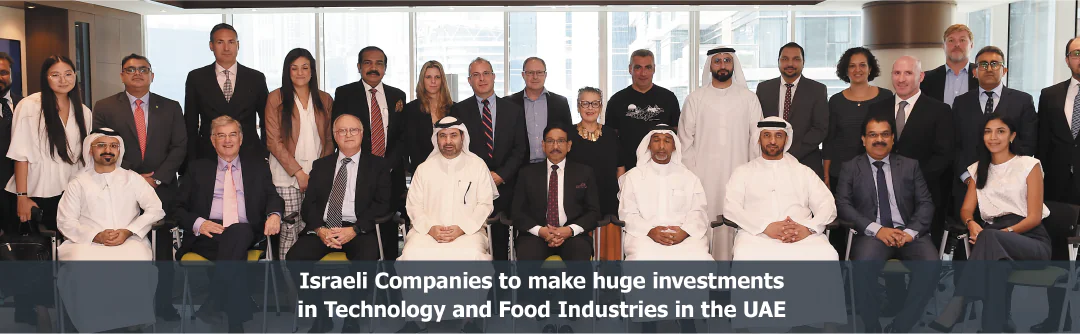
Israeli Companies to make huge investments in Technology and Food Industries in the UAE
Kreston Menon

As the bilateral trade relations between the UAE and Israel are steadily growing, more Israeli companies are looking for major investments in the UAE. According to Prof. Ehud Menipaz, Chairman of International Advisory Committee, Israel Directors Union (IDU) the focus sectors would be Fintech and Digital Security, Food and Agriculture as well as in Energy. He was talking at the “UAE-Israel Business Meet 2021 – A Hybrid Event” hosted by Kreston Menon and Israeli Directors Union (IDU).

Ibrahim Ali, Director of the Investment Promotion Division of Dubai FDI presented the ‘Dubai Advantage’ and invited the Israeli investors to partner with Dubai to shape the future. He interacted with the visiting Israeli delegation of 26 investors in person and with over 200 delegates who attended this hybrid event online.

Jamal Bin Marghoob, Senior Director – Sales, Dubai Airport Free Zone (DAFZA), Faisal Jassim, Senior Manager – Sales, Jebel Ali Free Zone (JAFZA) and Rashid Al Mulla, Vice President – Marketing, Dubai Commercity presented the sector wise advantages that the Free Zones can offer to Israeli businesses. They reiterated rather than being a passive facility provider they are committed to be active partners to the growth and expansion plans of Israeli investors by being a gateway to the world markets.

Dr. Gritt Gur-Gershgoren, Chair of the Chairman Club IDU reiterated that the progress made in the first year of signing the Abraham Accords Peace Agreement, is bound to grow beyond expectations.

According to Shmulik Ben Tovim, President of the Fintech Community of Israel, major partnerships are in the pipeline in the Fintech sector, as Dubai is considered as the region’s hub for financial services and Israel as the tech capital of the world.

Speakers from diverse industry sectors including Banking, Taxation, Real Estate, Legal and Healthcare talked about the investment opportunities in the UAE. Pushpakaran Parambath gave an overview of 100% Foreign Ownership in the UAE while Surandar Jesrani, Managing Partner and CEO of MMJS Consulting made a presentation on the VAT Scenario in the UAE.

Other speakers included Ali Imran, Head of Transaction Banking & Digital Services, Comemrcial Bank of Dubai, Benjamin David Martin, Chief Commercial Officer of VPS Healthcare, Michael Ghaderi, CEO of Aaronz & Co Real Estate, Mohammad Maria, Managing Partner of Just Wills and Gilles Gamon, CEO of BioMeat FoodTech Ltd from Israel.

Doron Rozenblum, Managing Partner of Kreston IL expressed his confidence that more bilateral business partnerships will emerge and Israeli companies with global plans will be looking at UAE as a launching pad.

Raju Menon, Chairman and Managing Partner of Kreston Menon and Sudhir Kumar, Senior Partner and Head of Corporate Communications assured that Kreston Menon, who has supported and guided more than 8000 investors to setup operations in the UAE, will partner with IDU and Kreston IL to promote FDI in both the UAE and Israel.


FDI Law Update on 100% Foreign Ownership – Manufacturing Sector to be the Biggest Beneficiary
Kreston Menon
In the previous two articles, my colleagues elaborated on the recent FDI Law update allowing 100% foreign ownership in mainland companies. We are overwhelmed by the great response and we are excited that it has led to meaningful deliberations on how our clients can benefit from the new change in the Law.

The UAE has strategized to raise the industrial sector’s contribution to GDP and boost economic growth by building a diversified and sustainable economy. The country has set its goals to equip the economy for the Fourth Industrial Revolution post oil era through the UAE Vision of 2021 and UAE Centennial 2071 – the Five-Decade Government Plan. The reformed FDI regulations and the associated cabinet resolutions shall act as precursor to the sector.

Despite recent fluctuations in oil prices and the global slowdown caused by the Covid-19 pandemic, UAE’s economy is moving towards greater diversification and a future-based on leadership in non-oil sectors.

UAE understands that the advanced technology outputs are radically transforming the business models and investment climate across the globe even as companies struggle to address supply chain and additional manufacturing location issues. Strategically located, UAE ranks high in all the five key dimensions of manufacturing environment namely policies and regulations; energy and transportation; workforce quality; infrastructure and innovation; and unrestricted adaption to automation and AI facilitates. Increased productivity that results from such economic environment helps develop transformative technologies which are envisaged in the UAE national strategies created to guide development during the next phase in the fields of Advanced Innovation, Artificial Intelligence (AI), Fourth Industrial Revolution and so on.

While there are uncertainties on the prospects of growth in the near future, UAE is now focusing on completing the strategic and infrastructure projects which were on hold due to various reasons making UAE the preferred destination for new investment. Enough weightage is given to the manufacturing segments which complement these projects in all economic sectors such as renewable and nuclear energy, aluminium, military, food, engineering, plastics, medicine, aviation, space, robotics, artificial intelligence, self-propelled vehicles, biotechnology etc.

Current Contribution of Various Sectors to the GDP of UAE


Sectors and General Conditions
The positive list available to the foreign investor at 100% ownership


The Foreign Investors have to meet the general conditions which are applicable for all the three sectors:

  • Use of advanced technology;
  • Adding value to the UAE economy;
  • Contributing to Research and Development; and
  • Meeting the requirements of the licensed activities.

Status of National Industrial License
It is worth to be noted that “the Article (8) of the FDI Law clearly states Foreign Investment Companies licensed pursuant to the provisions of this Law shall be treated as national companies to the extent permitted by legislation in force in the State and international agreements to which the State is a party”.  ccordingly, the Foreign Investment Companies are also eligible to be treated as an industrial unit having National Industrial License and thus benefitted with:

  • Duty exemption to import raw materials and machines
  • Privilege to use “Made in UAE” mark on final product
  • Duty exemption to export products to GCC countries
  • Duty exemption to export products to member countries of Great Arab Free Trade Agreement

Current Contribution of Various Sectors to the GDP of UAE


The investors will still need clarity on certain requirements specified in the Law, such as:

  • How do you demonstrate high added value?
  • How will the contribution to research and development be measured?
  • What is the magnitude of Emiratization requirements?
  • What are the criteria to assess if the technology can be considered “modern”?
It is noteworthy that the Cabinet Resolution clearly mentions the mode of exit of UAE national partner enabling the foreign investor to acquire the entire shares and thus transforming the entity as a FDI Company. My advice to the existing manufacturing entities in UAE would be to explore this opportunity to strengthen and protect their investment.

Kreston Menon Corporate Services team will be happy to address your queries regarding the new FDI Law.
UAE Federal Law on Foreign Direct Investment – The Game Changer
Kreston Menon
Covid-19 impacting world economies
As the Covid-19 pandemic continues to rip nations, governments are forced to impose strict public health measures, such as social distancing, to physically disrupt the conta- gion. By doing so, the flow of goods and people are halted, economies are stalled and many economists are predicting a global recession. But there is hope as many govern- ments are taking unprecedented steps to contain the economic damages caused by this pandemic.
UAE’s Response
UAE has always been the most favoured investment destination in the Middle East and the credit goes to the timely decisions taken by the visionary leaders. We have seen a flurry of investor friendly measures in the past which has helped UAE retain its global reputation intact.

It is heartening to see the numerous initiatives taken by the UAE Government to support the business community at this challenging time. In the past few weeks, we have seen a spell of encouraging announcements aimed to provide relief to various sectors of the economy.

Few days back, the Ministry of Economy announced a new list of service fees, reflecting a reduction across 94 of its offered services, particularly provided by the Ministry to the public covering individuals, companies and the business sector.

The Federal Government as well as all the Emirates have introduced many relief measures and the governmental agencies and free zones have followed suit with deferment of rentals and license renewal fees. A number of regulatory reliefs announced by the Central Bank of UAE is aimed to soften the impact of the pandemic.

In this series of communiqué, we will be talking about the new update on the UAE Federal Law on Foreign Direct Investment grant- ing foreign investors an ownership up to 100% and related incentives. The positive list provided for in the UAE FDI Law has now come into effect and will prove to be a significant stimulus for foreign investors who are interested in investing in or have already invested in the UAE.

Background of the new FDI Law Update
Positive List Resolution
On 23 September 2018, Federal Decree-Law No.19 of 2018 on Foreign Direct Investment (FDI Law) was issued allowing increased levels of foreign ownership by foreign investors in certain companies and sectors of the economy. Later in 2019, the UAE government approved the ‘Positive List’, outlining the details of relevant activities and sectors wherein foreign investors can invest up to 100% in mainland companies in UAE. The primary objective of the FDI Law is to attract large scale investment by foreign investors by providing exceptions to the provisions of the Federal Law No. 2 of 2015 on Commercial Companies which mandates that foreign shareholders can only hold up to a maximum of 49% of a mainland company’s shares.

On 17 March 2020, the UAE Cabinet issued a Cabinet Resolution setting out the ‘Positive List of Economic Sectors and Activities in which Foreign Direct Investment is Permitted’ termed as the ‘Positive List Resolution’. The Positive List Resolution is now in effect as it was published in the Official Gazette dated 31 March 2020.

The positive list available to the foreign investor at 100% ownership


Negative List
The FDI Law, has published a ‘Negative List’ for sectors where foreign investment above 49% will not be permitted. The Law states that the UAE Cabinet has discretion to amend the “Negative List” by adding or removing sectors. 13 sectors are currently specified in the ‘Negative List‘, including oil exploration, the defense sector insurance, financial institutions, telecommunications as well as
ground and air transportation.

Sectors and General Conditions
The activities on the FDI’s Positive List span across three sectors:

  1. 19 activities in Agricultural Sector
  2. 51 activities in Manufacturing Sector
  3. 52 activities in Services Sector
The Foreign Investors have to meet the general conditions which are applicable for all the three sectors:

  • Use of advanced technology;
  • Adding value to the UAE economy;
  • Contributing to Research and Development; and
  • eeting the requirements of the licensed activities.

Capital Requirements
The FDI Law requires a minimum capital investment between AED 7.5-10 Million for the Agricultural and between AED 2-100 Million for the Manufacturing Sectors, while the capital requirement for the Services Sector will be in accordance with the legislation in force. It should be noted, however, that the Resolution relies on the general minimal capital requirements for some commercial activities.

Benefits for Foreign Investors

Opportunity for existing companies
The new FDI Law is not only applicable to new companies, but also provides the opportunity to existing companies to change into a FDI Company. I believe that this will be something that many of our esteemed clients would like to explore.
Changing the Landscape of Internal Audit
Kreston Menon
Background

The inadequacy of system to cater to business needs, issues regarding integrity and robustness of data generation (MIS), the absence of management strategy for monitoring risks, lack of control over the operational process, ambiguity over policy and procedures and issues so galore.

The above situations appear familiar? Indeed, these are common challenges that plague many businesses regionally and globally. Conventional belief laid emphasis on achieving business results and cash inflows, relegating the need to address pressing issues. Mounting challenges of varied nature posed by new economic order have made compelling reasons for businesses to introspect, to improve efficiencies, identify and manage risks, control leakages, rationalize costs etc. With matters of risks, control and governance gaining priority, many businesses are viewing internal audit as an important tool to achieve its dynamic objectives.

This article is an effort to shed light on the new approach used in internal audits that has led to increasing acceptance of internal audit activity as an investment that provides a return to an entity and not just reflect as a cost on the income statement.

Internal Audit
Internal Audit as a concept is exhaustive, but broadly refers to an activity carried out by independent professionals to assess whether an entity’s process and controls are adequately designed and are operating effectively, business risks are effectively identified and managed, whether resources are efficiently utilized etc. Based on the observations and findings, solutions and suggestions for improvements are provided in the form of a report to the team entrusted with governance.

The process areas covered under internal audit activity can be extensive but generally includes inter-alia, review of operational and financial functions of an entity (Operations, Procurement, Finance and Accounts, Human Resources, Information Technology etc.). Depending on the size of the entity, complexity of operations and the objectives to be achieved, approach to internal audit could assume the form of review, by covering different functions over a period. Alternatively, it may involve review of the design of all the functions at a time, backed by follow-up reviews. Dividing the scope into various functions, covered over a period, facilitates specialized focus on the department’s efficiency in achieving functional objectives as well as entity’s objectives.

Evolving Internal Audit Approach

There has been a paradigm shift in the expectations of businesses from the internal audit activity. Growing business competition, disruptions caused by advancement in technology and the desire and vision to be the industry leader by clients have brought to the fore, key questions regarding value creation, effectiveness and relevance of internal audit. This entailed an objective response by the internal audit fraternity, transforming the activity from a typical checklist-based conventional approach to a more sophisticated, comprehensive and risk-based audit.

Erstwhile Approach

Traditional internal audit approach involved an overall review of process and controls for compliance to established procedures from financial accounting/ treatment perspective. Also, the earlier approaches had greater focus on transactional accuracy and compliance with approved procedures.

This, to a large degree, ignored any significant impact of risks arising from operational, market and regulatory factors of the business. As a result, the traditional approach educed the internal audit to a mere fault-finding activity drawing lesser participation from the client management.

New Approach to Internal Audit

With the advent of the renowned concept of Enterprise Risk Management (ERM) Framework, a model developed by Committee of Sponsoring Organization of the Treadway Commission (COSO) for evaluating the risk management practice of an entity, coverage under internal audit has evolved into a more holistic and objective-based approach.

One of the components of ERM framework calls for risk assessment at all levels of the business organization setup including Entity Level, Division, Operating Unit and Function. Risk Assessment is a process of identifying and appropriately managing any adverse event (risk) that may impede or pose a challenge to an entity in achieving its goals or objectives (long term or short term).

The relevance and importance of timely risk assessment were greatly felt by corporates across the globe when market leaders faced an overnight catastrophe or near business closure event. Famous examples are Yahoo not assessing risk related to consumer preferences and eventually losing out on user experience and search engine business (market risk), BlackBerry losing out its relevance as they did not focus on bigger touchscreen displays (product technology obsolescence risk). More recent example is when Imagination Technologies Group suffered a major setback when Apple, its single largest customer (customer concentration risk), discontinued using their product. This concept of risk assessment was adopted by internal auditors to develop a risk-based audit approach to help businesses achieve operational, reporting and compliance objectives by becoming agile, transparent and resource efficient.

A risk-based audit approach requires a complete understanding of the entity’s business, industry, market segments, customers, suppliers, operations and expectations of the stakeholders. This understanding is transformed into objective statements at all organizational levels of the entity and risks (events having an adverse impact) impeding achievement of such objectives are identified, assessed for their risk levels and mitigation strategy is implemented.

Outcome/Benefits of Risk Based Audit Approach

Some of the major benefits arising from risk-based internal audit approach are listed below:

Internal audit UAE

Conclusion

The above internal audit approach and outcomes/benefits derived in recent times, has made internal audit activity pivotal to corporates looking to unlock their potential and be prepared to face any adversity.

Further, the advancement in data analytics has led the internal auditors to employ advanced technologies to effectively orrelate the performance of the controls over risk, which an organization might encounter.

Kreston M E Consulting (formerly Morison (UAE) Consulting) has been providing internal audit accounting services Dubai including, systems review, business process review, drafting of policy and procedure manuals etc., for many years creating considerable value to its clients from varied industries.
Reinventing business in the digital era
Kreston Menon
Digital threats and opportunities

Digital technologies are leading to many of the wellentrenched businesses losing their market share rapidly  to new and nimble players emerging with innovative business models. The threat from new digital startups will continue to grow as digital technology keeps evolving.  Digital technologies also, however, provide the incumbent  businesses endless opportunity to expand the scope of  their business, come with newer operating models and  provides them to leverage existing platform or build a new  business platform for themselves, their clients and even their  competitors.

Digital strategy

For a leader of successful business from the past it becomes  important to assess and sometimes discard the strategies that have been successful in the past; identify new ways of doing business which could be changes to the business  model, processes or customer engagement and change  from having a portfolio of products or businesses.

Business leaders need to know if their business is influenced  or affected by digital technologies already or in the near  future. Your business is becoming digital if:

  • Data analytics and artificial intelligence is affecting business processes and decision making
  • Social media shapes the opinion and consumption pattern of your customers to your offerings
  • Mobile apps and cloud are key to delivering your offerings to your individual and enterprise consumers
  • Your product is embedded with sensors and software
  • Your supply chain is thinking of using robots and drones
  • If any of the above applies to your company, then the company is already on the digital path. In the next ten years, you can expect digital to drive every aspect of your business.
Digital framework

The digital technologies have resulted in customer acquiring immense power to take decisions. Even though digital is supposed to make decision-making quicker for the customers, in reality, customers are spending more time online to review the options available to them for their purchases due to plenty of online information available. As business leaders, you must have realized that the digital tools have greatly enabled the power of consumers to make an informed decision. Your organization may have probably started a few digital initiatives and carried out experiments to digitalize the business. For digital to make a transformative impact, you need to have a new framework for reinventing the business which will involve leveraging the existing strengths and developing new capabilities for successfully adopting  the digital technologies. The key components of the new framework consist of reimagining the business, reevaluating  the value chain, reconnecting with customers and rebuilding  the talent pool. Reimagining the business requires looking  at the scope of the business, existing business model and  customer behavior and preferences

Redefining the scope of the business around customers and not around your product or competencies in the digital age is very important for survival and growth. Amazon has 0leveraged digital to define its business around its customers and build competencies that help it to leverage digital  technologies. Redefining your business around customers is just not limited to technology companies. Traditional business in the automobile, hospitality and banking sectors have woken up to the challenge posed by Uber, Airbnb and Paytm respectively and have begun to offer their customers solutions that these companies offered.

Digital shaping customer interaction

Business leaders need to realize that competition is no longer defined by traditional industrial oundaries and digital technologies are blurring the boundaries. Today the customer needs are rapidly changing driven by the advances in digital and incumbent business need to constantly interact with the customers directly and through digital platforms to evolve their business model to meet the shift in customer needs.

The companies that have successfully leveraged digital in the past have mastered a few skills that need to be emulated by the new players planning to transform their business through digital.

Getting to know more about their customers through data analytics
Building skills and capability on digital technologies and deploying them
Building a series of complementary services around the core business thereby redefining the ompetitive advantage
Amazon, Airbnb, Uber, Paytm, Netflix and many other digitally driven businesses have successfully mastered the above skills and built capability around that to successfully challenge the incumbent well-entrenched businesses and radically change the consumer behavior.

The emergence of digital-driven startups in the last decade which have acquired large customer base led by a series of changes in the consumer behavior requires incumbent to radically transform their business model to protect their existing business.

The growth of digital technologies is changing customer behavior to move away from owning the products to experiencing the product. Product companies need to understand this shift in customer preference and evolve their business model accordingly. This shift is very much visible in the shopping malls in the U.S., Europe and the GCC where the malls in their fight against e-commerce players to increase their footfalls are creating experience shopping  for their consumers at the malls through restaurants, culinary schools, cultural events targeting different age groups.

Conclusion

Companies need to understand their digital inflection point to realize if the existing business model is becoming ineffective. Leadership needs to mobilize their team for the digital journey. Invest in small digital experiments. Adopt an agile framework to rollout digital initiatives and have a passionate team to drive the digital transformation
The Seven Essentials of Successful Business Innovation
Kreston Menon
Need for organizations to be innovative is a critical requirement for organic growth. Organizations can run innovation programmes the same way they run their factories – with inputs, transformation processes and desired outputs. Of course there would be non-financial and financial measurements to verify the effectiveness of the innovation programme. Innovation no doubt is risky but like many other business risk can be quantified, calibrated and managed.

Many organizations think of innovation as limited to products, technology or services which is not the case. Innovation can be extended to other areas of the business such as procurement, supply chain, manufacturing, costing and business models. Innovation also need not be unsettling and big ticket, but can be incremental and less glamorous.

There are several examples of businesses successfully innovating not in product. US retailer Walmart’s claim to success is really their inventory management and Indian e-tailer Flipkart’s innovation is about delivery and payment options.

I don’t have geniuses, can I innovate is a question that haunts many leaders. Such thoughts are dangerous and fatal for creation of innovative organization. Innovation can happen by taking advantage of skills of ordinary knowledge workers. Leadership need to structure, manage, measure and improve innovative processes to produce stream of innovation.

Essentials required for organization to be successfully innovative:
First and foremost requirement for organization to be successfully innovative is inspiring leadership and customer centric approach. Other important aspects to consider would be, purpose, stretched goals, innovation culture and enabling structures, reliable systems and processes.

1. Inspiring Leadership
Inspiring leadership has to set organic growth goals which cannot be achieved without innovation. Leader has to ensure that consumer / customer is keenly observed and listened in the process of innovation. Leader has to tie-up teams across the organization into the innovation path. There has to be a structured mechanism to constantly review and assess the progress of innovation. Small experiments have to be carried out and experiments that fail have to be erased. Leader also has to mould diverse individuals into innovation team. Lastly leaders need to ensure a strong idea pipeline by encouraging idea flow though strong process.

2. Customer-led
Innovation to be successful has to be customer-led. Sales and marketing team has to make extraordinary efforts to constantly know the needs, expectations and desires of their customer- both stated and unstated. The focus should be to know the gaps consumers perceive in the product / service offering and what the customer want and the impact of the offering for the customer. Sales should also find out the reason for customer, many times, not buying their entire requirement from single supplier and why, many times, customer buys the product only first time.

3. Innovation culture
Organizations need to ensure that idea flow is not encouraged only from perceived geniuses within the organization or from R&D team. Idea flow has to be encouraged from ordinary knowledge workers with system of rewards and appreciation. The fear of failure is stumbling block for ordinary worker to participate actively in idea flow and pipeline. Organization culture should be such that fear of failure has to be eliminated. The organization culture should foster curiosity, openness, collaborative work and experimentation. Employees should be trained to become innovators.

4. Enabling structures
There should be a framework in the organization that makes innovation a routine affair. Idea flow can be from internal people or from customers, suppliers, JV partners and other stakeholders. Ideas can be incremental or disruptive. Idea flow has to be perpetual.

5. Short listing ideas for next stage
Ideas selected should have clear linkages to organization revenue and growth goals. The shortlisted ideas should be a mix of incremental and disruptive. The idea pipeline should have ideas, both low and high risk ideas and flowing from internal and external stakeholders. The ideas need to be prototyped passed through stage-gate process and finally tested at customer-end for feedback.

6. Idea ownership
Every idea needs to have an owner who will be responsible to identify the resources, arrange fund, allocate them, pilot the idea through stage-gate process, subject the idea to review, reward success and deal with failures.

7. Go to market
Go to market of an idea does not mean only sales and marketing team would be responsible. Such a step is sure way to kill an idea. Innovation team has to involve the manufacturing, applications and sales and marketing team together at every stage of the process to ensure successful transfer of idea to the customer. To conclude organizations need to understand that innovation is the best form of defence for organizations to maintain consistent growth trajectory. Growth through inorganic acquisitions can at best be short-term defence strategy. Innovation will help organization to enter new markets faster and deeper with better price margins. Innovation puts sales team in offensive mode in the market and provides them an edge against competitors. Lastly there is no choice if organizations don’t innovate. Failure due to non-innovation is a certainty and hence it is every leader’s priority to build an organization that supports and fosters innovation and delivers it.

This article was originally published in Kreston Menon April-June Newsletter.
Inheritance in UAE – Way forward for expatriate investors
Kreston Menon
Matters of inheritance in the UAE are governed by Federal Law No. 5 of 1985 (amended in 1987) regarding the Civil Transactions in the UAE (“the Civil Code”), and by Federal Law No. 28 of 2005 regarding the UAE Personal Affairs Law (“The Personal Affairs Law”). However, as a general rule, inheritance issues for Muslims are dealt with in accordance with Sharia’h, whereas for non-Muslims, the law of the deceased’s home country may apply provided there is a Will or a corporate structure in place to address an eventuality. Accordingly, it is highly imperative for the investors or residents of UAE to have a Will in place absence of which directly attracts provisions of Sharia’h law with respect to the inheritance of their assets. Upon death, the personal assets of the deceased, including local bank accounts, shall be frozen (Article 379 (4) of the Commercial Transactions Law, UAE Federal Law No. 18 of 1993) till the local court releases the order of succession.
As a matter of reference, when Sharia’h law is applied to the properties of the deceased, the wife of the deceased receives one-eighth of the total estate, while the children receive one-sixth of the share. For every share received by the daughters, the sons receive twice as much. Amendments were made to the Civil Code in the year 1987 and the Article 17/1 further states that inheritance shall be subject to the law of the deceased’s home country at the time of death. This law was promulgated to curtain the confusion surrounding inheritance issues for expatriates. Therefore the law of the domicile country of the deceased would apply. However, as per Article 5 of the Code, provisions have been made to apply the law of the United Arab Emirates to the Wills made by aliens disposing of their real property located in the State. Further, the Personal Affairs Law (No 28 of 2005) made it clearer that, a non- Muslim expatriate who is resident in the UAE can opt for the law of their Domicile Home Country to be applied to the distribution of their UAE assets, provided they have a legally recognized Will.
Freehold Property & Corporate Structure
Though the freehold property is governed by the inheritance laws of Sharia’h and may not be distributed in accordance to the conditions of the Will, the recent practices show the local authorities treat the inheritance of ownership of the freehold property favorably in the case of non-Muslim investors provided there is a Will or corporate structure in place. However, the local fraternity is of the opinion to examine the application of Sharia’h closely in the case of real properties owned by the foreigners. Considering the possibility of application of Sharia’h laws, the investors may seek the option of corporate structure in place to own real estate properties in UAE in addition to have a Will.

Special Purpose Vehicles for holding shares in UAE registered companies (Limited Liability Company/Free Zone Company)
Similar treatment shall be applicable to the inheritance of ownership of shares in a locally registered limited liability company as well as a company registered in a Free Trade Zone. It may be considered to own the shares of a local mainland company or a free zone company by an offshore entity formed outside UAE. Among other basic advantages, bringing an offshore structure in the line of ownership of locally registered company offers convenience in inheritance since amendments in the documents of the local company is not warranted unless there is change in management.

The beneficial owner of an offshore entity formed outside UAE, may further opt for establishing a trust structure in place to ensure a smooth succession in case probating a Will at the court in an offshore jurisdiction is affected by the residence status of the deceased. In light of the above, considering British Virgin Islands as the preferred offshore jurisdiction for the time being, the trust may be established in accordance to the Virgin Islands Special Trust Act – Vista Trust – by which no probate is required and the director of underlying BVI Company has freedom to control the assets owned by the BVI Company.

It may also be considered the shares of the BVI Company be held in the joint name of the tenancy of the survivorship with the family members (wife/children) which will allow smooth succession from father to children. However, the other side is immediate ownership to the shares and thereby acquires rights.
Guardianship of Minor Children
It is worth noting and should consider in line with the inheritance, the custody and guardianship of minor children. The legal way to address this vital matter is to appoint individual(s) to care the children by naming them as testamentary guardian(s) in the Will. Accordingly guardian(s) can step in to the shoes and care the children till they become adults if they were minor at the time when the parent dies.
Conclusion:
The UAE Civil Code requires the immovable assets should be distributed to the legal heirs as per the provisions of Sharia’h law
Owning real estate is considered as owning an immovable asset and technically this should be distributed as per Sharia’h law
It is widely being debated and there are tested cases that foreign law applied and the real property distributed as per the deceased’s Will
The UAE Courts are likely to decide on the applicable law on a case by case basis.
It is always advisable to execute and register a Will in UAE which has been written under the laws of home country or have the corporate structure in place in an offshore jurisdiction outside UAE which ultimately owns UAE situs assets and properties.
VAT ENGINE
Kreston Menon
Age of Technology

Data is the new oil of the world. The business inputs that can be derived from the data points and acting upon it makes or breaks a company in today’s world. It has become a reality that technology has taken over the mundane tasks that has had the brilliant human minds at stake. The impact of Artificial Intelligence on our lives both professionally and personally cannot be ignored or avoided.

In such an era, it is natural to be worried since it is rendering humans redundant but at the same time it is imperative to understand that the technology is also making us smart by freeing us up to do the more high-yielding work. Who would have anticipated that we could make complex calculations in few seconds or for that matter open a bank account just by talking to a virtual assistant?

Tackling VAT Compliance using Technology

VAT as a subject has been relatively new to the GCC region and being a consumption-based tax, puts a lot of onus on businesses for compliance. With a staggered mode of collection across the supply chain, businesses step into the role of custodians of government revenue for collecting and depositing taxes. With this role of custodianship, comes the responsibility of being 100% accurate and to do justice to this responsibility, a lot of businesses end up investing significant amount of resources – not just monetary but also, time. Many businesses may still not feel confident about their VAT returns, despite the amount of resources put in, because:

  • System set-up issues
  • Multiple sources of data
  • Time lags
  • Inter-dependency on numerous people, across departments
  • Human intervention in ERP
  • FTA updates, etc
Businesses today have started their migration towards technology and automation within their organisation changing their work style and sometimes line of business. Evidently, organizations resort to machines as they are especially good at repetitive actions, don’t get tired, avoid mistakes and react in a speedy manner. Much of the inhouse functions in an organization are automated and Value Added Tax (‘VAT’) compliance is not an exception. Most of the big organizations continue to employ large numbers of people in VAT departments whose roles are very process oriented.

For example;

Repeatedly engaged in requesting for information and data from within their own organization’s business verticals;
Aligning the date in case the date is not provided in the specified format, manually;
Spending time in checking, adjusting the data to ensure the accuracy of VAT returns, manually;
Preparation of Group VAT returns, manually;
Preparing VAT reports, manually; and
Reconciling the VAT returns prepared with chart of accounts, manually.
lmagine there is a system which does all such tasks with least human intervention for carrying out data and analytics testing. This system does not have sick leaves or family time, it can work 24*7, 365 days a year. This is our tax engine, VAT eGenie.


It must be understood that the tax engines are not rigid and can be customized to meet the requirements of each specific businesses across multiple systems. What may look complex today can be broken down into multiple pieces and fixed on the click of a button.

How would it help your company and people?

  • One-time set-up, post which the engine sits on an auto pilot mode;
  • Reduction of human intervention reducing errors;
  • The Tax engine can also integrate with your inhouse ERP software supporting collation of data
    from multiple sources;
  • Regular updates released by FTA, which helps in ensuring your business is updated;
  • Timely VAT reporting (even daily possible)
  • Accuracy and transparency of tax returns
  • Reconciliations (multiple of them, GL, Customs data etc)
Is your organisation ready for a change?

There is never a right time to be ready, it is a process and the companies that start early will benefit the most from it. Even we as consumers were initially more cautious towards making online payments or swiping our credit cards as we were concerned about the safety of our bank details. However, advances in digital security have reduced those concerns and now digital payments have become an important part of  our daily life.

The FTA has adopted technology by making available the submission, payment and filing online without a single paper to be submitted physically. This requires the companies to also be ready to embrace a digital approach for Tax Compliance.

Tax engine is not going to result into savings, accuracy and optimization if we mull over it without taking any action. What will set you apart as a company is your approach towards tackling VAT compliance with technology
Doing Business in UAE, Why Dubai & Abu Dhabi Become Good Places?
Kreston Menon
Doing business in UAE is an uncomplicated and hassle-free. The visionary government has always had pro-investment and pro-business policies, and has encouraged foreign investment. In fact, in the UAE, those who setup business are even offered incentives. Redtape is minimal, procedures are simple, and is taxation is almost non-existent. The government of the UAE had the foresight to realise that backing new businesses will help sustain their economy in the long run. Due to all these reasons, Dubai and Adu Dhabi are ideal places for business setup UAE and open an offshore branch.

Let’s examine the reasons for Doing Business in Dubai & Abu Dhabi, UAE in some detail:
Growing and Diverse Economy: the economy of Dubai is a dynamic and constantly growing one, which is why it is so attractive to companies from all over the world who are interested in company formation in an offshore location. This wealthy Emirate has a stable financial climate which helps a wide range of businesses from start-ups to multimillion dollar conglomerates to operate successfully.
Legal Framework: entirely different set of rules and regulations (except for criminal law) are applicable to foreign investors who want to set up business in Dubai. Paperwork is minimal and procedures are fast tracked so that it becomes extremely easy for company setup, licensing and registration and so on.
Physical Infrastructure: the governing bodies of the free zones provide excellent infrastructure and warehousing, office spaces, power supply, connectivity, and so on.
Availability of Manpower: there is no shortage of manpower in the UAE and especially so in Dubai. Both skilled and unskilled labour flock to the UAE in search of opportunity as wages are high and taxes low, or non-existent. It is therefore easy for a new company to find the requisite manpower for their operations.
Investment Support and Promotion by the Government: the government provides several pre-and post-support services to investors doing business in Dubai or elsewhere in the UAE, like help with documents, licenses, certificates, postcodes and so on.
There are several special areas within the UAE which have special tax customs and imports rules and regulations; these are called Free Zones. In the UAE are over 35 free zones which are spread across Dubai, Abu Dhabi, Sharjah, Ras Al Khaima, Fujaira, Ajman, and Um Al Quwain. These free zones are also spread across the mainland airports and seaports.
The special benefits of these free zones are:

  • Complete exemption from import and export tax
  • Possibility for complete foreign ownership of the company
  • No corporate tax for up to 50 years
  • Exemption from personal income taxes
  • Possible to repatriate the entire capital and profits
  • Support services like assistance with hiring, sponsorship, housing, and so on.
Generally a Free zone is meant for certain specific categories of industry and licenses are provided only to those companies functioning under those categories. Probably the most famous of these is the Dubai airport free zone.

Open Trading Hub: being a member of the World Trade Organisation, Dubai encourages open trade and has established stable trade relations with several countries in Asia and Europe and North America. In fact, it is a kind of meeting point between the east and west as far as international trade is concerned.
Quality Lifestyle and Culture of Excellence: Dubai is perhaps the most cosmopolitan of all the emirates within the UAE, thus making it a popular destination for tourism and business alike. Home to many of the world’s biggest brands, it is a shoppers’ paradise. Dubai also hosts several trade shows and exhibitions, allowing businesses to showcase their best to the world.
Visionary Leadership: early on itself, the rulers foresaw the potential this tiny island nation had to be a business hub and accordingly, introduced legislation’s that set the wheels in motion.

Let’s look at the best places for doing business in UAE:
Dubai: probably the most popular destination for starting a company in UAE due to its liberal cultural atmosphere. The DAFZ, or Dubai Airport Free Zone, is the leading Free zone service provider in the UAE. Established in 1996, the governing body of the DAFZ provides organisations with a modern and inclusive base to conduct business. Other free zones in Dubai include the International Finance Center, Gold And Diamond Park, Industrial City, Internet city, and so on.
Abu Dhabi: the Khalifa Industrial zone, or KIZAD, is the largest and one of the best planned industrial free zones in Abu Dhabi. It supports manufacture, logistics, and trade. Companies can enjoy low operating costs and comprehensive and innovative infrastructure. The Abu Dhabi Airport Business City owns, operates, develops, and manages free zones around the airports.
Sharjah: The Airport International Free Zone is the premier Free Zone in Sharjah that encourages foreign investments.
Ras Al Khaima: This Emirate chiefly provides the RAK Investment Authority Free zone, the Ras Al Khaima Free Trade Zone, and the Ras Al Khaima Media Free Zone to foreign investors.
Jebel Ali: this Free Zone located at the western end of Dubai. Started in 1985, it provides ready-made facilities to customers, and has now expanded to include light industrial units.
Other convenient free zones in the UAE for business setup include Hamriyah, Jumeirah Lakes Towers free zone, Fujaira Creative City and so on.
How does Kreston Menon help for starting a company in UAE?
Before starting any business anywhere in the world, it is important to conduct a feasibility study to know what your prospects for success in that particular industry and geographical location are. This is the first step in the process of business setup Dubai. This is where we, Kreston Menon, step in as business consultants. We help by conducting market research and a feasibility study, and can offer expert advice throughout the way. This includes guidance and/or assistance with the following:

  • Legal issues relating to the business structure
  • Finding the appropriate location for the new venture
  • The preparation and submission of the requisite documents
  • Liaising with the authorities to obtain the requisite approvals and certificates
  • Visa, immigration and labor card support services
  • License renewal reminders and liaising with authorities for the same
  • Provision of secretarial services for the new company
Our in-depth knowledge of offshore company formation UAE has enabled us to assist in the incorporation of over 500 companies in the UAE Free Trade Zones. We believe in delivering comprehensive service to our clients after understanding the exact requirements. We are happy to stay that with our professional and client centric approach we have been able to build long-lasting relationships with our clients. The expertise and dedication shown by our team will ensure that you have smooth sailing as far as your company incorporation in Dubai or elsewhere in the UAE is concerned. We take care of the nitty-gritty so that you can just focus on your core business and in growth. We are passionate about our work and take pride in delivering customised solutions that not just meet client expectations but exceed them.

Our expertise includes the following areas:

  • Accountancy, analysis, financial consultancy, taxation, corporate finance, property and HR consultancy
  • Turnkey solutions for clients requirements
  • In-depth knowledge of the Middle East market especially the UAE, and regulations connected with company registration in the region
Our team is not only focused and professional, but is consistent in offering tailor-made solutions and getting results that are time bound and cost-effective. Kreston Menon also has excellent working relations with government agencies, decision-makers and others in power.

whatsapp