



Get in Touch
Recent posts

 gulfnews , Gulf News
UAE AND INDIA MARK THE FIRST YEAR UNDER THE LANDMARK AGREEMENT
A year after the UAE-India Cepa deal came into effect, the stage is set for the next big bang in trade and investment flows between the countries – a dirham-rupee payment mechanism.
When that happens, multiple categories – and businesses within them – would benefit from the closing deals in the two currencies and not have to use US dollars to make it happen. What that does is cushion trade between the countries from foreign exchange volatility brought on by the dollar’s movements.
“India is looking to ways that can speed up and smoothen out trade with its biggest economic partners,” said a senior Indian government source. “We have learnt the processes well in using the rupee in financing imports from Russia, and it’s been a major factor in limiting inflationary pressures in the economy.”
“If India and UAE sign a deal confirming rupee-dirham, it will further expand the scope of Cepa.”
Meeting CEPA targets
It was with India that the UAE entered into its first CEPA – or the Comprehensive Economic Partnership Agreement – that immediately brought down import duty across categories and opened up new investment possibilities for entities in these countries.
What UAE and India are looking for are to go in for immediate benefits from CEPA where possible and then work on those areas where they can make steady progress.
“I’m not aware of any UAE imports that are subject to 0 per cent import duty in India,” said Raju Menon, Chairman and Managing Partner at Kreston Menon, the audit consultancy.
“However, under CEPA, India has agreed to reduce or eliminate tariffs on a range of products imported from the UAE.”
“The UAE has agreed to provide tariff concessions to India on 60 per cent of items traded between the two, including on basmati rice, textiles, and pharmaceuticals.” (India last week reworked the processes involved for the country’s gold trade to source bullion from the UAE under CEPA. This could in the coming months see UAE provide up to 140 tonnes of bullion to India, and which will consolidate its status as the second biggest supplier of gold to that market after Switzerland.)
Trade is on the up
Trade gains have been there from the start of the CEPA becoming effective from May 1. Between April to November 2022, two-way movements totalled $57.8 billion from $45.3 billion a year prior to that. That’s a rise of $12.5 billion in value terms and 27.5 per cent in percentage terms.
India’s exports to the UAE went past $20 billion during this period, leveraging a 19.32 per cent increase.
“As per the CEPA agreement, there would be periodic reviews to assess progress and identify areas for further cooperation,” said Menon. “The UAE has set up a dedicated task force to ensure the smooth implementation of the agreement, while India has created a website to provide information about the CEPA and facilitate trade between the countries.”
Beyond $100b in trade
Boosting two-way trade to $100 billion is the stated aim before the end of this decade, but there is also the greater emphasis on generating more from trade in services, with a target of $15 billion.
The cable-maker Ducab Group recently opened an office in the south Indian metropolis of Bengaluru, and its CEO Mohammed Abdul Rahman Al Mutawa was there on the ground. And he’s liking what’s showing up as possibilities post-CEPA.
“India is our new home market,” said Al Mutawa. “India has always been of interest to us and CEPA made the decision of opening an office in Bengaluru easier.”
“Ducab has been supplying to the Indian market since 1988, with its first project being the Nhava Sheva Port in Mumbai. Ducab has supplied 263,000 MT of of CuEq (copper equivalent) of metals to the market through the years. This is equal to powering approximately 3 million houses.
The other big investments or commitments made by UAE businesses are by the likes of Emaar, LuLu and the Sharaf Group, while DP World is expanding the scope of its already substantial interests in that market.
But business chiefs say it is still too early to fully realise the full possibilities that come with CEPA. “The impact of such agreements can take time to be felt, as businesses need to navigate through the legal and regulatory requirements of investing in a foreign country,” said Abdul Jebbar P. B., Group Managing Director at Dubai-based Hotpack Global, currently on a major expansion in the UAE and Saudi Arabia.
India is becoming one of the most desirable markets for businesses from all over the world due to its sheer size. And the government has been prudent in encouraging investment.”
With CEPA, UAE businesses with an India focus might have that extra edge.
 gulfnews , Gulf News
Raju Menon, founder, chairman, and managing partner of Kreston Menon talks to Pranitha Menon about dreaming big, his management principles, and his autobiography The View from My Perch
Rajagopalan Menon, better known as Raju Menon, was 29 years old when he boarded his first-ever flight– from Mumbai to Dubai in 1991. Armed with a degree in Chartered Accountancy and a year’s work experience, he arrived on a visit visa with hope and courage to seek a life and livelihood in the UAE. ‘I was unsure of what the future held even though I had very clear visions of what it should be. There was no apprehension, just excitement,’ says Raju, who hails from a tiny hamlet called Edavilangu in the southern Indian state of Kerala.
Over three decades in the UAE, he would go on to found and helm the Kreston Menon Group, a leading audit and business consulting firm with operations in UAE, India, Qatar, and Oman; gather a long list honours; be named one of top 100 Indian Leaders in the Arab world, and pen an autobiography that is eliciting rave reviews.
Released late last year at the Sharjah International Book Fair, The View From My Perch chronicles his story of consistency and perseverance. Neatly demarcating his life into different phases, each represents a struggle and a step towards his destination and dream.

What led him to pen this story?
‘I never thought of writing a book and I felt I was too young to be writing an autobiography,’ says Raju, with a smile. However, the seed of a book was first sown by Sudhir Kumar, his senior partner Kreston Menon. A book, Sudhir was sure, could inspire students and young entrepreneurs.
‘Whether that happens or not, the thought convinced me to give it a try,’ recalls Raju.
The pandemic acted as a catalyst. Keen to use the free time that he had productively, he decided to pen his memoir. ‘To compile my experiences, thoughts, and vision into this compendium of life, I remember spending hours and days in the office meeting room, aptly named Maydan, which became my haven for ferreting into the past to dig out nuggets buried in the deep recesses of my mind.’
Once he got going, he wanted to ensure that the book would be perfect in all senses of the term. To that end, he made a few trips to Kerala to relive and experience once again firsthand some elements that had shaped his personality, and meet a few key people who in some way had had a bearing on his life.
Insightful vignettes of all of these feature in his book giving it a deeply personal feel.
‘Like everything else I do, I just gave it my very best,’ says the man who started out life in the UAE as an audit manager in a modest firm in Dubai.
What motivated him to set up Kreston Menon, a company that has bagged the Super Brand status for nine consecutive years? I ask.
‘To excel and never to be content with the ordinary,’ says Raju, with a smile. It is a mantra that pushes him to make his choices. It is a lesson, he says, he learned the hard way.
Need to think big
Forced to pursue higher studies in a privately-owned educational institution after performing poorly in his Grade 10 board examination, Raju watched with envy his friends heading off to vibrant, exciting environs of reputed colleges.
Realizing that his lack of focus at a crucial juncture of his studies had cost him the opportunity to continue education in a well-known college, he resolved ‘never to settle for the mundane again.
‘Even today, I hold that character trait dear. Think big, do big, execute big. You can break beyond the limits by thinking big. Once you think big and set your goals high, it will widen the horizon of your life, and bring you greater opportunities and greater success,’ he asserts.
Pursuing academics with a vengeance of sorts, he cleared his Chartered Accountancy exams in the first attempt, an achievement that made his parents proud.
Encouraged, he decided to set up an entrepreneurial venture in Kozhikode, Kerala. However, it did not take off as planned.
Not one to give up, he decided to look beyond the boundaries of his state to realize his dream of making it big in life. Heading off to Mumbai, he landed a job in a multinational company and earned valuable experience.
However, Raju’s dreams were big.
‘People get comfortable in their little successes and trapped in them for eternity, unable to realize their full potential. To succeed and achieve the maximum, one has to take risks and venture out into the challenging world… outside their safe haven,’ says Raju. Practicing what he preaches, he decided to move out of his safe job and took a flight to Dubai.
Raju was aware that it is a new place where he would have to put in long and hard hours to make a mark in his field. But he was willing to do that and more.
‘Upskill yourself and stay competitive. A successful entrepreneur needs to be a constant learner,’ he advises before adding, ‘Hard work is the cardinal principle for me.’
Is it not – work smart, not hard? I ask.
Hard work is the base. It is that first step that you must take before you work smart.
It was Raju’s mother, Susheela Menon, a midwife, who had a strong influence in shaping him into who he is today. ‘She was hard-working, willing to help people at any hour of the day or night, and was empathetic.’
The first job he got was in a company named Mak&Partners, in Dubai. For close to a decade here, he worked 14 hours every day. ‘I was never a clock watcher but used the flexibility given to me by my boss, Khalid Bhai, as an opportunity to gain knowledge and experience.’
In 1995, he set up the Kreston Menon Group. From a small team of three people, the firm today has grown into an enterprise employing more than 400 Chartered Accountants, internal auditors, and accountancy professionals. Raju’s wife, Girija Menon, is a senior partner at Kreston Menon and a certified internal auditor.
Even today, he believes in working hard… and smart. ‘Now, I head an organization that is structured and runs like a well-oiled machine. All I must do is manage it well.’
Delegation, he believes, is the key to effective management. ‘I have learned that micromanagement of people and business is self-defeating. When given the freedom, people bloom,’ he points out.
Trusting, empowering, incentivizing, and giving employees the freedom to creatively develop the business in their own style could work wonders, he says.
As an entrepreneur, he stands by the management principle of the People First approach and values work-life balance for all employees. ‘If you do not empower your leaders (partners, directors, managers) and give the freedom to operate, you won’t be successful,’ he says. ‘I am supported by a great team that shares the same objectives and strives for a common goal.’
Raju believes that there are no shortcuts to success. ‘My success will definitely be counted on how effectively I am creating a unique experience for each of my clients by providing them with the right and timely business advice.’
He goes on to explain that in an ever-evolving business environment, his success also lies in how effectively he leads his team to stay relevant, updated, and ahead of the competition.
The going– and growing– however, was not easy.
A legal issue in 2011 threatened his firm’s survival but Raju fought the case and won it.
The pandemic too affected them, but that was a great teacher, says Raju. ‘The lesson that it left in its wake that had to be put into practice was to be prepared for unpredictability and rework on short-term and long-term planning and strategies.’
The first break
Over the years, Raju says that he has witnessed and experienced that getting that first break is the most difficult task. He has noticed that once a person gets the right break, they move up very fast, provided they are willing to work hard.
‘Wiser by having undergone such ordeals, I believe in giving the first break to people who are known to me or have been referred even if they may not be up to par in their qualifications but have the fire in them to do well and succeed.’
One initiative that he is extremely proud of is partnering with the Expo 2020 team, as early as 2013, to support their bid to organize the world-renowned, unique, and historic event, the Expo, in Dubai.
A firm believer of women empowerment, the father of three mentions that 45 percent of the total workforce at Kreston Menon are women.
‘Life has been very kind and generous to me. Now, in turn, I try to spread happiness in people around me,’ he says.
To give focus to their philanthropic efforts, Raju and Girija have started the CA Girija & CA Raju Menon Foundation in Kozhikode, Kerala, providing support for education, marriage, and healthcare for individuals who approach them for help.
To empower women, they conduct training courses to enhance their communication and public speaking skills, which will give them the confidence to contribute to society.
‘Both of us wholeheartedly believe that all human beings are equal and equally capable of achieving and contributing to the community, society, and humanity,’ says Raju.
Source: “Think big, do big, execute big”, AuthorSpeak Section, Friday Magazine, Gulf News, 31 March 2023 and online article here.
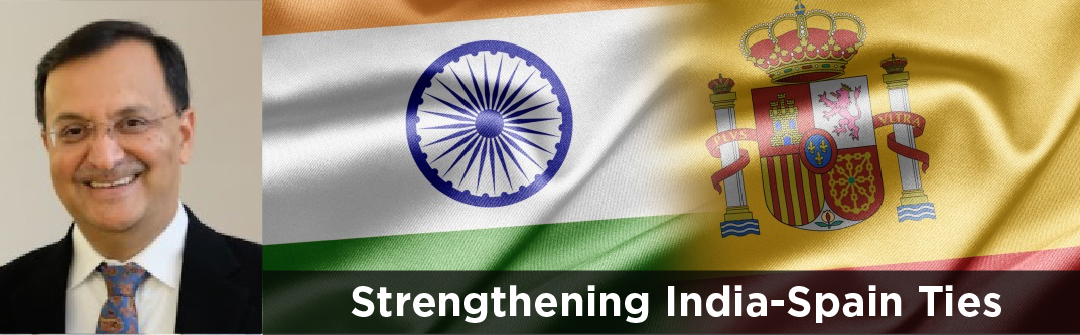 HE Dinesh Kumar Patnaik , Ambassador of India to the Kingdom of Spain
I am delighted that Kreston Global is having their Annual conference in Spain. While the UAE-Spain trade and business corridor is quite active, I would like to talk here a bit about the India-Spain economic & commercial relationship.
India and Spain share a very close relationship, both being strong democracies and without any bilateral, geopolitical irritants. Relations between India and Spain go back to the 20th century and Christopher Colombus, who discovered America, was actually sent by the Spanish Queen to look for a route to India. In 1937, Rabindranath Tagore wrote a Pamphlet titled “Conscience of Humanity”, which appealed to Indians to help in the fight for democracy during the Spanish civil war. In modern times, we established democratic relations in 1956 and today we have a vibrant political and economic relationship, which also encompasses considerable interaction in the field of Education, Science & Technology, Culture and other fields.

Economic & Trade relations have been extremely vibrant and Spain is India´s 6th largest trading partner in the EU. Bilateral trade, which registered a drop of 19 per cent during the pandemic, has rebounded and crossed 2019 figure of US$ 6.5 billion. India has a surplus of about
US$ 3 billion in its trade balance with Spain, but this is offset to a large extent by the large number of Spanish companies present in India who are doing very good business.
There are about 250 Spanish companies in India, with multi-sector presence across infrastructure & construction, auxiliary products and industrial engineering, renewable energy and environmentally sustainable products, EICT (electronic information and communication technologies), automotive components and automotive accessories. Spain has also invested more than US$ 3.56 billion as cumulative FDI in India. Recently, the Ferrovial Group of Spain invested US$ 425 million in the infrastructure sector through Prime Minister’s Gati Shakti Master Plan.
In addition, India has recently signed a major contract with Airbus Spain for procurement of 56 C-295 military transport aircrafts. This is one of the biggest ´Make in India´ contracts signed as 40 of the 56 aircrafts would be completely made in India with almost 13,000 plus parts of the aircrafts to be manufactured and assembled in India. This will see a relocation of the entire supply chain for Aerospace industries, especially for the C-295 aircrafts to India.
As I had mentioned before, India has a surplus in its bilateral trade with Spain with the main items of export being organic chemicals, textiles and garments, steel, fuels & mineral oils, aluminium and other articles, leather and leather goods, marine products, vehicles, auto components, pharmaceutical, pigments, inorganic chemicals, etc.
India has also made considerable investment in Spain of almost US$ 1 billion. There are more than 50 Indian companies in Spain mainly in Software & IT services, automotive parts & automobile industries, pharmaceuticals, chemicals and logistics.
The future looks bright for India-Spain collaboration and there are many sectors in which there is considerable scope for cooperation among entrepreneurs of Spain in India, with a maximum potential being in the start-up business. Spanish entrepreneurship ecosystem increased between 2015 to 2021 from €10 billion to €46 billion. This provides considerable opportunity for start-ups in India to upscale in Spain and Spanish speaking countries as well as for Spanish start-ups to do the same in India. The future is bright for India-Spain relations and companies and organizations active in this corridor, especially in UAE should take advantage of this opportunity.
 Sameer M Nawani , Chief Representative of Dubai Chamber International Office - India
India and Dubai share historic and strong trade and cultural ties. The non-oil trade between India and Dubai has consistently increased over years from $26 billion in 2017 to $36 billion in 2019, making India the second largest trading partner for Dubai. Indians are the largest investors in Dubai’s real estate sector and make up the largest segment of tourists visiting the emirate. The city also is home to over a million Indian nationals, who account for over 30% of the population of the Emirate.
Since 2015, India and the UAE have exchanged several high-level visits, which strengthened the relationship and led to the signing of the Comprehensive Strategic Partnership, an agreement that aims to expand economic cooperation and boost bilateral trade and investment. Given the role Chambers play in mobilizing businesses and promoting trade and investments, India’s Prime Minister Narendra Modi during his visit to Dubai in February 2018, welcomed the idea of Confederation of Indian Industries (CII) opening an office in Dubai and Dubai Chamber of Commerce & Industry opening an office in India. Dubai Chamber opened its first representative office in Mumbai, India, in June 2018. The main objective of the office in India is to identify bilateral business opportunities that businesses in India and Dubai can capitalize on and benefit from.
The year 2020 has not been an easy one. It has put the healthcare systems of global economies through tremendous strain, disrupted supply chains and brought businesses to a standstill. In such times where the world is pressing a reset, the continued exchange between India and UAE is ensuring a smoother turnaround in economic activities. Both governments have been agile in taking the right measures while enhancing ease of doing business. Businesses on both sides are being extremely pro-active in exploring diversification, finding growth opportunities globally, implementing technology and strengthening their supply chain. We have seen growing interest in a number of high-potential sectors, and you can read on to learn more about these opportunities.
Food security and trade
Ensuring food security is high on the agenda for UAE and the pandemic has underlined its importance. India is first globally in milk production, livestock population and millet production and ranks second in fish, rice, wheat, cereals, fruits & vegetables, and total food production. India has the potential to double its food exports from $30 billion in 2019 to $60 billion in 2022. Lack of storage facility and transportation infrastructure results in 30% food losses in India. The India-UAE Food Corridor project is expected to fill this gap, with an investment of $7 billion from the UAE to develop dedicated logistics infrastructure connecting farm to ports in India. This project has the potential to increase the food trade between India and the UAE from $2.2 billion to $7 billion in next five years.
Dubai has developed specialized infrastructure to facilitate global trade of select products. Jebel Ali Freezone (JAFZA) in Dubai, is home to the world’s largest port-based sugar refinery which has a production capacity of 2 million MT and contributes to 3% of the refined sugar production of the world. JAFZA also has a rice hub which handles the storage, processing, and packaging of rice. Around 66% of the rice imported into Dubai comes from India. There are dedicated storage facilities for grains, pulses and other food products at JAFZA.
Dubai Multi Commodity Centre (DMCC), the free zone focused on commodities trade is home to the Tea Centre and Coffee Centre. The Tea Centre is a purpose-built facility dedicated to storing, blending, and packaging of tea. The centre has 5000 MT of storage capacity. The Coffee Centre is a 15000 square metre state-of-art temperature-controlled facility which can be used to store, clean, roast, package and distribute coffee. It also has a coffee quality centre laboratory, cupping lab, and training campus. DMCC in 2020, introduced an agri trade platform called Agriota, which facilitates trade between Indian farmers and international traders.
In 2021, Dubai Chamber is pushing ahead with new initiatives to facilitate collaboration between businesses to connect the infrastructure of Dubai and the production capacity of India.
Retail Opportunities
Retail in India is highly fragmented but transforming at a tremendous pace. It is expected to become a $1.75 trillion market by 2026. India has the second largest population in the world. With a growing middle-class and increasing urbanization, the household incomes are rising, resulting in increased consumer spending. Driven by these developments, India has seen numerous homegrown brands in retail like Lenskart, Nykaa, Forest Essentials, Belgian Waffles, etc. grow at an enormous speed. The young new India is ambitious and aspirational, making it an ideal destination for International brands and retailers, opening doors for retail businesses from Dubai.
Having one of the busiest airports and being one of the world’s most sought-after tourist destinations, Dubai is a great place for retailers and brands to have high international visibility. Dubai ranks number one globally in international brand penetration. Dubai has been among the most popular destination for Indian businesses since a few decades. It endures as an ideal destination for new and fast-growing Indian brands and retailers to learn the lessons of international operations in a dynamic market which echoes global trends, and yet provides a familiar environment close to home.
Technology and scale-ups
India is the third largest start-up ecosystem in the world whereas Dubai is the preferred hub for start-ups in MENA region. Strong regulations, access to funding, sizeable market, thriving start-up ecosystem and access to talent makes Dubai a lucrative destination for start-ups. Numerous Indian start-ups providing tech solutions have seen their solutions being widely accepted by businesses in Dubai, which has given them a strong footing in MENA region as well as helped expand their operations back home.
The pandemic has accelerated the adoption of digital solutions in banking and healthcare. Telemedicine services saw a spike in demand and hospitals rapidly moved to implementing solutions for contactless delivery of services. Digital transformation in banking is a key enabler in boosting business. The ability to be able to pay anyone, anywhere at the click of a button has been a game changer and has seen new business models evolve across sectors. The payments and the venture capital regulations introduced by the Dubai International Financial Centre (DIFC) in 2020 are changing the financial services and funding ecosystem. The DIFC’s Innovation License Program helps innovative tech companies work in a regulated environment and helps DIFC build supportive systems and regulations.
The Dubai Chamber International Office in India along with Dubai Startup Hub, StartupIndia and Mumbai FinTech Hub organized the Dubai Tech Tour, a virtual delegation in 2020, which was joined by promising fintech and health-tech scale-ups. The scale-ups Advarisk, AIkenist, Anatomiz3D, BestDoc, Cube, ePayLater, Karza Technologies, Lucine Rich Bio, Metanoa, Seragen, Supermoney, Turtlemint, Value3 and vPhrase were shortlisted through a rigorous screening process and introduced to key businesses & investors in Dubai. Some of these scaleups are in advanced stages of negotiating their first commercial deals or currently in the process of setting-up in Dubai.
Riding on this success, in 2021, the India Office of Dubai Chamber will focus on RetailTech and introduce tech solutions from India that address the changing needs of retail and e-commerce.
Dubai Chamber currently has a network of 11 International Offices in Latin America, Africa, and Eurasia, dedicated to exploring promising markets and facilitating trade and investments between these regions and Dubai.


